Episode Transcript
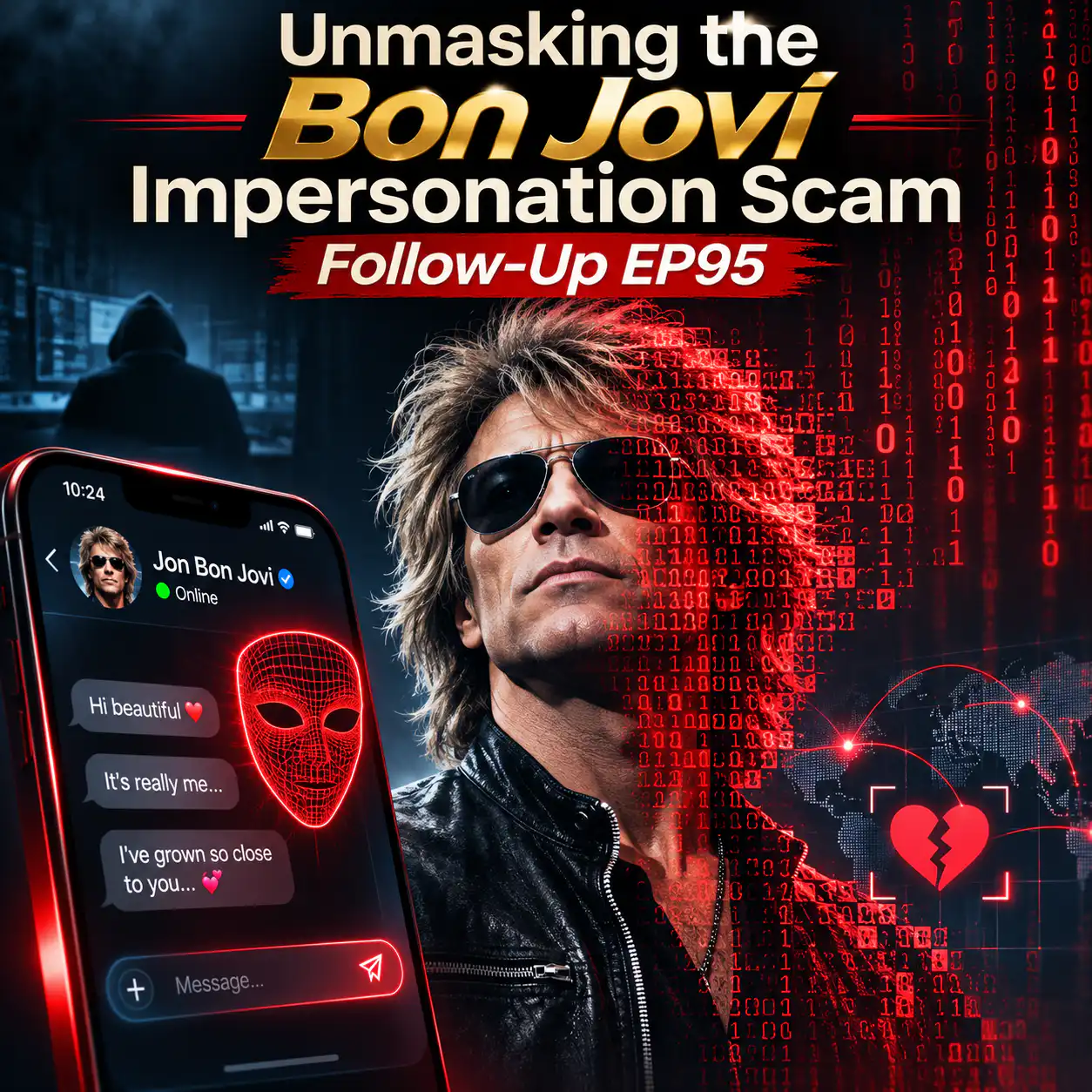
[00:00:00] Speaker A: Welcome back to behind the Scams on the SOS Media Network. I'm Nick. As always, I'm here with my wife Sue. In this episode, we're continuing to follow the evidence, checking the claims relative to the Jon Bon Jovi impersonation scam.
[00:00:16] Speaker B: That's right, Nick. There is more to the story, much more bad medicine surrounding this impersonation scam.
[00:00:22] Speaker A: In the last episode, we followed Leslie Pickett's experience with someone pretending to be Jon Bon Jovi. Not the real artist. An impersonator who used messages and convincing looking video to build a relationship that Leslie believed was real.
[00:00:36] Speaker B: And we're not going to retell her story as a test of whether listeners would have been smarter. That's not what this show is for. We're asking what the person committing the fraud did, how the deception worked, and what can interrupt it.
[00:00:50] Speaker A: There's a question hanging over that first episode. What happened to Leslie's scammer? Did anyone find him? Did someone knock on a door?
Before we follow that trail, let's introduce the journalists behind this investigation. Ariana Van Zeller is an Emmy winning investigative journalist and the host of National Geographics Trafficked with Mariana Van Zeller. That series follows the people and networks behind black markets, including drug trafficking, romance scams and crypto fraud. She had investigated romance scams before. Super Scam Me. This time she took a different approach by creating an undercover identity and becoming the target herself.
[00:01:28] Speaker B: Yes, and these are two separate cases. Leslie the Bon Jovi impersonator Victim reported trail led to Lagos, Nigeria. Mariana Van Zeller's face to face confrontation in Ghana involved a different Persona. General Mark. Finding Leslie's impersonator and confronting Mariana's contact are different questions. Two threads, two countries, not one interchangeable ending.
[00:01:50] Speaker A: That distinction is the backbone of this episode. We're following Van Zeller's National Geographic investigation. Super scammy. From the digital bait to the human encounter. We'll talk about what the reporting establishes, what it doesn't, and why. Discovering a location is not the same thing as making an arrest.
[00:02:08] Speaker B: Also, finding out that somebody lied to you doesn't instantly make the hurt disappear. You can understand the evidence and still miss the relationship you thought you had. Leslie described heartbreak as well as financial damage. Both deserve to be taken seriously.
[00:02:23] Speaker A: Sometimes we say closure, as if someone closes a folder and feels fine. For a person who has been deceived, over time, it may mean something smaller but still important.
Finally having an answer that contradicts the story they were sold.
[00:02:38] Speaker B: An answer, not a refund, not necessarily a prosecution.
And not a deadline for getting over it.
[00:02:47] Speaker A: Van Zeller takes an unusual approach.
Instead of only interviewing people after the harm, she creates a fictional dating Persona and makes herself the target. The undercover identity is Mary Zell. The investigation lets us examine the messages, the attention and the pressure from inside the exchange,
[00:03:05] Speaker B: with one enormous difference. She knows she's investigating the people she's reporting on didn't have that safety net.
We should keep that difference in mind when we discuss how she responds.
[00:03:16] Speaker A: You're right. This isn't a challenge for listeners to repeat. We're not recommending that anyone start a sting or travel overseas to confront a stranger. If you think you're being targeted, stopping further contact and getting support are safer priorities.
[00:03:30] Speaker B: We'll finish with three practical rules you can use with someone you love. Not a lecture, not an interrogation. A way to make help easier to accept.
[00:03:41] Speaker A: First, though, the question we owe Leslie's story. What did that Lagos lead tell the investigator?
[00:03:47] Speaker B: And what did people start claiming it told them? Those aren't always the same thing.
[00:03:51] Speaker A: Leslie Pickett reached out to Mariana after the relationship and payment demands had left her struggling. Public reporting describes a team working with a former hacker to bait the impersonator with what appeared to be another bitcoin payment. The reported location was Lagos, Nigeria, and Google Earth was used to look at the house associated with that lease.
[00:04:13] Speaker B: What appeared to be is doing important work there. This wasn't a recommendation to send another payment and hope the scammer slips up. Coverage of the film describes a fake bitcoin receipt, not Leslie simply paying more money for another chance at love.
[00:04:28] Speaker A: Let's look more closely at the moment the relationship became a payment problem.
Reporting describes Leslie sending smaller amounts, including $100 and $150, and being told the payments had failed.
She was directed to try different services, including Venmo, PayPal, Cash App and Bitcoin.
We're describing the instructions she received, not accusing those services of being part of the impersonation.
[00:04:58] Speaker B: The important distinction is between a payment that actually failed and somebody telling you it failed. If the only person interpreting every transaction is the person asking for the next one, you're depending on their story instead of checking your own records.
[00:05:13] Speaker A: Our analysis is that the task can quietly change. At first, you're deciding whether to pay for a promise meeting. Then you're trying to solve a transaction problem. Which service will work? Which amount will clear? Which instruction will finally get this finished? The bigger question, whether the meeting and the person are legitimate gets pushed aside.
[00:05:34] Speaker B: That's a useful moment for a loved one. To interrupt gently, not how could you send that? But let's check what your bank says happened before you send anything else. A second payment shouldn't be the automatic response to an unverified claim about the first.
[00:05:49] Speaker A: Later, Leslie described a supposed security clearance call ending abruptly, followed by a demand for more Bitcoin.
The claim was that her attempt to examine the call had created a security problem. That's another reversal. Checking the story becomes something she is told she must pay to repair.
[00:06:07] Speaker B: An honest question should lead to a clearer answer, not a new invoice. You don't owe someone money because you asked to understand who you were talking to.
[00:06:16] Speaker A: The cybersecurity expert was Armand Sadri, also known as Armand the Cyber. His interview about the production describes a controlled imitation of a crypto redemption process.
The lore made the person expecting money interact with something the investigative team could observe.
[00:06:32] Speaker B: So the same interest that brought the scammer into Leslie's life getting paid became the reason he interacted with the investigators. Bait. We can explain that principle without giving people a recipe for building deceptive tracking sites.
[00:06:45] Speaker A: And there's a technical correction we need to make some reporting calls this an IP address trace. Armand's own account says he requested device location through the browser because many of the scammers use VPNs. That is not the same thing as getting a precise street address from an IP address.
[00:07:03] Speaker B: Give us the plain language version. No whiteboard. We're married. I know where the whiteboard explanation can lead.
[00:07:09] Speaker A: I'll resist.
An IP address identifies a network connection. It can be a useful lead, but it isn't automatically the name or home address of the person using a device. Device location is a different kind of information in this investigation. Arment said that was the more useful signal.
[00:07:27] Speaker B: And Google Earth
[00:07:28] Speaker A: a way to view a reported location, not a witness that identifies the person inside a building.
You still have to ask who used the device, whether the location data were accurate and what other evidence connects that activity to the account.
A map image can make a lead feel conclusive before those questions have been answered.
[00:07:48] Speaker B: Which matters because they found a house and can turn into they proved who did it in about one social media repost.
[00:07:55] Speaker A: Exactly. The reporting supports a Nigeria based location lead connected to Leslie's impersonator. It doesn't establish that every message came from one person, identify an entire syndicate, or tell us how a group divided the war. Those are different findings.
[00:08:11] Speaker B: Did Mariana track down and interview Leslie's Bon Jovi impersonator? As of our reporting check on October 30, 2026. We found coverage of a location lead in Lagos, but no verified interview with that specific impersonator. The Lagos report says no suspect had been named or arrested in Leslie's case. That is not proof that nothing further will happen. It is the limit of what we can confirm now.
[00:08:35] Speaker A: What it offered was a concrete contradiction of the celebrity story. The connection the team traced was in Nigeria, not evidence of a private romance with Jon Bon Jovi.
The investigation was described as giving Leslie some closure. That does not mean it restored her money. That leaves three different milestones to keep locating activity associated with an account, identifying the person responsible, and obtaining an interview or an arrest.
A story can reach the first milestone without reaching the other two. When a headline says a scammer was tracked down, we need to ask what the reporting demonstrates.
[00:09:11] Speaker B: There is another potential source of confusion.
The Lagos coverage mentions separate Nigerian celebrity impersonation arrests. It does not connect those arrests to Leslie's case.
Similar methods and the same city do not establish that police caught her impersonator.
[00:09:30] Speaker A: And an interview with Leslie about the scam is not an interview with the scammer.
Mariana, speaking about her own Ghana confrontation is not evidence of a second confrontation in Nigeria. Those distinctions aren't technicalities. They determine whether we're giving listeners an answer or simply a satisfying assumption.
[00:09:50] Speaker B: And her financial recovery remains her real life, not just the closing paragraph of a case summary. She has described rebuilding after the loss and trying to warn other people.
[00:10:01] Speaker A: Here's where my 25 years in law enforcement helped frame the distinction without pretending I worked this case.
A useful lead and an arrestable case are not synonyms. Information must be corroborated, lawfully obtained, preserved and connected to the conduct under investigation.
[00:10:20] Speaker B: People hear outside our jurisdiction and understandably hear nobody cares. Leslie said local police and the FBI told her the scammers were outside their jurisdiction. That was her experience seeking help.
[00:10:31] Speaker A: But we shouldn't turn that into a blanket claim that cross border fraud can never be prosecuted. In general, a local American officer cannot simply exercise American arrest powers in another sovereign country. International evidence requests cooperation with local authorities and any extradition process depends on law and the circumstances. I'm explaining the framework, not promising what will happen in Leslie's case.
[00:10:54] Speaker B: It also means that a journalist getting someone into an interview chair is not the same as authorities taking custody of that person.
[00:11:02] Speaker A: Right. A confrontation can reveal something. It doesn't replace the legal process.
And an overseas location is not a reason to stop reporting a crime or seeking help from your payment provider.
[00:11:13] Speaker B: There's a compassionate way to say all of that to a victim, this lead matters. The limits matter too. You deserved help before the map appeared and you still deserve help afterward.
[00:11:24] Speaker A: I'd add, don't speak. Spend more money trying to force the ending. Your safety and remaining resources matter more than making the scammer admit what you already have reason to know.
[00:11:35] Speaker B: So Lagos gives us a reported location and a reality check. Ghana is the other investigation.
To understand how Mariana got there, we need to meet the person she invented. Mary Zell. Mary Zell wasn't just Mariana with a different screen name. The transformation included a wig, glasses and a prosthetic nose. The Persona was a middle aged antiques dealer looking for a relationship. The disguise also helped prevent someone from recognizing the journalist through her photographs.
[00:12:05] Speaker A: It's a practical reporting choice if you want to observe how people approach a dating profile. You don't want the profile announcing that an investigative journalist is watching.
[00:12:14] Speaker B: The biography included a recently divorced woman with children in college, living a somewhat lonely life and looking for love.
That's how Mariana described the experiment in her interview.
[00:12:26] Speaker A: None of those things is a defect. People get divorced, children grow up, a home gets quieter. Wanting company is normal.
The wrong is somebody using those ordinary life changes as an opportunity to exploit you.
[00:12:40] Speaker B: And according to Mariana, the responses started within minutes of putting the profile and photos on dating and social media sites.
That's the part that makes me stop. She didn't have to spend months finding a scammer. They found her.
[00:12:53] Speaker A: We should be careful about explaining how a fast response doesn't prove that a particular scammer used automated scraping software.
Bots and scraping can make outreach scalable in general.
But the reporting we've reviewed doesn't establish the tool behind each message to Mary.
[00:13:11] Speaker B: So we can say the flood was fast. We can discuss automation as a possible way to scale contact.
We cannot claim we examined those account software.
[00:13:21] Speaker A: Correct. And whether the first contact was automated or typed by a person, the later messages can still be tailored to what the target reveals.
[00:13:30] Speaker B: That's why a profile's ordinary details matter. An interest in antiques becomes a shared interest. Children in college become a shared family story.
The person seems familiar because the conversation echoes what you care about.
[00:13:44] Speaker A: In the account Mariana gave of Mark, the early exchanges involved small talk, antiques and a story about his late wife and children. The intense affection came later.
Those were claims made through the Persona, not facts we should accept about the person operating.
[00:14:02] Speaker B: The distinction changes how you understand the scam.
It isn't necessarily a stranger blurting out a marriage proposal followed by a money request. It can be repeated contact apparently Thoughtful questions, and the feeling that someone remembers you.
[00:14:17] Speaker A: That feeling can become part of a routine. If a message arrives when you wake up and another before you go to sleep, the person starts occupying the edges of your day. Our analysis is that the routine can make later requests feel like requests from someone already inside side your life.
[00:14:35] Speaker B: And we should not train listeners to believe that every attentive person is dangerous. The warning is the combination a hard to verify identity, repeated excuses about meeting, secrecy, and pressure to send money.
[00:14:48] Speaker A: The FTC describes that pattern. Scammers build trust through frequent conversation, claim distance or overseas work, prevents meeting, and eventually make a financial request.
[00:14:59] Speaker B: Mariana knew that was what she was studying. Even so, she described the relationship as emotionally draining. Knowing the assignment didn't make every part of participating easy,
[00:15:11] Speaker A: which is a useful antidote to I would never fall for that. You can know a situation as manipulative and still feel the effect of sustained attention. That doesn't mean the undercover experience and a victim's experience are identical.
[00:15:24] Speaker B: She also told an interviewer about sitting next to her husband while messages made her blush.
That detail is human. Not proof she forgot the investigation, but a reminder that emotions don't wait for our permission.
[00:15:37] Speaker A: I'm relieved. The most demanding message you send me from the next room is usually about moving laundry,
[00:15:42] Speaker B: and that request has been independently verified by the laundry.
[00:15:47] Speaker A: There's a separate case that shows why this pattern matters beyond Leslie. In a public account released by the FBI's Salt Lake City office, Montana woman identified as Rita said she lost $90,000 to someone posing as a celebrity. The contact started on social media, moved to an encrypted messaging app, and developed from friendship into romance. She said they connected over stories about divorce. Later came requests for Bitcoin payments for things like a meet and greet.
[00:16:14] Speaker B: Rita described the messages as something she felt she couldn't live without. That helps explain why Just block him can sound simple to a family member and feel devastating to the the person receiving those messages. Stopping a payment may also mean facing the loss of daily companionship.
[00:16:30] Speaker A: This was a different case, not another person connected to Mariana's investigation. But the resemblance is worth noticing. Private access to a supposed celebrity, an emotional connection, and then a payment request.
Recognizing that sequence is more useful than asking whether someone should have known better. Here's a practical distinction. For families, you don't have to convince somebody that none of the feelings they experienced were real. Their affection was real. Their anticipation was real. The identity and intentions presented to them may have been fabricated.
[00:17:02] Speaker B: If we attack the feelings, the person may hear us Attacking their judgment, their dignity, or their right to want companionship. We can instead say, I understand why this connection matters to you. I'm concerned about the money request and the things we can't independently verify.
[00:17:18] Speaker A: The point is to keep a route back to help open.
That's how we'd suggest approaching the conversation ourselves. We're not quoting Leslie or Mariana.
[00:17:26] Speaker B: The experiment also ran into celebrity impersonators. Mariana described juggling accounts claiming to be George Clooney, Keanu Reeves and Brad Pitt. Several versions of the same famous face could be trying to build trust at once.
[00:17:39] Speaker A: Different faces, similar question. Will attention turn into compliance?
And when the request becomes financial, who controls how the payment happens?
[00:17:49] Speaker B: That takes us from the dating profile to a very physical place. A crypto kiosk. The conversation may be online, but the money can leave through a machine down the street.
[00:17:59] Speaker A: Barry's central contact called himself General Mark Turner, a supposed four star American general deployed in Syria.
That was the role the account presented, not a verified military identity.
[00:18:14] Speaker B: It's a story with an explanation built into it. He's far away. His work sounds important.
There can always be another reason why normal contact or a visit is complicated.
[00:18:25] Speaker A: That's our analysis of why the Persona is useful. It combines an authority signal with distance. The FTC specifically warns that romance scammers may say they're in the military or overseas to explain why they cannot be.
[00:18:38] Speaker B: And alongside the general were the celebrity accounts. George Clooney, Brad Pitt, Keanu Reeves. Mariana described multiple versions of some of them. The reporting also describes deep fake celebrity videos in the film. We should not assume that every account used the same technology.
[00:18:54] Speaker A: A familiar face can seem like an answer to the identity question. But seeing a face on a screen is not the same thing as independently knowing who controls the account or where payment will go.
[00:19:07] Speaker B: Which is why the video looked real. Cannot be our entire safety plan. And spotting an awkward movement in a clip shouldn't be the only reason someone feels entitled to stop paying.
[00:19:16] Speaker A: You don't need to solve the visual effects puzzle to set a financial boundary.
[00:19:21] Speaker B: Leslie didn't simply accept a photograph and stop asking questions. She described requesting personalized videos, including one with specific facial gestures, and receiving a response within minutes. The coverage describes the material as AI generated. Her experience is a reason to update our verification habits, Not a reason to ridicule her for trying to verify.
[00:19:40] Speaker A: A response that appears to follow. Instructions can feel much stronger than a still photograph. You ask for something unusual, something apparently matching. It arrived.
But the question is still whether that response independently establishes the identity of the account operator. In Leslie's case, the apparent response reinforced the deception rather than ending it.
[00:20:03] Speaker B: There's a second layer. She showed the material to a skeptical relative, and the relative reportedly became convinced too. Asking someone else can help. But two people looking at the same misleading evidence are not necessarily two independent checks.
[00:20:17] Speaker A: That doesn't mean give up on verification. It means change the source of the verification.
If the person supplies the account, the video, the management contact, and the payment instructions, every apparent confirmation may still originate inside the same story.
Step outside that circle
[00:20:35] Speaker B: and remember the emotional cost. Beyond the screen, Leslie told an interviewer she couldn't enjoy Bon Jovi's music anymore, even though she understood the real musician had scamter. Something that had brought her joy became a reminder of the betrayal that is a loss no transaction receipt can capture.
[00:20:53] Speaker A: We can now be specific about the tutorial detail. ABC's coverage of Super Scamme describes Mariana's supposed four star general sending her videos, teaching her how to use a Bitcoin ATN that connects the romantic Persona directly to the physical payment process.
[00:21:09] Speaker B: And it makes the word helpful complicated. Helping someone understand a machine is not proof you're acting in their interest.
If you're also the person pressuring them to send the money, the tutorial can serve the demand.
[00:21:22] Speaker A: Our interpretation is that guidance can remove the very hesitation that might have protected someone. The target thinks, I don't know how to do this. The person asking for money turns that into don't worry, I'll show you.
Familiarity with the process increases while the identity and purpose remain unverified.
[00:21:41] Speaker B: Official consumer guidance documents Scammers controlling the payment process, directing deposits, staying on the phone and telling people what to say to others.
What can look like patient help can keep someone under pressure until the money is gone.
[00:21:55] Speaker A: The broader pipeline is well documented. A crypto ATM isn't a conventional bank atm. Cash inserted into the kiosk is converted into cryptocurrency and sent to a specified crypto address.
If the scammer supplies the receiving address or QR code, the value may be going to a wallet the scammer controls not an account safeguarding the customer's cash.
[00:22:16] Speaker B: The machine is local. The person persuading you may be overseas. Those two facts can coexist, which makes the whole thing feel less distant than it really is.
[00:22:25] Speaker A: And the transfer can happen quickly and be irreversible. There isn't a normal credit card style chargeback built into a completed crypto transfer that makes the method attractive to someone trying to extract money. Before Target gets independent advice,
[00:22:39] Speaker B: let's also avoid Crypto is untraceable. That's not the same as crypto is hard to recover.
A record of a transfer and the ability to get the money back are different problems.
[00:22:50] Speaker A: Exactly. Finding a wallet address does not automatically identify its owner or give a victim control over the funds. Official guidance warns that identifying the owner can be difficult, and a transfer to an address cannot simply be reversed.
[00:23:05] Speaker B: You can have a receipt and still have no practical refund button.
[00:23:09] Speaker A: And we need to be precise about the scale claim. The FTC's kiosk reporting describes many government, business and tech support impersonation scams. We're discussing the same payment vulnerability in a romance scam investigation. We're not claiming romance scams make up all or most kiosk fraud.
[00:23:27] Speaker B: What interests me is how help changes the meaning of the request.
If you've never used a kiosk, you might hesitate. Then the person tells you where to go, what to press, and how to finish. Your uncertainty becomes another opportunity for them to seem caring.
[00:23:42] Speaker A: Our analysis is that there are two forms of emotional control over why you pay, and procedural control over how you pay. The same person may be offering reassurance while narrowing your opportunities to stop.
[00:23:56] Speaker B: Here's a made up example, not a quote from Mark don't worry, I'll stay with you until you finish. In an honest context, that can be kindness. In a fraudulent payment demand, it can mean keeping you inside the conversation until the transfer is complete.
[00:24:11] Speaker A: Exactly. Think about how many times in our stories a victim says they just felt like they couldn't end the call right? That's because the professional knows if the person hangs up, the logic comes back or they realize they're being pushed. And that is why you hear that insistent pressure. That's why the safest interruption may be very simple. Put down the phone before making any decision.
Call your bank or a trusted person through a number you already know, not the contact details supplied by whoever wants the money.
[00:24:40] Speaker B: And if someone says you must keep the payment secret, tell them you won't. Privacy in relationship is one thing. Being coached to hide a financial transfer from people who can help is another.
[00:24:51] Speaker A: Official guidance flags secrecy, urgency, and instructions about what to tell others as warning signs. Those behaviors deserve attention even when the messages between them sound tender.
[00:25:02] Speaker B: If you're helping a loved one, don't make them earn help by first admitting the entire relationship was fraudulent.
Let's pause this payment while we check is a smaller, more workable first step.
[00:25:13] Speaker A: And in Mariana's investigation, the crypto lure also became a way to Develop a location lead on the person behind Mark. Armand described repeated device location returns at a home in Accra, Ghana. That is the thread that leads to the face to face meeting,
[00:25:29] Speaker B: not Leslie's Bon Jovi impersonator in Legos. We're keeping our case folders separate.
[00:25:33] Speaker A: You brought the timeline for a reason. The next stage takes Mariana to Accra, Ghana. The hacker's account places the location returns there. And Mariana's interview confirms that she traveled to Ghana and confronted the person behind her scammer Persona.
[00:25:47] Speaker B: There was more than a digital pin. Reporting describes flyers distributed in the neighborhood using a combined image of Mary and Mark that had been made as part of the online courtship. Digital information and local reporting worked together.
[00:26:02] Speaker A: And those weren't just flyers. You know, tactile polls. Neighbors organized online searches. They monitored surveillance, shared updates.
The digital trail left by these scammers is often far deeper than that final cash grab.
[00:26:17] Speaker B: That's important.
An investigator doesn't have to pretend.
[00:26:21] Speaker A: One piece of evidence does everything.
A location lead points to questions, people on the ground. Additional observations and corroboration can help answer them.
[00:26:31] Speaker B: The interview also describes serious uncertainty. Before the encounter. The team didn't know whether the main would show up alone, bring other people, or be armed. This was not a harmless victory lap,
[00:26:43] Speaker A: and it is not a model for a listener to follow. Don't arrange your own meeting with someone you suspect is decratting you. The fact that a reporting team obtained an encounter doesn't make confrontation a safe recovery strategy.
[00:26:55] Speaker B: Before we get to this psychology, one more clean distinction. This is the person connected to Mariana's General Mark investigation in Ghana. It is not a verified face to face capture of Leslie's Bon Jovi impersonator in Nigeria.
[00:27:10] Speaker A: And the military photos were another layer of impersonation. Mariana said the pictures belonged to a real man named Sam, whom the production interviewed. Having your photograph stolen makes you another person harmed by the scheme. It does not make you the person operating the scam account.
[00:27:26] Speaker B: So listeners shouldn't find a matching face and start accusing that person. A reverse image match can challenge the story, but the person in the photograph may have nothing to do with the messages.
The face to face encounter raises a broader question.
Why might someone keep making romantic claims after the identity story has been challenged?
[00:27:47] Speaker A: The temptation is to say, he must believe his own story or he has no conscience.
We can't diagnose someone from an edited encounter. We can discuss possible functions of the behavior without claiming to read his mind.
[00:28:01] Speaker B: Start with control.
If the person can keep the conversation about love, maybe the person being deceived spends the next minute debating feelings rather than the false identity or the money.
[00:28:13] Speaker A: That's one possibility.
Did you really care? Can become a detour from what did you falsely represent and what happened to the funds? The emotional question matters to the victim. It can also be exploited to postpone the factual one.
[00:28:27] Speaker B: And then there's self preservation. Acknowledging deception may feel more costly than continuing to deny it, especially when a camera is present. That's a possible explanation, not evidence that we know his legal strategy.
[00:28:40] Speaker A: Right? A third possibility is investment in the Persona. Somebody has spent time maintaining a story and may keep defending it rather than admit it has collapsed. But I'd be careful with the phrase sunk cost fallacy
[00:28:55] Speaker B: because that describes a way past investment can distort decisions. It doesn't magically explain every denial, and it doesn't establish this particular man's motive
[00:29:06] Speaker A: exactly.
It's often useful when discussing why a target might struggle to leave. I've given this relationship so much time. I can't accept that it wasn't what I thought. A scammer can take advantage of that investment.
Applying the same label to a. A scammer's persistence should remain a hypothesis.
[00:29:24] Speaker B: And even with the target, we should be gentle. We're talking about somebody who may be grieving the loss of an imagined future, not somebody who just made a bad spreadsheet decision.
[00:29:33] Speaker A: There's another important distinction. A profession of love is a claim. It doesn't undo a stolen photograph, a fabricated rank, or a deceptive request for money. You don't have to disprove every fear feelings someone claims in order to decide their conduct is unacceptable.
[00:29:51] Speaker B: That may be the most useful part for a family. Listening your loved one may still wonder whether the person cared. You can say we don't have to settle that question before we protect your accounts.
[00:30:03] Speaker A: The boundary can be based on conduct. No more payments, no access to your accounts, no carrying out transfers for them, and no secret financial arrangement.
[00:30:13] Speaker B: There's also a danger that doesn't begin with sending your own savings. In an FBI video, a woman named Glenda described how an online romantic contact asked her to open personal and business bank accounts. Checks and deposits then began arriving in those accounts. The FBI describes her as a romance scam victim who became a money mule. Someone used to move money for others.
[00:30:34] Speaker A: Her account is a serious warning, not a prediction about every victim. Glenda said she continued despite warnings from bank employees and law enforcement and eventually pleaded guilty to two federal felonies. We shouldn't assume the same legal circumstances apply to Everyone. The practical lesson is that receiving money for an online contact can put you at risk too.
[00:30:56] Speaker B: So I haven't sent him any money. Doesn't settle the safety question.
Is someone asking you to receive deposits, open accounts or pass money along? Don't do it if it is already started. Contact your bank and get appropriate legal advice. You can ask for help without letting that person control the next step. Also, don't use a confrontation video as a weapon against the person you want to help. Look how foolish you were, repeats the shame. Look how a false identity can be maintained keeps the focus on the deception.
[00:31:28] Speaker A: We're not suggesting denial is persuasive evidence of guilt by itself. We're saying that neither denial nor affectionate language substitutes for independently checking the underlying facts.
[00:31:39] Speaker B: Then there's the bigger question. Why are we asking the target to solve all of this alone? The identity, the technology, the payment system, the international geography, the emotional pressure. It's a lot to put on one person.
[00:31:54] Speaker A: Mariana has argued that the response responsibility should also fall on governments, banks and big tech. That's a useful starting point for our own recommendation.
Awareness matters, but it shouldn't be the only barrier between a person and financial devastation.
[00:32:09] Speaker B: Here are proposals, not claims, about what every company already does.
Platforms could make repeated impersonation harder to sustain, make reporting easier, and respond faster when stolen identities are used as across multiple accounts.
[00:32:24] Speaker A: Money transfer services could provide more specific warnings when patterns suggest coercion or fraud, and make it easier to reach a trained human before a risky transfer finishes. The warning should explain the situation, not just ask someone to click. I agree.
[00:32:38] Speaker B: Kiosk operators could build in better intervention, clearer language about whose wallet receives the money, prompts about whether someone is directing the transaction, and a meaningful chance to stop and get help.
[00:32:51] Speaker A: Delays or additional checks for high risk transactions are worth considering too, with privacy and access in mind. These are prevention proposals. We're not claiming they guarantee safety or are mandated everywhere.
[00:33:03] Speaker B: Good friction isn't simply making every honest customer's life harder. It's creating an opportunity to interrupt a pressured decision at the point where there is still a decision to interrupt.
[00:33:17] Speaker A: And once someone reports fraud, a humane response matters. Don't bounce them endlessly between the platform, the payment app, the kiosk and the bank, as though the gaps between those services are their personal responsibility.
[00:33:30] Speaker B: That's where the story stops being just a scammer and a victim. The person committing the fraud exploits the connections between systems. Those systems can also create connections to help.
[00:33:41] Speaker A: The Ghana meeting makes an online Persona into a real world encounter. It doesn't answer every legal or financial question.
The practical lending for our listeners is not to chase a confession. It's to make the next payment less likely and make the next request for help easier.
[00:33:59] Speaker B: Three rules simple enough to remember, but not so simple that they blame someone for what already happened.
[00:34:05] Speaker A: We followed two different investigative threats. Leslie's case produced a reported Lagos location lead. Mariana's General Mark investigation led to a confrontation in Ghana. We did not establish an arrest or recovered money in Leslie's case, and we're not turning one interview into a substitute for prosecution.
[00:34:25] Speaker B: What we can carry home is a plan. Here are our three Not a guarantee against every form of fraud, but a useful boundary before money moves.
Rule 1 Keep online romance separate from money. Don't send money or gifts to a romantic contact you haven't met in person. That is the FTC's bottom line. A video call, a famous face, or an affectionate message is not an exception.
[00:34:48] Speaker A: And meeting someone once is not a guarantee of honesty either. We're drawing a protective line for online only relationships, not declaring every in person relationship safe.
[00:34:59] Speaker B: If somebody claims to be a celebrity, independently verify any legitimate ticket or event purchase through established channels. Don't let the private account asking for money also supply the only evidence that the account is real
[00:35:12] Speaker A: the moment a romantic story becomes an urgent payment instruction. Stop treating payment as a test of affection. You can care about someone and refuse a financial demand.
Rule 2 pause and verify outside the conversation Leave the conversation before making a financial decision. Talk to someone you trust. Contact your bank through a number from your card statement or established banking app, not a number sent by the person asking for money.
Official guidance recommends independently verifying the story and slowing down.
[00:35:43] Speaker B: If the proposed solution is a Bitcoin atm, gift cards or moving money to protect it, that's a major warning sign. The FTC says real businesses and government agencies do not tell you to use a crypto kiosk to protect your money or fix a supposed problem.
[00:35:59] Speaker A: And don't give someone remote access to your device because they say they'll handle the difficult steps. The CFTC flags remote access demands and unfamiliar software as risk.
[00:36:10] Speaker B: Our family version is simple. Nobody has to be embarrassed to ask for a second look. I'd much rather spend 10 minutes checking a message than have someone worry they'll be mocked for asking.
[00:36:19] Speaker A: Same here, and I promise not to turn the 10 minutes into a presentation.
[00:36:25] Speaker B: We'll put a timer on that.
Rule 3 Bring in help early without shame. If money has already gone out, tell the bank or payment company immediately. Explain that it was a scam and ask whether anything can be stopped or refunded. The FTC recommends contacting the provider even when cryptocurrency was involved. An answer may be disappointing, but silence removes the chance to ask.
[00:36:47] Speaker A: Preserve the messages, account names, transaction details and any receipts you already have. Don't keep engaging just to collect more. Make a factual timeline and don't post private details or accusations online while trying to get answers.
[00:37:02] Speaker B: Report the account to the dating or social media platform.
File a fraud report through the FTC's official reporting service. The FTC uses reports to identify patterns and support enforcement. It does not resolve each individual consumer's case.
[00:37:17] Speaker A: Internet enabled fraud can also be reported to the FBI's Internet Crime Complaint Center. Reporting is not a promise that your money will come back. It is a way to get the incident into the channels that connect. Investigate patterns and evidence.
[00:37:30] Speaker B: Be cautious about anyone who approaches you afterward promising recovery for another payment. Don't let the urgent wish to undo the loss lead to a second, pressured decision.
[00:37:40] Speaker A: The recovery warning isn't hypothetical. In a July 2026 advisory, the FBI described criminals impersonating FBI personnel in the Internet Crime Complaint center to target people who had already lost money. Some claimed they had recovered funds others offered to help recover them. The apparent rescue was another route to taking information or money.
[00:37:59] Speaker B: That is a particularly cruel switch. After you question the supposed lover, somebody arrives playing the person who will put things right. The pressure may sound official instead of romantic, but it can still exploit the same urgent need for relief.
[00:38:12] Speaker A: The advisory also describes AI generated videos of an FBI leader directing people to a counterfeit complaint website. A A familiar looking official, a convincing page and even a reference number did not make the process genuine. The FBI says the Internet Crime Complaint center doesn't investigate or recover funds through Facebook, Telegram or similar platform.
[00:38:33] Speaker B: So a badge in a video isn't a shortcut around verification any more than a celebrity's face is. And the fact that somebody knows you were scammed doesn't establish that they're authorized to help. Don't use their message as your only route to challenge checking them.
[00:38:47] Speaker A: If a genuine investigator needs further information, the advisory says, contact may come from FBI field office personnel or other law enforcement. That's different from a stranger claiming to be the complaint center in a private chat. Verify through an independently established official channel before sharing anything further. And get emotional support, too. A trusted person, a counselor or a qualified local victim support service can help you deal with the disruption. You don't have to decide alone whether your experience was bad enough to deserve support.
[00:39:18] Speaker B: If you're listening because someone you love is still in one of these conversations, begin with concern, not ridicule. Try this I'm glad you told me we don't have to settle everything tonight. Let's make sure no more money leaves while we check. That's our suggested language, not a quotation from the documentary.
[00:39:37] Speaker A: Leslie's willingness to tell her story gives other people a chance to recognize a pattern without first having to lose Sheila.
She has said she wants to prevent this from happening to others.
[00:39:48] Speaker B: We owe her and anyone else sharing a painful experience a response that makes the next person less afraid to speak.
[00:39:56] Speaker A: Thanks for spending this time with us on Behind Scams on the SOS Media Network.
[00:40:00] Speaker B: Before we go, a reminder. We're a nonprofit and donations help us continue sharing stories, explaining the warning signs, and giving people a place to turn without shame.
If this episode helped you and you're able to give, we'd be grateful for your support. If donating isn't possible, sharing the podcast with someone you care about helps too. Thank you for listening and for being part of this work. Check in with someone you love and remember, asking for help is nothing to be embarrassed about. We'll see you next time on behind the Scams. Bye for now.