Episode Transcript
[00:00:00] Speaker A: Hello, this is Nick Henley. I host behind the Scams along with my lovely wife Susan. I'm flying solo today, so buckle up, it could get scary.
Anyways, we started a podcast series a couple of weeks back called behind the Scams Pop Up Podcasts. If you have not heard the first one yet, it is episode 70 titled AI Voice Cloning Grandparents Scam Elder Fraud Protection.
Basically, with these pop up podcasts, either sue or I will do a short introduction, tell listeners what the episode is about, and then turn the microphone over to the person or persons who lived the story.
They become the podcast hosts for the day. We step back and they tell it in their own words. Today we are turning the mic over to someone we are going to call Ted. That is not his real name.
We are protecting his true identity for obvious reasons.
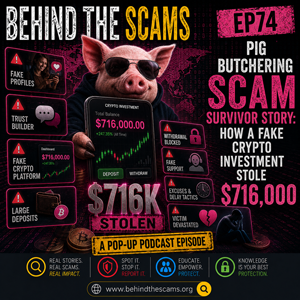
Ted was a real life victim of what turned out to be a pig butchering scam.
One of the most calculated and psychologically manipulative financial frauds we see today. These scams do not usually begin with someone asking for money.
They begin with contact, conversation, trust.
Sometimes it looks like friendship, sometimes it looks like romance, sometimes it looks like mentorship.
In Ted's case, it started with a social media message from a woman he did not know just before the holidays.
Over time, that contact became a relationship, that relationship became an investment opportunity, and that so called opportunity became a trap. Ted had worked hard his entire life. He understood money. He had experience around finance and business.
And that is important because one of the biggest myths about fraud is that it only happens to people who are careless or uninformed.
That is not true.
These criminals are patient. They are organized. They use fake platforms, fake profits, fake customer service, and real emotional pressure. And they know exactly when to push.
Ted's story also includes grief.
During the scam, he suffered the sudden loss of his son. And while he was trying to survive that kind of pain, the scammers kept working him.
That is hard to hear, but it is important because fraudsters do not pause for tragedy, they exploit it.
In the end, Ted lost $716,000. But as you are about to hear, the dollar amount is only part of the damage.
This is also a story about trust, shame, isolation, bank warnings, grief, and the moment someone finally realizes the account balance on the screen was never real. Before we dive into Ted's story, our pop up podcast idea has really proved to be a concept we want to continue exploring.
The numbers tell the story for us.
Behind the Scams is now proudly sitting in the top 10% of scam prevention podcasts. Globally, it is because our fantastic listeners as well as the innovative approach we take to our podcast.
The last thing the world needs is two more talking heads talking about something they know nothing about.
Also, people who lack the charisma and charm of my wife Susan and I.
My wife Susan demanded I say that. Anyways, my point is we really think that our pop up podcasts can really give a voice to scam victims worldwide. With an already established podcast platform, we are going to be putting together a website page devoted to outlining how our pop up podcasts will work.
This page will be on our podcast website located at BehindTheScams.org this new page will also have a way for anyone who wants to submit a short summary of their story for episode consideration.
Best of all, there will be no need to come out to our podcast studio. A cleanly recorded MP3 audio file will most likely be all we need.
Each episode will be thoroughly vetted and evaluated. Okay, now back to the real important stuff. Without further ado, here is Ted's story, told in his own voice.
Any potentially identifying details have been changed to protect him and his family.
Listen closely not just for what happened, but for how it happened.
Because if you understand the pattern, you may be able to recognize it before it reaches someone you love.
Oh, one last thing before Ted takes over.
You can watch a video format of this episode on our YouTube channel, Scam TV.
This video version will have accompanying watercolor animations that track with Ted's story.
[00:04:48] Speaker B: The message came in like all the others had calm, polite, almost routine.
It said there was one more issue with my withdrawal. One more step, one more wire.
$40,000 this time. I remember reading it once, then reading it again and just sitting there.
My hand was on the mouse, but I was not moving.
The account on the screen still showed more than a million dollars.
The customer service window was still open.
The woman I thought was helping me was still telling me I was close.
And somewhere inside me, something finally whispered, no, no, this is not right. By then I had already sent $716,000 retirement money, savings money from a life of working and planning and believing that if I was careful enough, I would be okay.
And now I was staring at a screen that wanted more.
Not because there was a real tax, not because there was a real account, because the entire thing had been built to keep me paying until there was nothing left. This is not an easy story for me to tell. There are parts of it that still make me feel ashamed. There are parts that take me right back to the grief I was Living through when the scam tightened around me.
But I want to thank Nick at Behind the Scams for allowing me to tell it in my own words.
As difficult as it may be for me, I believe it is important.
Because the person who stole from me did not kick down a door. She arrived as a mistake, stayed as a friend, became a mentor, and then.
Then she left as a thief. I used to think I was, you know, the kind of person this could never happen to. And I do not just mean that as a phrase people say afterward. I had spent my adult life around money, around. Around risk, around people trying to make more of one while pretending they understood the other. I had worked as a financial advisor. I had owned a small business. Later, I taught fitness classes part time, mostly because I liked being useful. And honestly, I liked having somewhere to go in the morning. By the time this happened, I was in my early 70s. I was not rich, but I had done what people are told to do. I saved, I invested. I lived below my means when I had to. I had a retirement account, a cushion, a plan.
And after decades of working, I was.
I was tired.
I wanted to slow down.
I wanted my money to work harder so I would not have to. That was the opening. Not stupidity, not greed in the cartoon sense, Just fatigue, hope. The old temptation that maybe there was a smarter way, a faster way, a way to make the last chapter easier. I also think there is a kind of vulnerability that comes after a lifetime of being responsible. You get tired of calculating. You get tired of worrying whether you have enough. You look at the years ahead and wonder how long your savings will last, what medical costs might come, whether you will become a burden to anyone. I was not looking for, you know, a yacht or some fantasy life.
I was looking for relief. It started just before the holidays. I received a friend request on social media from a woman I did not know. Her profile said she lived on the West Coast. Her photos were polished, but not outrageous. Attractive, yes, but not the sort of thing that immediately screamed fake. She messaged me with something casual, then apologized and said an assistant must have saved the wrong contact information.
It was, she said, a funny mistake. We talked about ordinary things.
Family, work, aging parents, exercise, the weather, retirement. She was never crude, never rushed, never immediately asking for money.
And that was part of the genius of it. She made the relationship feel accidental, harmless, almost faded. I remember thinking, what are the odds?
A stranger reaches out by mistake, and somehow we have these things in common. I can hear now how that sounds. I really can. If someone else had told me this story, I probably would have had questions. But when you are in it, it does not arrive wearing a mask. It arrives as a conversation. It arrives as attention. At that stage of life, attention can feel different than it does when you are younger. A message can become part of your day. A question about how you slept can seem small, but it lands somewhere tender. She remembered details. She asked follow up questions. She made me feel seen.
Not in a dramatic, romantic way at first, but in the steady way that makes suspicion feel rude almost. After a while, she mentioned trading. Not in a sales pitch kind of way, more like a friend sharing something that had changed her life.
She said she had done very well with cryptocurrency futures. She said she had made hundreds of thousands of dollars. She showed me screenshots, clean charts, balances, numbers moving up and down in real time. She spoke with confidence, like someone who had mastered a system. I had been around investments long enough to know that anything promising easy money, should make you cautious. I mean, I knew that, but this did not feel like a promise. It felt like mentoring. She said I could start small. She said she would teach me. She said I did not have to trust her. I could test the platform myself. The website looked professional. It had a login portal account balances, market data, transaction records, customer support.
It did not look like something thrown together in a basement. When I wired money, the amount appeared in my account quickly.
And that mattered. It really did. Seeing the numbers show up gave me a sense of confirmation. The money had gone somewhere. The account recognized it. The system worked. Then came the first profits. Small at first, then larger. She would message me when she said the market was favorable.
She would walk me through what to click. I would watch the balance climb.
And it felt technical enough to be believable, but simple enough that I could follow along. At one point, I made a small withdrawal. It came through. That was the moment the hook went deep. It gave me something I did not realize I was craving permission to believe.
I told myself, well, a scam would never let me take money out. And once I had that proof sitting in my real bank account, every later doubt had to fight uphill against it. I I did not understand then that the small withdrawal was not proof of legitimacy. It was bait, a controlled loss on their side to build a much larger certainty on mine. The wires got bigger. 10,000, 20,000 more each time. The instructions came with urgency, but also reassurance.
She would say the market window was limited, that timing mattered, that if I wanted to participate, I had to act quickly.
Sometimes I was Told I had only a couple of hours, the money did not go directly to the trading platform. That should have stopped me, I know that now.
Instead, I was told to wire funds to different business accounts with ordinary sounding names. Shipping companies, import firms, international trading entities.
When I questioned it, I was told that was how the payment channels worked.
Crypto was global, they said. Liquidity providers, settlement partners, compliance routes.
The language was just technical enough to make me feel uninformed rather than suspicious. Looking back, that was one of the clearest red flags in the entire story. If you are investing with one company, but wiring money to companies that have nothing to do with that company.
Stop. Do not let jargon overrule common sense. I did. My online balance kept rising. Hundreds of thousands, then over a million. Eventually, it showed about $1.4 million. I would log in and stare at the number. I let myself imagine paying off obligations, helping family, retiring without fear. And the screen became a kind of drug.
Every increase quieted the voice that said this was too good to be true. Then my son died.
He died suddenly from a fentanyl overdose. There is no clean way to say that sentence. There just is not.
I still hear it in my head sometimes, like it is happening again.
Like I am getting that call all over again.
There is the life before the call and the life after it. Grief did something to my mind. It made everything heavy and unreal.
I was sleeping badly. I was answering messages without really reading them. I was trying to function, but part of me had stepped outside my own body. When you lose a child, people say you are in shock, and that is true. But it is not complete. Shock is not just numbness. It is disorganization.
Bills arrive and look like objects from another life. The phone rings and you forget why you picked it up. You reread the same sentence five times and still do not know what it says. I was making financial decisions during a period when I could barely, barely trust myself to remember whether I had eaten dinner. That is when the pressure intensified.
Not cruelly, not openly. She was sympathetic. She checked on me. She told me she was sorry.
And then, you know, gradually, the trading talk returned.
She framed it as something positive, something that could help secure my future after such a terrible loss.
In my grief, I accepted guidance I would have questioned in a clearer state. Bank fraud departments tried to intervene more than once. People at banks questioned the wires.
They warned me.
They delayed or refused transactions.
But by then, I believed the bank was the obstacle, not the scam.
I opened new accounts. I used different institutions.
I told myself I Was protecting an investment I had already built.
I told myself that because, honestly, I needed it to be true. That is hard to admit, but it is important.
The people trying to stop me were not enemies. They were the last line of defense. Seeing what I could not. There is a particular shame in remembering the warnings.
A bank employee asking why the recipient company name did not match the investment.
A fraud specialist telling me the pattern looked dangerous.
A delay that should have felt like protection, but felt, in that moment, like interference.
I can still hear myself explaining it away.
I can still feel how badly I wanted the explanation to be true.
I wanted it so badly that I.
I argued with the people trying to help me. The trap closed when I tried to withdraw the profits.
That is when everything changed.
Or maybe more honestly, that is when I finally saw what had already changed. Until then, everything had been designed to make the account feel like min.
The balance, the trades, the customer service messages, the successful small withdrawal. But when I asked to take out a large amount, the rules changed.
Customer service said there was a tax due before the funds could be released.
Nearly $134,000.
I remember thinking, wait, what tax?
Why can't it just come out of the account? I questioned it. I did. They told me it was required. They said the tax could not be deducted from the account balance. It had to be paid separately by wire before the withdrawal could process.
My mentor, the woman I thought I knew, reinforced it. She said this was normal. She said if I did not pay, I could lose access.
She said I was so close. So I paid. Then came another problem.
The receiving account was frozen. They said there was a government review, a compliance hold, a roadblock to unlock the funds. I needed to send the tax payment again to a different account.
I remember feeling panic rise in my chest, not just because of the money, but because if I stopped now, I would have to confront the possibility that all of it had been fake. And I was not ready. I was not.
I was not ready for that. That is one of the cruelest parts of this kind of scam. The deeper you are in, the more expensive it becomes emotionally, to question it. Every warning threatens not only your future money, but every dollar you already sent. So you keep going, not because you are convinced, but because the alternative is unbearable. By the end, I had wired $716,000 life savings, retirement funds, Money I had built over decades.
And even then, after all of that, they asked for another 40,000.
Another 40,000.
As if the last piece of me was just something else they could take. That was the moment something finally broke through.
Not clarity exactly, more like impact.
I saw the pattern. A fee, then another fee. A problem, then another problem.
A promise that kept moving farther away.
The woman was not a mentor.
The platform was not a platform.
The account balance was not money.
It was.
It was theater. I remember sitting there and feeling as if the whole world was coming to an end.
It is not just the loss.
It is the humiliation, the disbelief, the replaying of every decision.
The memory of each bank employee who tried to slow me down.
The thought of my son, the knowledge that people had studied me, comforted me, and robbed me while I was grieving. What makes the realization so devastating is that it happens all at once and then keeps happening.
You know? And then 10 minutes later, you know again. You look at an old message and see manipulation. Where you once saw kindness, you remember a compliment and understand it was bait.
You think of the money, then you think of the funeral. Then you think of the years you spent earning what disappeared in a matter of months.
It comes in waves. It really does. Afterward, people want to know how it could happen.
They want a single point where the victim should have known.
And I mean, I understand that. I ask myself the same thing. But the truth is, the scam was not one lie. It was a system of lies layered over time, reinforced by emotion, urgency, professional looking screens, and a relationship I thought was real. For a long time, I wanted to reduce it to one mistake, because one mistake would be easier to live with.
One bad click, one bad wire, one moment of weakness. But that is not how these scams work. They are campaigns. They are built to study you, pace you, reward you, pressure you, isolate you, and keep you moving forward. Long after your instincts begin to object.
Long after that small voice is saying, wait, wait a second. I ignored three warnings that I hope you will not ignore.
And I know how obvious some of them may sound now. From the outside, they did not feel obvious when I was inside it. First, indirect payments. If someone tells you to invest through one platform but wire money to unrelated companies, stop. A legitimate financial institution should not need your retirement savings routed through a rotating list of shell businesses with names that have nothing to do with your account. Second, with withdrawal fees, real firms do not require you to wire separate money for taxes, clearance charges, liquidation fees, or account unlocks before releasing your own funds. Taxes are not handled that way. If a platform says your million dollar balance cannot cover a $100,000 tax bill, the balance is probably not real. Third, pressure. Any investment opportunity that requires immediate large wire transfers and especially under a strict deadline, is Demanding that you act before your judgment catches up. Urgency is not a feature. It is a weapon. And if your bank questions a transfer, listen.
Really listen.
Do not assume they are being difficult.
Do not open a new account somewhere else to get around them.
I know how that sounds, because I did it.
But the person on the phone from the fraud department may be the only person in the entire chain who has no financial interest in keeping the fantasy alive.
They may be the last person trying to save you from what you cannot see. Yet. I lost $716,000. But the amount is only part of the story. I lost confidence in my own judgment. I lost sleep. I lost the version of myself who believed experience could protect me from manipulation.
And I have had to learn that shame is exactly what scammers count on. Shame keeps victims quiet.
Silence protects the criminals. The financial loss changed my future. There is no way to soften that. Plans I had made had to be rewritten. Security I thought I had earned was gone. But the emotional loss is harder to explain. I found myself suspicious of ordinary kindness. I replayed conversations with friends.
I wondered whether my judgment had permanently failed me. And I had to fight the urge to just disappear into silence. So I am telling you this plainly. If you are in something like this, stop sending money.
Please do not pay one more fee. Do not chase one more unlock code.
Save the messages. Save the wire instructions. Call your bank. Report it. Tell someone you trust, preferably someone outside the emotional pull of the situation. These scams do not work because victims are foolish. They work because criminals are patient. They learn your hopes. They wait for grief, loneliness, ambition, fatigue and fear. To do what? A single lie never could.
They wait for that one moment when you are not quite yourself. I wish I had known that before I met her. I wish I had believed the bank. I wish I had asked one more skeptical question before sending the next wire. But if my story reaches you before the next transfer, before the next fee, before the next promise, then maybe it can still do some good. Behind the screen, there was no investment. Behind the profits, there was no account. Behind the kindness, there was a script.
And behind all of it was a person like me trying to retire, trying to grieve, trying to believe something good was still possible. If you are listening because you are worried about someone you love, please do not start with judgment.
Start with patience.
Ask to see the platform. Ask where the wires are going.
Ask whether any withdrawal requires money to be sent first.
And if you are the one inside the story right now, please hear me.
The shame you feel is not evidence that you are guilty.
It is evidence that someone skilled found a way past your defenses.
And you can still stop right now.
You can stop. While I appreciate having this podcast as a place to tell my story, I hope and pray someone out there is listening before they find themselves sitting where I am now, bearing their soul into a microphone and trying to make sense of what happened. God bless you. And if this story sounds even a little familiar, please stop.
Please talk to someone before you send anything else.