[00:00:00] Speaker A: Hello everybody, and welcome back to behind the Scams. As always, I'm joined by my wife and co host, Sue. Say hello, Sue.
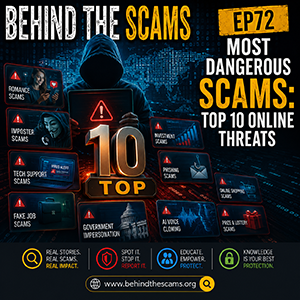
[00:00:07] Speaker B: Hello, Sue. Kidding. Hello, listeners. Nick, today's episode is about a top 10 list everyone wants to know about.
[00:00:17] Speaker A: And no, it's not a David Letterman Top 10 list.
This is a list of the 10 most dangerous scams out there right now.
[00:00:24] Speaker B: Right, because the information we've been looking at, I mean, the data from the FTC reports up to 2026, the new cybersecurity bulletins, it all points to a landscape that has just fundamentally changed.
[00:00:40] Speaker A: Yeah, it really has.
We are no longer dealing with, you know, pimply faced kids sitting in their parents house doing random cyber attacks. Or hacking a school's computer to change their grades from an A.
[00:00:52] Speaker B: Exactly. It's an industrialized global enterprise now and
[00:00:56] Speaker A: that tracks with what I saw in financial crimes. Work, work. These are not isolated hustles anymore. They operate like businesses with scripts, supervisors, tech support and money moving networks. So welcome to the deep dive. Our mission today is to deconstruct how modern scams actually work, both psychologically and technically.
We want to give you, the listener, the armor you need to protect your family.
[00:01:23] Speaker B: And we are going through all ten of the most devastating tactics out there today.
[00:01:31] Speaker A: So let's just jump right into number one. The massive $75 billion threat.
That is, I mean, that's the GDP of a small country.
[00:01:42] Speaker B: It is staggering.
This first one is often called pig butchering or confidence investment scams.
[00:01:50] Speaker A: Pig butchering, what a horrible name. In fraud cases, the cruelest part is often the patience.
The criminal doesn't rush because the relationship itself is the weapon.
[00:02:01] Speaker B: I know it's grim, but according to the research we reviewed, this kind of scam can produce a 70 to 80% compliance rate.
[00:02:11] Speaker A: Wait, 80%?
[00:02:13] Speaker B: Yeah, if they target you, the odds are overwhelmingly in their favor.
And it always starts with something completely harmless like a wrong number text.
[00:02:24] Speaker A: Right, like are we still on for dog grooming tomorrow? Or how's your day going, Sue? We get those all the time ourselves.
Don't be tempted to jokingly respond to them because that just alerts the scammer it is a viable number. So they keep it on their sucker list.
[00:02:43] Speaker B: Exactly. And they rely on this sucker psychological trigger called the representativeness heuristic.
[00:02:49] Speaker A: Okay, a heuristic is like a mental shortcut, right?
[00:02:53] Speaker B: Yes. Our brains process thousands of micro decisions every day.
When you get a wrong number text, your critical defenses just drop. Because, you know, mistakes happen.
[00:03:06] Speaker A: In the cases I worked that first Harmless contact was often the most important moment.
Once someone responded, even politely, the scammer knew they had a live person on the other end. So you just politely reply, sorry, wrong number.
[00:03:21] Speaker B: Right, and the trap is sprung. The operator apologizes profusely, maybe compliments your politeness, and just casually keeps the conversation going.
[00:03:33] Speaker A: But a wrong number text doesn't magically turn into an investment pitch overnight.
[00:03:37] Speaker B: No.
And that's where the destruction begins.
They call the next phase raising. Like fattening up the pig over weeks or months. They don't ask for a single dime. Wow.
[00:03:51] Speaker A: They just invest all that time?
[00:03:53] Speaker B: Yeah. They build genuine emotional attachment. They ask about your day, listen to your problems. They figure out what you're missing in life.
A friend, a romantic partner. And become exactly that.
[00:04:09] Speaker A: One thing I learned early is that scammers do not just steal money.
They study unmet needs.
Loneliness, grief, financial stress. Even simple politeness can become entry points. If the criminal is patient enough, they're essentially hacking human longing.
So when do they finally go for the money?
[00:04:28] Speaker B: Once the dependency is there, they gently introduce an investment platform, usually crypto or foreign exchange.
They casually offer to show you how they make so much money on the side.
[00:04:41] Speaker A: And the platforms look flawlessly professional.
I've seen the screenshots victims brought in. These fake dashboards can look polished enough to fool people who manage real investments.
[00:04:52] Speaker B: Oh, they are completely convincing.
[00:04:54] Speaker A: It's like the Truman Show.
An entire fabricated reality with real time market tickers and charts. You put in $100 and it says you made a thousand.
[00:05:04] Speaker B: But the money was gone the second you deposited it. Exactly. The profits are entirely synthetic. And the peak manipulation happens during the kill mechanism.
[00:05:15] Speaker A: Right, when the victim tries to withdraw their money.
[00:05:19] Speaker B: Yes. Suddenly there are manufactured roadblocks.
A 20% tax or an account unfreezing fee.
[00:05:28] Speaker A: This is where it gets crazy to me. Why do people keep paying fees when they are actively blocked from their own money? In investigations, this is where victims were often the hardest on themselves.
But by then, the scammer had engineered the pressure, the hope, and the shame all at once. That shame is part of the trap. Victims start thinking, if I stop now, I have to admit I was fooled.
So the scammer turns embarrassment into another lever of control.
[00:05:56] Speaker B: It's the sunk cost fallacy.
At this point, the victim has invested profound emotional capital.
To accept it's a scam means accepting utter devastation.
So the brain rebels.
[00:06:11] Speaker A: They just double down.
[00:06:13] Speaker B: They do.
They drain retirement accounts, take out second mortgages.
The scam only ends when there is absolutely nothing left to Extract.
[00:06:24] Speaker A: And by the time law enforcement gets the report, the money has usually moved through layers of accounts, crypto, wallets, and overseas exchanges.
That delay is exactly what these crews are counting on. It's tragic. And pig butchering is a long con built on patience.
The next two scams take the opposite route. They use fear, urgency, and authority to force a decision before you can think right.
[00:06:53] Speaker B: The imposter scams. Bank and business imposters, and government impersonation.
[00:06:59] Speaker A: They don't want to be your best friend. They want to scare the living daylights out of you in three minutes flat.
[00:07:05] Speaker B: And they hit the highest sheer volume of people.
Imposter scams are the number one fraud category, costing victims about $3.5 billion in a single year, with business impersonators making up nearly $1 billion and government impersonators hitting about $920 million.
[00:07:26] Speaker A: The mechanics are just brutal. You get a text or call saying your bank is compromised or you owe the irs or there's a warrant for your arrest. When I worked fraud cases, urgency was one of the biggest tells.
Agencies and banks don't need you terrified in order to solve a problem.
[00:07:44] Speaker B: And the solution is always, you know, move your money to a safe account. Right. Or pay a fine using untraceable methods like crypto or gift cards.
[00:07:56] Speaker A: It's like a fire alarm going off in a crowded building.
You panic, and someone hands you a fire extinguisher, but the person handing it to you is the arsonist.
[00:08:06] Speaker B: That is a perfect analogy.
They rely on emotional arousal. When you're terrified, your amygdala, the fear center of your brain, takes over.
[00:08:17] Speaker A: It just floods your system with stress hormones.
[00:08:20] Speaker B: Exactly. And it actively suppresses your prefrontal cortex, which handles logic and skepticism.
[00:08:27] Speaker A: That's why I never liked hearing people say, I would never fall for that.
Under fear, time, pressure, and isolation, people make decisions from survival mode, not from their best thinking. But I talk to smart business professionals all the time who fall for this.
How do highly educated people get tricked by a fake IRS call?
[00:08:49] Speaker B: Because the scammers have perfected corporate mimicry. They spoof caller IDs. Your phone literally says Wells Fargo or Internal Revenue Service.
[00:09:00] Speaker A: Caller ID was never evidence.
It is just a label on a screen. And scammers figured out a long time ago how to make that label. Say whatever creates the most fear. You don't even question the source.
[00:09:11] Speaker B: Right. And they use the exact same email templates and marketing cadences. If you're busy rushing between meetings, your brain defaults to routine compliance.
[00:09:22] Speaker A: The scammer's goal is cognitive overload. Too much urgency, too many instructions, too much emotion. If they can keep you reacting, they do not have to let you think. That leads right into number four on our list. Tech support and remote computer takeover scams.
[00:09:39] Speaker B: Oh, they are incredibly aggressive.
[00:09:43] Speaker A: Yeah, they use malicious code to literally freeze your computer browser.
Loud alarms start blaring and the pop up warns you not to restart the machine, but to call a toll free number immediately.
[00:09:55] Speaker B: And when you call, the person pretends to be from Microsoft or Apple. They demand remote access to fix your
[00:10:03] Speaker A: network, which is just game over totally.
[00:10:08] Speaker B: Once they have remote access, they log directly into your real bank accounts behind the scenes and wire the money out themselves while keeping you distracted.
[00:10:19] Speaker A: I've seen victims lose money without ever knowingly authorizing a transfer.
Once remote access is granted, the scammer can turn the victim's own computer into the crime scene. And that same access problem shows up in another form with scam number five.
This one weaponizes the banking system itself.
Job, task and side hustle fraud.
[00:10:41] Speaker B: This one heavily targets younger adults looking for extra income, Mystery shopping or car wrapping.
[00:10:49] Speaker A: The scammer sends a physical check for, say, $3,000.
They tell you to keep $500 and wire the remaining $2,500 to their supplier for materials.
[00:10:59] Speaker B: And the mechanical trick here relies on banking regulations.
By law, banks have to make deposited funds available to you within a few days.
[00:11:09] Speaker A: This is one of those banking rules criminals understand better than most customers. They exploit the gap between funds available and check cleared. So you see the three grand in your account and assume it cleared.
[00:11:21] Speaker B: Right.
So you wire the money to the supplier.
But a paper check takes weeks to actually clear behind the scenes.
[00:11:30] Speaker A: Weeks even in 2026?
[00:11:33] Speaker B: Yes. It has to be routed through multiple institutions. When the system finally realizes its counterfeit,
[00:11:39] Speaker A: then the check bounces and the bank takes that $3,000 back out of your account.
[00:11:45] Speaker B: Exactly.
But the $2,500 you wired out, that is gone forever. And you're responsible for the negative balance.
[00:11:54] Speaker A: You're just left holding the bag. It's so frustrating.
Now scam number six moves from banking delay to login speed. This one is everywhere right now. Delivery and one time passcode or OTP scams.
[00:12:08] Speaker B: This is a huge scam. Right now you get a T text saying your package delivery failed and you need to click a link to update
[00:12:17] Speaker A: your address, which, I mean, we all get packages constantly. It's so easy to just blindly click. These scams work because they borrow from everyday habits. You are not making a big financial Decision. In your mind, you are just clearing a text notification while life is moving fast, right?
[00:12:36] Speaker B: But the link takes you to a fake site that asks you to log into your account.
When you type your password, the scammer takes it and immediately tries to log into your real account.
[00:12:47] Speaker A: What if you have two factor authentication?
[00:12:49] Speaker B: That's the terrifying part. The real site texts you a one time passcode. The scammer's fake site prompts you to enter that code to confirm your delivery address.
[00:13:01] Speaker A: Oh, wow, sweet. So you literally hand them the keys to bypass your own security.
[00:13:06] Speaker B: Exactly. You give them the OTP and they are into your email, your bank, everything.
[00:13:13] Speaker A: From an investigator's standpoint, an OTP is not just a code, it is proof of control.
If you give it away, you may be authorizing the very login or transaction you're trying to prevent. Unbelievable. And once scammers learn how to bypass your digital defenses, they start using the physical world against you.
Scam number seven is charity and disaster relief fraud, specifically using quishing.
Quishing is QR code. Phishing.
[00:13:42] Speaker B: It's a weird word, but it's a huge problem.
[00:13:45] Speaker A: Scammers print fake QR codes on high quality stickers and slap them over real ones on parking meters or charity donation boxes.
[00:13:54] Speaker B: So you scan it, thinking you're donating to hurricane relief or paying for parking.
[00:13:59] Speaker A: And it routes your payment straight into a scammer's untraceable crypto wallet. It bypasses all your digital filters. Because you're physically scanning it in the real world, your guard is totally down. From an investigative standpoint, QR scams are especially frustrating. Because the victim initiates the scan, it feels voluntary even though the destination was rigged.
[00:14:21] Speaker B: So if you're paying a meter, just skip the QR code and use your credit card on the physical machine or carefully verify the URL it sends you to.
[00:14:32] Speaker A: Good tip.
And scam number eight shows how identity theft can sit quietly in the background until a government system tells you something is already wrong. Tax Identity theft.
[00:14:44] Speaker B: Right.
Scammers steal your Social Security number, often from data breaches, and they file a fake tax return in your name very early in the tax season.
[00:14:56] Speaker A: So they claim a massive refund before you even get your W2s together.
[00:15:00] Speaker B: Exactly. Then later, when you try to file your legitimate taxes, the IRS rejects it because their system says you already filed.
[00:15:11] Speaker A: And it takes months, sometimes years of bureaucratic nightmare to sort it out.
[00:15:16] Speaker B: The best defense there is filing as early, as early as possible, or getting an identity protection PIN directly from the IRS website.
[00:15:26] Speaker A: And if The IRS says a return was already filed in your name. Treat it as identity theft immediately, not a paperwork glitch. Yeah, that pin is crucial. From there, scam number nine moves from government systems to something more personal.
The family vacation, fake travel and vacation rental fraud.
[00:15:45] Speaker B: This one ruins entire family vacations.
Scammers create spoofed booking websites that look identical to Airbnb or Expedia.
[00:15:55] Speaker A: Or they hijack real listings.
Yes, they'll reach out after you book and say there's a processing issue and ask you to pay them directly outside the platform using Zelle or wire transfer.
[00:16:06] Speaker B: And once you pay off platform, all your consumer protections are just going to gone.
[00:16:11] Speaker A: You show up with your family, your luggage, and there is no rental. And these cases are hard because the victim often authorized the payment even though the listing was fake.
That matters. Later, when they try to get reimbursed.
[00:16:24] Speaker B: It's heartbreaking.
But up to this point, all these scams rely on a stranger playing a character.
Number 10 is different because the character may say, sound like someone you love.
[00:16:39] Speaker A: AI voice cloning and family emergency scams.
[00:16:42] Speaker B: Right?
What happens when the scammer doesn't sound like a generic bank rep, but sounds exactly like your own child?
[00:16:51] Speaker A: It takes the imposter scam to a level that is almost impossible to defend against. Using traditional logic, the old investigative advice was trust, but verify.
With AI voice cloning. The rule has to become verify before you trust, even when the voice sounds familiar.
[00:17:10] Speaker B: The old family emergency scam was someone claiming to be a police officer saying, your grandson is in jail.
[00:17:17] Speaker A: But now using AI, they just play your grandson.
[00:17:20] Speaker B: And the technological leap is insane.
They only need, what, three seconds of clear audio?
[00:17:29] Speaker A: Just three seconds to create a highly personalized, dynamic voice clone.
[00:17:33] Speaker B: How does an AI replicate a human voice with so little data?
[00:17:37] Speaker A: It maps the phonetic topology, the microscopic pauses, the specific resonance of your vocal cords, the unique timbre.
[00:17:46] Speaker B: So they scrape a tiny clip from a public TikTok video or even your voicemail greeting.
[00:17:52] Speaker A: Yes, they feed it into an AI tool, and the algorithm can synthesize realistic speech that mimics your exact emotional inflection, saying whatever they type into the prompt.
[00:18:03] Speaker B: Deepfake enabled fraud losses exceeded $200 million in the first quarter of 2025 alone.
But nothing made this threat more real to me than that July 2025 case study in Dover, Florida.
[00:18:18] Speaker A: That case is a masterclass in how devastating this technology is.
[00:18:23] Speaker B: A mother gets a frantic phone call from her daughter. The voice is crying, desperate, hyperventilating.
She says she's been in a Horrible car accident and tragically lost her unborn child in the crash.
[00:18:37] Speaker A: It's just horrific.
[00:18:39] Speaker B: She begs for $15,000 to pay for legal representation and avoid jail.
The mother is in total shock.
She withdraws $15,000 in cash and hands it to a courier at her front door.
And the reality was her daughter was completely safe.
The accident never happened.
The voice crying on the phone was 100% AI generated.
[00:19:13] Speaker A: If my child calls me crying, my biology overrides every logical protocol.
If our own ears can't be trusted, how can anyone possibly defend against this? And that's why I tell families not to rely on willpower in the moment.
Panic is faster than reason. You need a pre planned rule like the code word before emotion takes over.
[00:19:36] Speaker B: It's the ultimate bypass of human rational defense.
When you hear a loved one in pain, skepticism shuts down completely.
[00:19:47] Speaker A: You just don't have the bandwidth to analyze the audio for like digital artifacts.
[00:19:51] Speaker B: Which means we have to pivot our approach.
We have to build tactical defenses long before the phone rings.
[00:19:59] Speaker A: So how do we build that psychological armor? Because just knowing about these 10 scams clearly isn't enough.
[00:20:06] Speaker B: The apps absolute best defense against AI Voice cloning is surprisingly low tech. It's the family code word.
[00:20:14] Speaker A: I love this. You fight cutting edge AI with a secret password.
[00:20:19] Speaker B: It's incredibly effective. You establish a unique secret word that only your immediate family knows. Something random. A scammer could never guess from your public data.
[00:20:30] Speaker A: And the rule is in any emergency call, ask asking for money. The safe word is mandatory.
[00:20:37] Speaker B: Exactly. AI can perfectly mimic acoustics, but it cannot guess a secret password. If they can't provide the code word, you hang up and dial your loved one's real number.
[00:20:48] Speaker A: We also have to look at our digital hygiene. We are freely handing scammers the ammunition they need. Investigators call that open source intelligence.
Scammer scammers call it free research.
Public birthdays, family names, vacation photos, and voice clips all help them make the lie feel personal.
[00:21:08] Speaker B: We really are. We need to limit public audio and video sharing on social media.
Lock accounts down to friends and family, starve them of the voice samples.
[00:21:20] Speaker A: And for imposter scams, we need the disengagement rule.
[00:21:24] Speaker B: Yes. If your computer freezes with a loud alarm, do not call the number, perform a hard shutdown.
[00:21:32] Speaker A: Just literally hold the power button until it dies.
[00:21:34] Speaker B: Right. And for phone calls or texts claiming to be your bank or the irs, disengage, hang up, never click the link, never call the number in the alert, break the connection, go independently to the official website and call their verified customer service number yourself.
[00:21:55] Speaker A: It's all about breaking that amygdala hijack, getting your prefrontal cortex back online.
The simplest question is, am I being pushed to act before I can verify? If the answer is yes, that pressure is evidence. Stop, step away and bring someone else into the decision.
[00:22:14] Speaker B: And finally, pay attention to the payment red flags.
[00:22:19] Speaker A: Right, because they always have to find a way to actually get the money out of your hands.
[00:22:24] Speaker B: And legitimate entities will never demand payment in cryptocurrency, retail gift cards or immediate wire transfers.
[00:22:32] Speaker A: If someone says you need to buy Apple gift cards to pay off a tax debt, it is a scam. Period.
[00:22:38] Speaker B: The research points to a massive paradigm shift. A zero trust approach.
[00:22:44] Speaker A: Meaning we can't just trust caller ID anymore.
[00:22:47] Speaker B: Historically, if an email looked like Amazon, we trusted it.
Now you must authenticate every single request for information or money independently, every single time.
[00:23:01] Speaker A: It feels cynical, but in an era of industrialized deception, it's the only way.
If I had to reduce 25 years of fraud work to one rule, it would be this.
Slow the moment down.
Scammers need speed, fear and isolation.
Take away any one of those and the scam starts to break.
[00:23:23] Speaker B: It really does.
[00:23:25] Speaker A: It is a whole new world.
So let's recap this journey.
We've explored 10 devastating scams, from the massive pig butchering industry to authority driven imposter scams, fake checks, quishing and tax identity theft.
[00:23:40] Speaker B: And we've seen how AI voice cloning has completely erased the boundary of trust in our own senses.
[00:23:48] Speaker A: Establish that family code word today.
Call your kids.
Set it up right now.
Because as we wrap up this deep dive, I want to leave you, the listener, with a chilling future scenario.
[00:24:01] Speaker B: Things are moving so fast.
[00:24:03] Speaker A: They are.
Scammers are currently orchestrating financial ruin using just three seconds of audio.
But technology never stands still.
How long until we see real time interactive video deepfakes?
[00:24:16] Speaker B: It's definitely coming.
The models are constantly evolving.
[00:24:21] Speaker A: Imagine answering a FaceTime call.
You don't just hear your loved one crying in distress. You see them, their micro expressions interacting with you dynamically. All completely generated by a machine.
[00:24:34] Speaker B: How will society or the legal system function when seeing is truly no longer believing?
[00:24:42] Speaker A: That is the technological arms race we are currently in. And right now, awareness and preparation are our first line of defense.
[00:24:51] Speaker B: Be vigilant.
[00:24:52] Speaker A: Share this knowledge with your loved ones.
Thanks for tuning in to behind the
[00:24:57] Speaker B: Scams and please be safe out there. These scams are designed to make good people feel alone, afraid or ashamed. And that is exactly why sos Media Network exists to help you, our listeners, recognize the danger before it reaches your family.
[00:25:16] Speaker A: That's right, Sue. We are a registered nonprofit, and we are always working to help people protect themselves from fraud. If you're able, please visit our donation
[email protected] any amount is appreciated, and every contribution helps us keep doing this work.
[00:25:32] Speaker B: Bye for now.