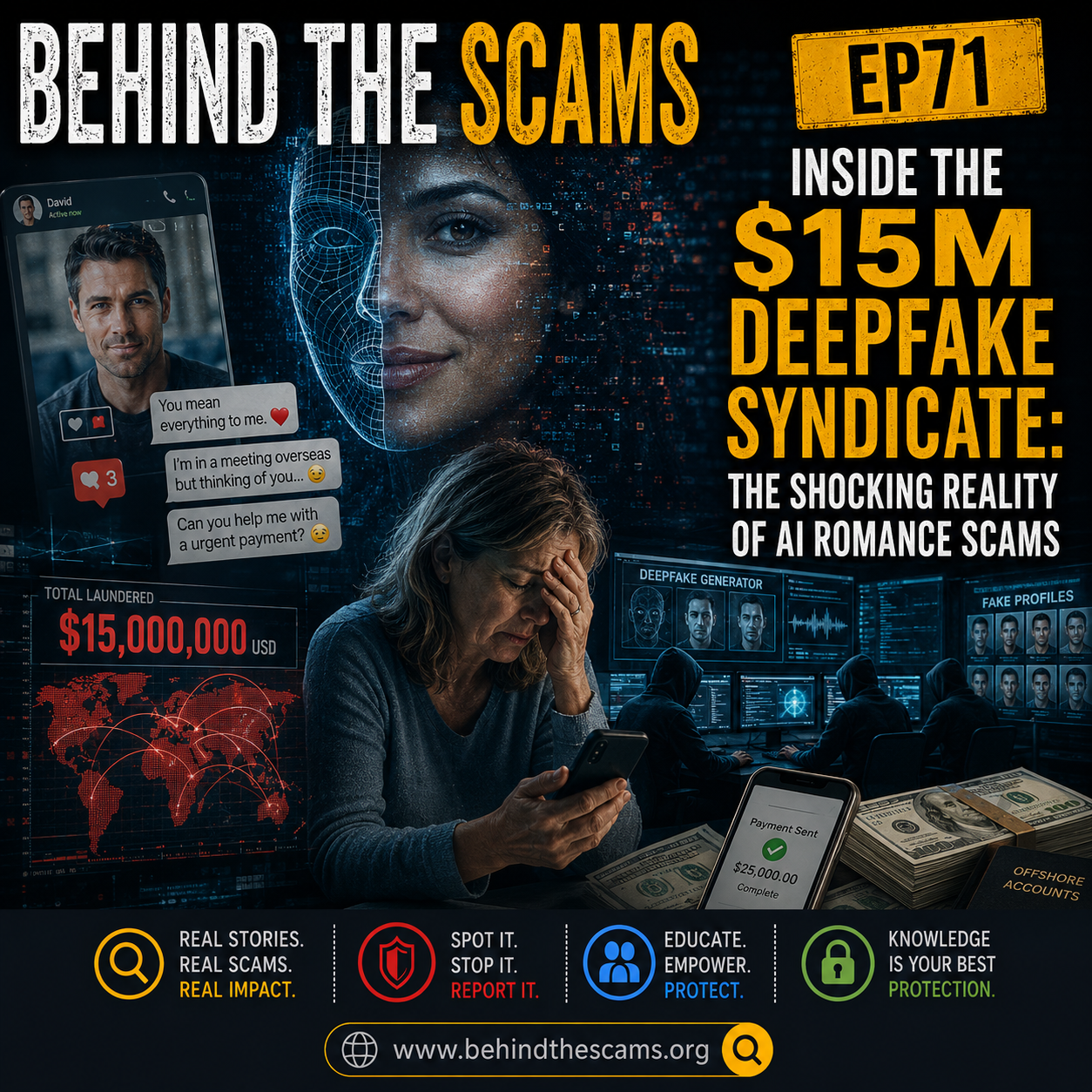
Episode Transcript
[00:00:00] Speaker A: Welcome back to behind the Scams. I'm Nick.
[00:00:02] Speaker B: Hello, everyone. And I am sue and Nick. I already see the stack of notes in front of you, which usually means we are either doing a podcast or preparing for a congressional hearing.
[00:00:14] Speaker A: Well, folks, we have a massive amount of ground to cover today. Sue is not wrong. When I have this many tabs open, it usually means somebody somewhere tried to hide money. Badly. But I want to start by asking you, the listener, to just kind of imagine a scenario.
Imagine watching your mother on a video call, right? She's, you know, she's smiling, she's laughing. Her voice sounds perfectly normal.
You can literally see the sunlight hitting her face as she turns her head.
[00:00:44] Speaker B: Feels completely real.
[00:00:46] Speaker A: Exactly.
Now imagine finding out, like, a week later that the person on that screen never actually existed, and the software that was generating her image in real time just drained your mother's entire retirement account.
[00:00:59] Speaker B: Which sounds completely dystopian, right? Like sci fi movie.
[00:01:03] Speaker A: But that scenario was not science fiction at all. It is the exact terrifying reality we are dissecting today.
[00:01:11] Speaker B: Yeah, it really is.
[00:01:12] Speaker A: And to do that, it requires us to completely dismantle a very atoxic assumption we have as a culture.
When you hear the phrase romance scam, there is almost this, you know, reflexive urge to roll your eyes.
[00:01:25] Speaker B: Oh, for sure. People are so judgmental.
[00:01:28] Speaker A: They really are.
People assume that if someone is defrauded by an online lover, they must be, I don't know, exceptionally naive or technologically illiterate or blinded by greed.
[00:01:40] Speaker B: Right, like they fell for some obvious trick.
[00:01:44] Speaker A: Yep, that's right. We mock the victims to protect our own egos, basically convincing ourselves we are just, well, too smart to fall for it.
I saw that attitude in financial crimes cases for years. As I can tell you, it is usually the first thing that gets an investigator in trouble, assuming the victim should have known better.
The truth is, by the time many victims came forward, they were carrying shame on top of the financial loss. And that shame often did more damage than any insult from a stranger ever could. It is the ultimate defense mechanism.
But by the time we finish this investigation today, that illusion of invulnerability is going to be completely shattered.
[00:02:26] Speaker B: Oh. Shattered into a million pieces.
Which, for listeners, keeping score is also how Nick describes my confidence every time he explains money laundering before coffee.
[00:02:39] Speaker A: All right, sue, let's don't bring those delicate, private moments into our discussions, however, because we're looking at a threat landscape that has evolved so rapidly and with such, I mean, devastating sophistication, that the old stereotypes of you know, emails with broken English and random requests for gift cards. They're practically ancient history.
[00:03:01] Speaker B: Yeah, they really are.
What we are dealing with now are highly weaponized, technologically flawless psychological operations.
Once someone is caught in the crosshairs of these syndicates, escaping with their finances intact is.
Well, it's practically impossible.
[00:03:21] Speaker A: This whole syndicate structure and its tactics is so important in the wide world of scamming that we all live in today.
[00:03:28] Speaker B: It is. So we better get going and do what we can to expose the scammers and their tactics.
[00:03:35] Speaker A: Let's do it.
In this episode, we will be diving deep inside this scam machine. We are going to deconstruct the exact mechanics of the AI technology they use, the neuroscience of the manipulation, the complex financial infrastructure that moves the money, and this unprecedented global law enforcement dragnet that finally brought one of these syndicates down.
[00:03:58] Speaker B: Yep, we sure are. Nick. We will take all of the intelligence we have gathered and translate it into a concrete, actionable shield to protect yourself. Because like you always say, you cannot defuse a bomb if you don't understand how the wiring works.
[00:04:16] Speaker A: You have to know the wiring. And in my old line of work, if you did not understand the wiring, you were just standing next to a very expensive smoking hole and pretending it was a clue.
[00:04:27] Speaker B: Yeah.
[00:04:28] Speaker A: And the wiring we are examining today comes directly from a newly unsealed federal indictment out of the Northern District of Ohio.
This is the staggering case of United States v. Jamal Abubakari et al. And just to set the baseline for what we are dealing with here, the sheer mathematics of this indictment are horrifying.
This single criminal syndicate orchestrated a $15 million international fraud operation.
[00:04:54] Speaker B: 15 million.
So this is no street level con operation.
This is a major league scamming operation that law enforcement has taken off the streets.
[00:05:07] Speaker A: And they extracted that wealth from elderly American victims.
It was a highly structured, almost corporate style network that stretched from the suburbs of Ohio all the way across the Atlantic to Accra, Ghana. And when you break down the related cases, investigators describe more than 80 elderly victims in one major cumi linked case alone, with losses exceeding $8 million.
[00:05:32] Speaker B: God, that's insane.
[00:05:33] Speaker A: Like you said, this is not some petty grift. This is the deliberate, systemic financial annihilation of older Americans.
These operatives were, you know, liquidating entire life savings. They were triggering early withdrawals on 401ks. And I have sat across from victims after those withdrawals cleared. The money moves fast, the grief lands slowly.
A lot of people imagine the harm ends when the account hits zero. But that is usually when the second injury starts the loss of independence, the hard conversations with adult children, the fear of becoming a burden, ruining retirements, completely convincing victims to take out massive home equity lines of credit just to get their hands on more cash.
[00:06:21] Speaker B: So, I mean, how does a syndicate manage to extract that kind of wealth so consistently?
Let's. Let's dive into the scope of this operation.
Because the timeline and the targeting are deeply calculated, right?
[00:06:36] Speaker A: Yeah. Oh, very calculated.
According to the federal indictment, this specific conspiracy operated continuously, I mean, day in and day out, from July 2024 to April 2026.
[00:06:50] Speaker B: That is nearly two years of uninterrupted psychological warfare.
[00:06:56] Speaker A: Yeah, and their targeting wasn't random either. They specifically hunted older Americans, isolating them on dating websites, community forums, social media platforms. They basically capitalized on the epidemic of loneliness that, you know, disproportionately affects aging populations.
And from an investigator standpoint, that isolation creates the first major challenge.
By the time a victim tells anyone, the money trail may already be three banks, two payment apps, and one foreign jurisdiction away. And I want to pause here, because this is where the mechanics of the crime completely shift.
For a decade, the standard advice given by consumer protection agencies to anyone online dating was demand a live video call.
[00:07:44] Speaker B: Right. The golden rule. Also the rule every family member says with enormous confidence at Thanksgiving, usually between bites of pieces. Yeah.
[00:07:54] Speaker A: If they won't get on a webcam, they are a catfish. A live video call was considered the ultimate infallible proof of life.
It was basically the silver bullet to keep you safe.
[00:08:05] Speaker B: Exactly. Because our brains are biologically hardwired to trust what our eyes and ears process in real time.
[00:08:13] Speaker A: Right. If you are talking to someone and you see them laugh at your joke, or you watch them, like, brush a piece of hair out of their face and you hear the inflection in their voice, change your amygdala, which is the brain's threat detection center, it powers down.
[00:08:28] Speaker B: It just relaxes.
[00:08:30] Speaker A: Yeah, your natural skepticism evaporates because, historically speaking, you cannot fudge a live human interaction.
[00:08:38] Speaker B: But that is exactly what the Syndicate did. They hijacked the very verification tool we were taught to rely on.
[00:08:47] Speaker A: They weaponized it.
[00:08:49] Speaker B: Yeah, these operators weren't using static stolen JPEGs of models like the old days. They weaponized advanced generative artificial intelligence. They utilized AI driven video platforms to generate synthetic real time video and audio feeds of completely fictitious Personas.
[00:09:09] Speaker A: The technological leap here is what makes this so incredibly dangerous.
To understand how they do this, you kind of have to look at how generative adversarial networks or GANs have evolved.
[00:09:22] Speaker B: Okay, break that down for us before my brain starts filing a formal complaint.
[00:09:27] Speaker A: Okay, I will sue. Because I had to read it a few times before I actually fully understood how it works and how often it was being used in modern day scams.
So a 22 year old operator sitting in an Internet cafe in Ghana doesn't need a massive Hollywood server farm anymore. They use commercially available or sometimes dark web modified software that takes a single source image of a fake Persona and basically maps it over the operator's actual facial movements in real time.
[00:09:58] Speaker B: I am. I'm struggling to understand the logistics of that though. I mean, major movie studios spend tens of millions of dollars on C. CGI to de age actors or create digital humans easily.
And even then, if you look closely at the mouth or the eyes, it sometimes falls into that uncanny valley. You can just tell it's fake.
So how is a criminal syndicate in West Africa bypassing the latency?
Like, how is there no lag or glitching that just immediately gives it away?
[00:10:35] Speaker A: Well, it is a brilliant question, and it really comes down to the medium of delivery. If you were watching this deepfake on a massive, you know, 4K movie screen, yes, you would absolutely notice the micro jitters around the jawline or the unnatural pixelation in the irises.
But these scammers are not broadcasting to an IMAX theater. They are initiating video calls over platforms like WhatsApp or Facebook messenger, which inherently compress the video quality.
Fraudsters love friction, blur, delay, confusion. All the little things normal people blame on bad wi fi.
[00:11:11] Speaker B: Ah, so the compression hides the flaws.
The one time bad video quality is working for the criminal and not just ruining a family. Zoom call.
[00:11:20] Speaker A: Exactly. The victim is watching on a small 6 inch smartphone screen, likely holding it in their hand. So it's shaking slightly over a cellular or wi fi connection that naturally experiences buffering and artifacting.
[00:11:35] Speaker B: Wow, that's. I didn't even think of that.
[00:11:38] Speaker A: Right. The AI software uses latent space rendering to perfectly lip sync the cloned voice to the generated mouth.
Any slight lag or blurriness isn't perceived by the victim as a failure of artificial intelligence. It is simply perceived as a bad Internet connection.
I cannot tell you how many fraud reports start with something that sounds harmless.
The call was fuzzy, the app was glitchy, the person said the signal was bad. It is an entirely asymmetrical war.
You have a lonely older adult sitting in their living room, desperate for human connection, staring at a blurry phone screen.
Yeah, and on the other side you have a highly organized corporate syndicate using neural radiance fields and deep learning voice cloning to render a perfectly responsive human being.
I mean, it is an incredibly unfair fight.
[00:12:32] Speaker B: Totally unfair. How could anyone possibly defend against that in the moment, other than throwing the phone into a lake, which I assume is not the official guidance?
[00:12:43] Speaker A: They can't. They really can't.
The victim explicitly believes they are looking into the eyes of someone who loves them.
The emotional intimacy accelerates at a terrifying speed because the visual and auditory confirmation bypasses all their rational filters.
They are completely bought in. And when that bond is exposed as fake, the victim is not just losing money, they are grieving a person who never existed. Which is a very strange and very real kind of heartbreak.
[00:13:14] Speaker B: Which naturally begs the crux of monetization.
Because, you know, falling in love with an AI doesn't automatically drain your bank account, right? You have to somehow bridge the gap between emotional intimacy and financial extraction.
How do they actually get the money out of a victim who thinks they are just in a normal long distance relationship and not accidentally starring in the worst finance seminar ever?
[00:13:43] Speaker A: They do it by manufacturing what investigators call the emergency narrative.
The scammers don't just like, ask for a loan to buy a car or pay off a credit card.
Once the psychological hook is set and the trust is absolute, they introduce a sudden, catastrophic, time sensitive cris.
[00:14:01] Speaker B: It's never mundane. It's never, oh, I'm a little short on rent.
Apparently scammers do not believe in ordinary adult problems like parking tickets or replacing a water heater.
[00:14:15] Speaker A: No, never.
It is always a high stakes tragedy. The Persona is suddenly trapped in a foreign country and their passport is seized. Or they are a maritime contractor whose equipment is being held by corrupt port authorities.
Or they're in a hospital needing emergency surgery and their insurance was denied.
[00:14:36] Speaker B: It's always life or death. Or financial ruin.
[00:14:41] Speaker A: Exactly. The specific narrative almost doesn't matter. What matters is the neurological response it forces.
By creating a severe emergency, the scammers intentionally induce a panic state in the victim.
[00:14:54] Speaker B: Right.
[00:14:55] Speaker A: When a human being believes someone they deeply love is in imminent physical or legal danger, the brain floods with cortisol, the amygdala goes into hyperdrive, basically initiating a massive fight or flight response.
[00:15:09] Speaker B: And when that happens, logic just goes out the window, doesn't it?
Possibly carrying your common sense with it in a little suitcase.
[00:15:18] Speaker A: Physiologically, yes, it has to be.
The fight or flight response literally suppresses the prefrontal cortex, which is the area of the brain responsible for critical thinking, risk assessment and financial Common sense.
[00:15:32] Speaker B: Wow.
[00:15:33] Speaker A: The victim is no longer evaluating the legitimacy of a wire transfer. They are purely reacting to a survival threat.
I look at the mechanics of this and the only way to accurately describe it is as a digital hostage situation in financial crimes investigations. That was always the part that stuck with me. The money was gone, yes, but the victim had also been held emotionally captive.
[00:15:58] Speaker B: That's exactly what it is.
[00:16:00] Speaker A: Think about the psychological pressure. Even though the person in danger doesn't exist, the emotional terror experienced by the victim is 100% real.
They feel the exact same desperation as a parent paying a ransom to a kidnapper.
In interviews, you could see victims replaying the moment they sent the money over and over again.
Not because they were careless, but because they were trying to rescue someone they believed was in danger.
[00:16:27] Speaker B: That is a perfect way to conceptualize it. It is a psychological ransom. Yeah.
[00:16:32] Speaker A: And because it is an emergency. Right. The scammers apply unrelenting pressure. They demand secret, secret, high value wire transfers immediately.
[00:16:41] Speaker B: Right. The urgency is key.
[00:16:44] Speaker A: And crucially, they isolate the victim to prevent any external reality checks. They instruct the victim not to tell their children or to lie to the bank tellers about why they were moving the money, claiming that revealing the truth might, you know, jeopardize the surgery or anger the corrupt officials.
That secrecy is not accidental.
In law enforcement, delay is the enemy. Every hour the victim stays silent gives the Syndicate more time to move, layer and disappear the funds.
[00:17:16] Speaker B: I'm.
I'm stuck on the banking aspect of this, though, because isolation only goes so far when you have to physically move the money.
If I try to use my debit card to buy a coffee two states over, my bank freezes my account instantly because of their fraud algorithms.
Which is flattering, I guess, that my bank thinks I live such a predictable coffee life.
[00:17:41] Speaker A: Oh, yes.
[00:17:42] Speaker B: So how is an older American walking into a local branch, suddenly wiring $50,000 across international borders without tripping every single anti money laundering alarm at the Federal Reserve?
Because my bank once questioned a gas station sandwich.
[00:18:01] Speaker A: Well, they don't trip the alarms because the Syndicate engineered a multi tiered financial structure specifically designed to bypass the Bank Secrecy act and those exact algorithmic red flags.
And here is the unglamorous part of these cases.
Investigators often know something is wrong before they can legally prove every piece of it. You are waiting on subpoenas, bank returns, IP logs, account opening documents, and sometimes translations while the bad guys are moving at app speed. Okay, how they knew that a direct transfer from a retiree in Ohio to a 22 year old in West Africa would be blocked in milliseconds.
[00:18:43] Speaker B: Right? Obviously.
So how do they route the money then? Because apparently the criminals have a better logistics department than most airlines.
[00:18:51] Speaker A: If we look at the actual indictment, there is a very clear, deliberate division of labor on the front end, operating the deepfakes and executing the psychological manipulation.
You have individuals like Jamal Abubakari and Kamal Abubakari, the masterminds.
Right. They are young, highly tech savvy digital natives operating out of Accra.
But they aren't the ones receiving the money directly.
To get around the international banking safeguards, the Syndicate employed a network of domestic facilitators.
In this specific indictment, one of the central figures was a woman named Amanda Joy Opoku Boachi.
She is a 53 year old resident living right here in the United States.
[00:19:36] Speaker B: Let me make sure I understand the mechanics of this before I need a whiteboard and possibly a snack.
The victim is panicked, thinking they need to send $50,000 to save their partner who is supposedly stuck in an emergency in a foreign country.
[00:19:54] Speaker A: Right.
[00:19:54] Speaker B: But the operators in Ghana instruct the victim to wire the money to a standard domestic retail bank account here in the US Held by Amanda.
[00:20:06] Speaker A: Exactly.
From the perspective of the bank teller or the bank's automated fraud detection software, the transaction doesn't look like an international remittance to a high risk jurisdiction at all.
[00:20:17] Speaker B: Oh, I see.
[00:20:19] Speaker A: It just looks like an older American transferring funds to a 53 year old woman in the next state over.
It appears to be a completely normal local domestic transaction.
That is what made these schemes so hard to triage. In real time.
A single wire may look ordinary. The crime only becomes obvious when you step back and see the pattern across victims accounts, dates and destinations.
[00:20:44] Speaker B: It acts like a financial airlock.
[00:20:47] Speaker A: Ooh, an airlock. I like that. I may steal that for the next retired agent dinner where everyone is pretending they do not miss subpoenas.
[00:20:56] Speaker B: Yeah, like if you think about a spaceship. You can't just open the door to the vacuum of space or you'll get sucked out. Which is generally considered bad podcasting.
You have to step into an airlock, let the pressure normalize and then open the outer door.
[00:21:13] Speaker A: Right.
[00:21:14] Speaker B: Amanda's domestic bank accounts were the airlock. The victim wires the money in, the banking algorithms see a normal domestic transfer and they depressurize their red flags.
Then once the money is safely inside the US banking system under Amanda's control, she opens the outer door and pushes it offshore.
[00:21:38] Speaker A: That is exactly how the placement and layering phases of money laundering work. In these Syndicates.
It is laundering by normalization.
Amanda basically acted as the domestic clearinghouse. In old school cases, you followed cash deposits and cashier's checks. Here the principal is the same, but the machinery is faster and the paper trail is wearing a hoodie.
[00:22:02] Speaker B: Unbelievable.
[00:22:04] Speaker A: The illicit capital from dozens of panicked victims was wired into her various accounts.
She pulled that money, allowed it to clear the initial security holds, and then executed secondary structured transfers to route the funds overseas to the operators in Ghana.
[00:22:20] Speaker B: It is staggering when you view it from a macro level.
This is highly organized multinational corporate crime.
They literally compartmentalize their business.
[00:22:32] Speaker A: They absolutely did.
[00:22:33] Speaker B: They have a customer acquisition and psychological operations department department in West Africa run by 20 something tech experts.
And they have a regional financial compliance and logistics officer in the US handling the revenue clearing.
[00:22:49] Speaker A: And the sophistication doesn't stop once the money reaches Ghana either.
Because digital money, even in offshore accounts, can eventually be traced. Right. If the US authorities get involved and issue international warrants, those bank accounts can be frozen.
The syndicate understood this vulnerability, which brings us to the final stage of their financial machine asset conversion. And this is where asset recovery becomes brutally difficult.
You are not just asking who stole the money, you are asking what did they buy, whose name is it in, where is it parked? And can we prove it came from victim funds before it changes hands again?
[00:23:31] Speaker B: Right, because keeping $15 million in a checking account in Accra is a massive liability.
So what did they do with the cash? They turned it into metal. Really expensive metal.
[00:23:45] Speaker A: Very expensive. The investigators in this case eventually seized physical luxury assets. We are talking about a Lamborghini, a Tesla cybertruck, multiple top tier Mercedes Benz vehicles and BMWs.
[00:24:00] Speaker B: They took the digital illusion of romance and converted it into highly liquid, tangible physical assets.
[00:24:07] Speaker A: It's wild. People often see a criminal driving a Lamborghini and think it is just a flamboyant status symbol. But in the context of international fraud, a luxury vehicle is actually a mobile, untraceable bank account.
[00:24:22] Speaker B: That makes total sense. You can't just freeze a cybertruck with a keystroke from a federal courthouse in Ohio. Although I am sure someone at the courthouse has wished they could.
[00:24:32] Speaker A: Exactly. It stores the stolen wealth in a physical form. If the heat gets turned up, they can sell the vehicle for cash. They can trade it on the black market or simply move it across a border. It is the integration phase of money laundering where the illicit funds are fully absorbed into the legitimate economy.
[00:24:51] Speaker B: It is absolutely enraging. You have older Americans taking out second mortgages, skipping their prescription medications. And living in a state of absolute psychological terror.
All while the people who manufactured that terror are driving stolen Lamborghinis through the streets of another continent.
[00:25:13] Speaker A: It makes you sick. And what stays with you is not only the dollar amount amount. It is the voice of the victim saying they do not know how they are going to tell their family, or whether they can stay in the house, or whether they will ever trust themselves again.
[00:25:28] Speaker B: It really does.
Which makes me incredibly eager to dissect how this machine was finally broken. Because catching a decentralized, offshore, technologically advanced network like this seems nearly impossible.
[00:25:45] Speaker A: Well, historically, it was. For decades, there has been a pervasive sense of jurisdictional helplessness in cybercrime.
[00:25:52] Speaker B: What do you mean by that? And please tell me this is not one of those jurisdictional puzzles that requires three maps and a law degree.
[00:26:00] Speaker A: A victim would report a loss to local police, right? And the police would trace the IP address or the wire transfer overseas, and the investigation would just hit a brick wall.
Law enforcement would essentially shrug and say, the money crossed the ocean. It's out of our jurisdiction.
I heard versions of that sentence for years, and it never got less frustrating.
[00:26:22] Speaker B: Right, because they can't just fly to another country and make an arrest.
[00:26:25] Speaker A: Exactly. But the takedown of the Abubakari linked syndicate proves that the era of hiding behind international borders is rapidly closing.
The sheer scale of the dragnet required to dismantle this group is unprecedented.
[00:26:40] Speaker B: Yeah, tell us about that before I start drawing red string between countries on my wall.
[00:26:46] Speaker A: It started with an incredibly aggressive federal and state partnership right in Ohio.
This investigation was spearheaded by the FBI Cleveland division. But the key to their success was that they didn't operate in a vacuum.
That matters because financial crimes cases die in the gaps between agencies.
One office has the victim reports, another has the bank intelligence. Another has the corporate records. And unless somebody forces those pieces onto the same table, everyone is staring at a different corner of the map. Okay, they formed a coalition with the Elder Justice Initiative, the Small Business Administration, Office of Inspector General, and the Department of Health and Human Services. Office of Inspector General.
[00:27:29] Speaker B: Wait, I have to ask. Why the Small Business Administration and Health and Human Services?
What do business loans and healthcare have to do with an AI romance scam?
That is not a crossover episode I expected.
[00:27:43] Speaker A: That is the perfect question. And it reveals the underlying nature of these syndicates. The Department of Justice has realized that transnational criminal networks do not exist in silos.
[00:27:54] Speaker B: Right.
[00:27:55] Speaker A: The exact same infrastructure, the same domestic facilitation, the same shell companies, the same money mules that Launder funds for a romance scam is often simultaneously being used to launder money from Medicare fraud or stolen PPP loans from the pandemic.
[00:28:12] Speaker B: Oh, wow. So they are essentially sharing the plumbing criminal infrastructure as a service.
Which sounds like something no one should ever put on a PowerPoint. So slide. But here we are.
[00:28:26] Speaker A: Precisely. By pooling data across these different federal agencies, they can map the entire financial plumbing of the criminal underworld. They even establish data sharing agreements with state level entities like the Ohio Secretary of State to instantly identify ownership links between fraudulent shell corporations.
That is the part most people never see. The case is won less by one dramatic raid than by months of tedious records. Work spreadsheet after spreadsheet until the pattern finally starts talking.
[00:28:59] Speaker B: That's smart.
[00:29:00] Speaker A: Very.
They built a comprehensive multi agency intelligence model to map every single dollar moving through that domestic airlock we talked about.
[00:29:09] Speaker B: But mapping the money in Ohio only gets you the domestic facilitators like Amanda.
To cut the head off the snake, you have to cross the Atlantic.
[00:29:20] Speaker A: You do. And this is where the geopolitics of this case get fascinating to me.
The Justice Department's Office of International affairs had to work directly with the Ghana Attorney General's Office, the Economic and Organized Crime Organization, which is known as eoco, and the Ghana Police Service.
This level of cooperation represents a monumental shift in international cyber enforcement.
For a long time, there was an assumption that local authorities in certain West African nations were either entirely unequipped to handle complex cyber forensics.
But international cooperation is not just picking up the phone and asking nicely.
It means evidence packages, legal assistance requests, chain of custody questions, diplomatic timelines, and a lot of patience when the victim's family understandably wants action yesterday.
[00:30:13] Speaker B: Or they simply lack the political will to intervene.
[00:30:16] Speaker A: Which is exactly what I want to push back on.
Let's look at the incentives here. I understand the FBI arresting someone in Virginia, but how does the United States government convince a foreign sovereign nation to actively deploy their police force, kick down doors in their own neighborhoods, seize millions of dollars in luxury assets, and arrest their own citizens? Especially when these syndicates are injecting massive amounts of of American capital into the local Ghanaian economy.
I mean, why would Ghana choose to help us instead of just looking the other way? It is a critical question about leverage. And the answer lies in the architecture of the global financial system.
Ghana is a rapidly developing, modernizing nation.
Their economic growth relies entirely on international trade, foreign direct investment, and their ability to participate seamlessly in global banking networks like the media social swift system.
[00:31:12] Speaker B: Right, the system that Allows banks to send money across borders.
[00:31:16] Speaker A: Exactly. The international banking community is heavily regulated by organizations like the Financial Action Task Force or fatf. If a country is perceived as a safe haven for transnational cyber terrorism, money laundering and fraud, they risk being placed on the FATF gray list or even blacklisted entirely.
[00:31:38] Speaker B: And if they get blacklisted, what happens?
I am guessing it is not a strongly worded email and a disappointed look.
[00:31:47] Speaker A: It would be an economic death sentence.
Global financial institutions would refuse to clear transactions originating from Ghanaian banks. The cost of harboring these localized fraud syndicates would absolutely eclipse whatever illicit cash is being pumped into the local economy by a few 22 year olds buying cars.
[00:32:08] Speaker B: So it is a matter of national economic survival for Ghana to clean house.
[00:32:13] Speaker A: Exactly. The Ghanaian government operating through EOCO and their cybersecurity authority is highly motivated to demonstrate to the global community that they are a safe regulated environment for business.
They are actively showing that they will not tolerate their sovereign territory being used as a staging ground for international financial warfare.
[00:32:35] Speaker B: And they proved it with action.
They didn't just seize the Lamborghinis and the cyber trucks.
[00:32:41] Speaker A: No, they didn't.
[00:32:42] Speaker B: The related indictments also outline offshore co conspirators.
Frederick Kumi, who operates under the alias Abu Tra and Daniel Yousef, known as Slab, are both 31 year old Ghanaian men tied to the broader network and accused of participating in the Kumi case.
[00:33:04] Speaker A: Which perfectly transitions us from the physical takedown to the legal dismantling of the network.
[00:33:11] Speaker B: Yeah, because the dramatic international raids and extraditions are where they make the headlines, right?
[00:33:18] Speaker A: Oh yeah, everyone loves a good raid.
Nobody makes a prestige television series about reconciling bank records.
Although frankly they should.
Very suspenseful if you like coffee and eye strain.
[00:33:31] Speaker B: But the actual permanent destruction of a syndicate happens in the courtroom. And the judicial strategy deployed by the U.S. attorney's office here was just as meticulous as the investigation itself.
[00:33:45] Speaker A: It really was.
The prosecutors didn't just arrest these individuals and try them piecemeal in different jurisdictions.
They utilized a very specific procedural tactic. They consolidated related Ghana linked conspiracies under a single judge in the Northern District of Ohio to coordinate proceedings. The tactical brilliance of a consolidated docket cannot be overstated.
When you are prosecuting a decentralized compartmentalized network. The biggest risk is that individual judges only see a fraction of the crime.
That is not just a courtroom problem, it is an investigative problem too.
Fraudsters design these networks so every participant can say, I only touch this one piece.
The investigator's job is to show how those pieces fit into one machine.
[00:34:32] Speaker B: Right. Like the blind men feeling the elephant.
[00:34:35] Speaker A: Exactly. If you try a domestic money mule in one state, their defense attorney will argue. Your Honor, my client didn't make any deep fakes. They didn't manipulate anyone. They just moved some money around. They are a low level offender. And honestly, that is why prosecutors have to tell the whole story.
Fraud networks survive by making every participant look small.
[00:34:58] Speaker B: Playing the victim themselves. Almost.
[00:35:01] Speaker A: Yeah. And a judge only seeing that isolated act might just give them probation or a very white sentence.
[00:35:07] Speaker B: But by putting the entire Syndicate in front of Judge Adams, they removed that defense completely.
I look at this legal strategy and it instantly reminds me of how the federal government used the RICO act to take down the mafia in the 20th century.
[00:35:26] Speaker A: Oh, that's a great comparison.
[00:35:28] Speaker B: Yeah. They realized they couldn't just arrest the guys running the illegal gambling rings on the street.
They had to prove the existence of an ongoing criminal enterprise to hold the bosses accountable for everything.
[00:35:42] Speaker A: It is a very similar legal philosophy. By consolidating the docket, Judge Adams is presented with the full devastating mosaic of the Syndicate. He sees the artificial intelligence logs, the tragic victim impact statements, the complex layering of the bank transfers and the millions in stolen assets.
[00:36:02] Speaker B: He sees the whole picture.
[00:36:04] Speaker A: Right.
He sees how the low level mule is absolutely vital to the survival of the Mastermind. It ensures consistent evidentiary standards and guarantees that the sentencing reflects the gravity of the entire operation.
Not just individual isolated acts.
[00:36:22] Speaker B: And the hammer truly dropped. The sentences handed down under this consolidated strategy are brutal.
[00:36:30] Speaker A: They are.
[00:36:31] Speaker B: We already have nine co conspirators who have either pleaded guilty or been sentenced, receiving a collective total of roughly 50 years in federal prison.
[00:36:43] Speaker A: The individual sentences demonstrate that the court is treating this with extraordinary severity.
Dwayne Asafo Adjay was sentenced to 71 months.
Nancy Adom was also sentenced to 71 months.
Eric Adu received 71 months as well.
Other related defendants have received sentences ranging up to 108 months.
[00:37:05] Speaker B: And the court didn't just target the operators and the mules.
They went after the people who tried to shield the network.
Nader Wasif was sentenced to a full year in prison for obstruction of justice. Yeah, but what I find even more impactful than the prison time is how the justice system attacked their wealth.
[00:37:27] Speaker A: Yes, because incarceration removes the criminals from society.
But restitution orders are what truly dismantle the infrastructure.
The goal of the federal court isn't just to put these individuals in a cell. The objective is to completely strip them of the illicit wealth they accumulated and forcibly attempt to make the older Americans they devastated whole again.
And I want to be honest about the hard part. Restitution orders are powerful, but victims still may wait years to see meaningful money back if they ever do.
That gap between justice on paper and recovery in real life is one of the most painful parts of financial crimes work.
A judge can order restitution, but no court order can fully restore a person's confidence after they have been manipulated, isolated and blamed.
[00:38:17] Speaker B: And the financial judgments attached to these sentences are jaw dropping.
Defendants in the related cases have been ordered to pay hundreds of thousands and in some cases, more than $1 million in restitution.
[00:38:32] Speaker A: Incredible.
[00:38:33] Speaker B: Nancy Adam alone was ordered to pay more than $1 million in restitution.
[00:38:40] Speaker A: We really need to explain exactly how restitution works at the first federal level, because it is essentially a financial life sentence, not the kind people usually imagine when they think sentencing. But in white collar and fraud cases, it can be the part that follows a defendant long after the prison term ends.
[00:38:58] Speaker B: Walk us through it, preferably without making everyone check their bank app in a panic.
[00:39:03] Speaker A: When these individuals eventually finish serving their time, whether it's five, seven or nine years, they do not get a clean slate. They will walk out of the prison gates with a multi million dollar judgment chained to them for the rest of their natural lives.
[00:39:18] Speaker B: It never goes away.
[00:39:20] Speaker A: It never goes away.
Any legitimate income they attempt to earn, any tax refund they receive, any inheritance they might get, any property they ever try to acquire will be immediately identified, garnished and seized by the federal government to pay back the victims.
[00:39:39] Speaker B: They will never own anything again.
[00:39:41] Speaker A: It guarantees absolute, permanent financial ruin. It is a massive warning flare shot directly at anyone currently acting as a domestic facilitator.
If you are sitting here in the United States and someone online has convinced you to let them use your bank account to clear funds or receive wires, you need to understand the new math.
You aren't just risking a couple of years in a minimum security facility. You're risking a two or $3 million debt that will literally follow you to the grave.
The risk calculus has fundamentally changed.
[00:40:14] Speaker B: The window for operating these schemes with impunity has slammed shut the multi agency data sharing models, the cooperation of West African authorities, the aggressive use of consultants, consolidated dockets, and massive restitution.
Law enforcement is finally adapting to the threat.
[00:40:35] Speaker A: But even as law enforcement catches up to the syndicates of today, we have to look at what this technology means for tomorrow.
As we wrap up our analysis of this $15 million machine, I want to leave you with a deeply provocative thought about the future of your own security.
Every time investigators adapt, fraudsters adapt, too.
That is the frustrating rhythm of this work. We close one door and they start testing windows, vents, mail slots, and occasionally the chimney.
[00:41:08] Speaker B: Yeah, because we started this deep dive by exploring how generative AI and real time voice cloning have completely neutralized live video as a method of verification.
[00:41:21] Speaker A: Right. The proof of life is dead.
But if you extrapolate that out, it means that all static identity checks are becoming obsolete.
[00:41:30] Speaker B: Yes, they are.
[00:41:31] Speaker A: If looking at a live video feed of someone's face or hearing their voice on the phone no longer proves you are talking to a real human being.
What defense does a bank actually have left to protect your money?
If an AI can perfectly mimic my voice to authorize a transfer, how does my bank know it's not me?
[00:41:50] Speaker B: It is one of the most chilling dilemmas in modern cybersecurity.
The financial industry is rapidly coming to the realization that biometric verification, like passwords, fingerprint scans, voice recognition, and facial ID is no longer sufficient.
[00:42:10] Speaker A: It's just not enough anymore. No, the only viable defense against this level of artificial deception is a transition toward what is called continuous behavioral monitoring.
[00:42:21] Speaker B: Okay, explain how that works, because it sounds incredibly invasive. Like my phone is about to ask me how I am really doing.
[00:42:32] Speaker A: Oh, it is.
But it may be the only way to protect consumer capital.
Soon, it will not be enough for you to simply type your password correctly or look into your phone's camera to authorize a wire transfer. The bank's algorithms are going to have to track the microscopic behaviors of how you interact with your device.
[00:42:52] Speaker B: You mean like how fast I type because my typing style is less biometric signature and more raccoon loose in an office supply store.
[00:43:03] Speaker A: Exactly. And disturbingly, even the raccoon has a pattern. They will monitor the cadence of your keystrokes. They will analyze the cognitive hesitation in your mouse movements.
They will use the gyro sensors inside your smartphone to detect the micro tremors in your hand to see if you are shaking nervously while initiating a transfer.
[00:43:25] Speaker B: That is wild.
[00:43:27] Speaker A: They will evaluate the psychological vulnerability indicators in the timing and destination of your transactions.
[00:43:34] Speaker B: That is mind bending.
To protect you from being emotionally manipulated by a flawless AI deepfake. The bank's security software will essentially have to monitor your physiological and psychological state in real time.
[00:43:51] Speaker A: Yes. They aren't just checking your password. They are checking your anxiety levels to protect you from yourself.
[00:43:58] Speaker B: Because the AI on the other end of the manipulation is only going to get better.
[00:44:04] Speaker A: And that realization brings us full circle to the most important takeaway of this entire investigation, which is empathy. Not pity.
Empathy.
Pity looks down at victims and says, how could you let that happen?
Empathy sits beside them and asks, what did they do to make you believe that difference matters? If we want people to report quickly, recover faster, and stop carrying the shame that belongs to the criminals?
[00:44:33] Speaker B: Yes, Absolutely. I urge everyone listening to permanently discard the stereotype of the foolish, greedy victim.
Look at the immense sophistication of the technology, the calculated neuroscience of the emergency narratives and. And the multinational corporate structure designed to bypass federal banking laws.
[00:44:57] Speaker A: It's a machine. Anyone, absolutely anyone, could fall for this level of highly engineered deception. The human brain simply did not evolve to instinctively detect real time generative artificial intelligence.
Back when I started in financial crimes, we warned people about forged checks and fake invoices.
Now we are talking about synthetic faces that can look your mother in the eye.
That is not a failure of common sense. That is a change in the battlefield.
[00:45:26] Speaker B: We are all biologically vulnerable. But being vulnerable does not mean we are destined to be victims.
Knowledge is the ultimate equalizer, which is why we do what we do here at the SOS Media Network.
Expose the scammers and educate the masses.
[00:45:45] Speaker A: I couldn't have said it better, Sue.
Nice job.
So today we dissected the anatomy of the threat. You now understand the terrifying scope of the AI tactics, the mechanics of the money laundering airlocks, and the unprecedented international takedown of the Abubakari linked syndicate.
[00:46:04] Speaker B: I know the picture is much clearer for me, and frankly, it. It's not a real pretty picture, but it's certainly real.
[00:46:12] Speaker A: That's right. The next time you look at a screen, whether it's a video call, a news clip, or a message from a friend, think about how much faith you blindly place in your own eyes and ears.
Because we have officially crossed the event horizon where seeing is no longer believing.
And sue, for the record, if I ever video call you asking for gift cards, hang up and call the real me. Stay safe out there.
[00:46:39] Speaker B: Oh, you know I will.
That's it for now, folks. Thanks for tuning in to behind the Scams. Bye for now.