Episode Transcript
[00:00:00] Speaker A: Welcome back to behind the Scams. I'm Nick and across the microphone is sue, my favorite co host, my lovely wife, and the only person who can turn my dramatic pause into a fact.
[00:00:10] Speaker B: Ch Good. I was starting to worry there was a secret co host audition.
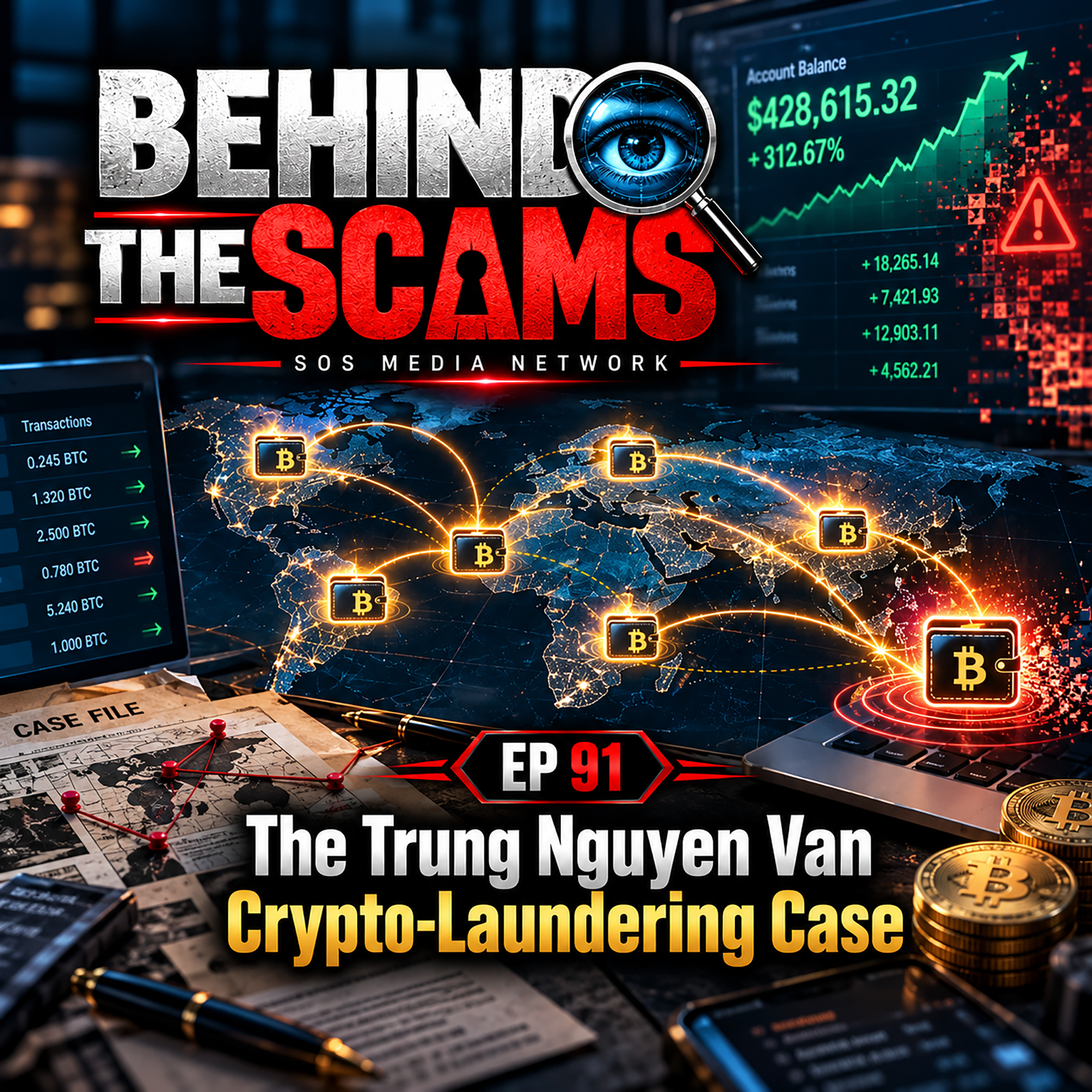
[00:00:15] Speaker A: Today's case starts with a fake crypto platform called Triangle. One Missouri victim who sent about $16 million and a wallet trail prosecutors say reached a Vietnamese national named Trung Nguyen Von Vaughn has been charged, not convicted, with two counts of money laundering in the Western District of Missouri. The government sized wallets linked to him received more than $53 million tied to fraud against Americans over nearly seven years.
[00:00:43] Speaker B: And it's important to keep those numbers straight. The victim sent $16 million into the alleged Triangle scheme, but the complaint traces only a portion of that money directly to Vann's wallet.
We'll keep those figures separate because this story is serious enough without inflating it.
[00:00:59] Speaker A: The procedural details are important. Vang is 37 and a Vietnamese national. The two count money laundering complaint was filed in the Western District of Missouri, then unsealed after his initial appearance in federal court in Los Angeles on September 24, 2026. The FBI's Kansas City Field office investigated the case with law enforcement and private
[00:01:20] Speaker B: sector partner and the charge is about laundering alleged fraud proceeds. The public announcement does not say Van created a triangle, contacted this victim or ran the relationship scam. Prosecutors still have to connect him to the wallet activity and prove the required knowledge and intent.
[00:01:36] Speaker A: Like many modern day scams, this case involved the scam known as pig butchering. The phrase is ugly and the crime is uglier.
It refers to fattening a target with attention and apparent profits before taking the money.
I prefer to call it relationship based investment fraud because that puts the focus where it belongs, on the offender's manipulation, not on the person who was deceived.
[00:02:02] Speaker B: You're right, Nick. Even the name of the scam is offensive. In this type of scam, the first move often looks harmless. A wrong number text, a friendly message or a dating app conversation that drifts onto an encrypted app. The scammer does not lead with crypto. They lead with consistency.
Good morning. How was your day? Did you eat? It feels personal because it is designed to feel personal.
[00:02:27] Speaker A: Then comes the credibility layer. The online acquaintance claims to trade successfully, mentions a relative or mentor with inside expertise and shares screenshots showing handsome returns. The invitation is usually framed as help, not a sales pitch. I can show you what I do. The target is directed to buy real cryptocurrency through a legitimate service, then transfer it to a wallet. Wallet or website controlled by the fraud network.
[00:02:55] Speaker B: And once that money leaves your control, you're no longer investing.
[00:02:58] Speaker A: You're just paying for an expensive story, which is really sick when you think about it.
[00:03:03] Speaker B: Triangle appears to have been the Missouri victim's false investment platform. The name sounds reassuringly geometric, stable, balanced, very. Someone made a logo. But a professional looking dashboard can be theater. The numbers rise because an operator controls the display, not because an investment is earning a return.
[00:03:21] Speaker A: Yeah, it's theater. It's, it's, it's a very common psychological trick, actually. It's, you know, when you're. You're basically in an environment where your brain just. Just looks for something to hang on to, you know, and you start creating reality. You start, you start creating what you want to be the truth, you know, and the, the platform, the app, whatever it might be, gives you that.
It gives you those little pieces that start building that world you want to live in. And suddenly you're not even questioning anything. That's all they got you. And that dashboard is central to the deception. A real looking balance can create the impression that the investor is making smart decisions. Even when the number is simply being typed into a controlled interface.
The victim sees apparent growth and may believe the safest choice is to add more before the opportunity disappears.
[00:04:12] Speaker B: Right, right, because they don't see those red flags and they're just completely unaware.
So the screen can show a profit while the real cryptocurrency has already left the victim's control.
[00:04:23] Speaker A: Exactly. The website is not necessarily holding an investment account in any meaningful sense. It may be displaying numbers while the actual assets move through wallets controlled by other people. That is why independent verification matters. A polished site, a customer service chat, and a rising balance do not establish that an investment exists.
[00:04:44] Speaker B: Yeah, in other words, seeing is not believing, at least in this context. It's all just smoke and mirrors, isn't it? And the withdrawal test comes late after trust and hope have already done most of the work.
[00:04:57] Speaker A: Right. In the earlier Triangular action, prosecutors said victims who tried to withdraw were told to pay additional fees or taxes. That demand is a major warning sign. A legitimate tax obligation is not normally paid by sending more cryptocurrency to an online stranger before your own funds can be released.
There is also an earlier enforcement chapter. On July 17, 2025, federal prosecutors in the same Missouri district obtained a temporary restraining order against unidentified foreign operators of a platform called Triangular. The order suspended access to two websites. The government also Filed a civil forfeiture case against more than $325,000 in cryptocurrency seized from two addresses. Prosecutors said those addresses had allegedly laundered millions in suspected scam proceeds, and the justice department credited tether with helping transfer the seized asset.
[00:05:49] Speaker B: Right. In the earlier triangular action, prosecutors said victims who tried to withdraw were told to pay additional fees or taxes. That demand is a major warning sign. A legitimate tax obligation is not normally paid by sending more cryptocurrency to an online stranger before your own funds can be released. There is also an earlier enforcement chapter. On July 17, 2025, federal prosecutors in the same Missouri district obtained a temporary restraining order against unidentified foreign oper of a platform called triangular. The order suspended access to two websites. The government also filed a civil forfeiture case against more than $325,000 in cryptocurrency seized from two addresses. Prosecutors said those addresses had allegedly laundered millions in suspected scam proceeds, and the justice department credited tether with helping transfer the seized assets. The name in that earlier action was triangular, While the later criminal complaint refers to triangle. We should not collapse those labels without the court records in front of us. But the earlier action shows what disruption can look like in real time. Take down access points, freeze reachable cryptocurrency, Preserve the wallet evidence, and keep tracing outward.
[00:06:58] Speaker A: Yeah, I mean, and these types of things, Names really do matter for a lot of reasons.
But what this really highlights is kind of like the playbook for these cases.
And it's kind of crazy just how effective that early disruption can be.
That earlier civil action also shows why investigators use more than one legal tool. A criminal case focuses on whether a person committed an offense.
Civil forfeiture action focuses on whether specific property is connected to unlawful activity and can be restrained or forfeited.
Temporary restraining order can interrupt access while the court considers the next steps.
[00:07:35] Speaker B: In other words, an arrest is not the only way to make the scammer's day worse.
[00:07:39] Speaker A: It certainly does.
Suspending two access points can interrupt new deposits. Seizing reachable cryptocurrency can preserve assets while ownership and forfeitability are litigated. Cooperation from a stablecoin issuer or exchange can help effectuate a lawful freeze or transfer. None of that resolves the criminal charge against fan, but it illustrates the broader disruption strategy surrounding these schemes. And it also shows why victims should report the exact platform address.
The name may change, but a domain wallet or service provider can give investigators something concrete to act on.
[00:08:12] Speaker B: The name may change, but a domain wallet or service provider can give investigators something concrete to act on. Between June and August 2024, the victim sent roughly $16 million, believing the transfers were investments. This was not one careless moment. It was likely a series of decisions reinforced by a trusted Persona. Staged gains and pressure.
[00:08:36] Speaker A: That is why. Why didn't they just stop? Is the wrong question. The better question is what did the criminal build around them that made continuing seem rational?
Shame keeps people isolated. A calm conversation can interrupt the script.
[00:08:52] Speaker B: The pressure tactics are familiar across scam types. A fake bank alert says an account is in danger. A grandparent emergency call says a loved one needs money now. A romance scam moves the conversation off platform. A fake invoice creates a deadline. A post storm contractor demands a deposit before the roof is inspected. A caller asks for gift cards or directs someone to a crypto kiosk. The costume changes. The script keeps returning to urgency, secrecy and irreversible payment.
[00:09:21] Speaker A: I know that word. The script. The target is not chosen because they are foolish. Criminals look for ordinary human conditions. Loneliness, grief, retirement savings, professional confidence, or simply a willingness to answer politely.
They may target experienced business people because experience can create comfort with large transactions. They may target older adults because there's more accumulated wealth. They adapt the pitch to the person.
[00:09:51] Speaker B: Once money is moving, the scammer manages doubt. A delayed withdrawal becomes a compliance review. A frozen account becomes a tax problem.
A threatened loss becomes an opportunity to save the investment. With one more transfer, each explanation creates a new payment. That is where sun cost pressure takes over. The victim is no longer investing only for profit. They are trying to rescue what is already gone.
[00:10:16] Speaker A: Families often notice changes first. Secretive phone calls, sudden interest in crypto, repeated bank visits, or a new online friend who seems unusually involved in financial decision.
The useful response is not an interrogation.
Ask, can we verify this together? Preserve the relationship, because the scammer is already trying to replace it and separate
[00:10:40] Speaker B: the platform from the source of trust. Even if the person online seems genuine, the investment still needs independent verification. Search registrations. Call the regulator or firm through a number you obtain yourself. Try withdrawal before adding more.
Never install remote access software for an investment advisor you met online. And never assume a small successful withdrawal proves legitimacy. Controlled payouts can be part of the bait.
[00:11:04] Speaker A: Urgent is where common sense gets held hostage. Two lines should stop the transaction. Move your money to protect it, and do not tell anyone.
Legitimate banks, government agencies and investment professionals do not require secrecy or insist that crypto is the only safe way out.
During my law enforcement career, I learned that good fraudsters do more than lie. They build an environment in which the lie seems to explain everything.
The defense is not superior intelligence. It is friction. Pause. Verify through a number you found independently and bring another person into the conversation.
If someone says don't tell your spouse, that is usually the best reason to tell your spouse immediately.
[00:11:45] Speaker B: Now, Nick, you investigated numerous cases involving money laundering during your career as a federal special agent. We hear that term all the time, so break it down for us in plain English. What does money laundering actually mean?
[00:11:58] Speaker A: Yes, I investigated numerous money laundering cases.
Most significant financial investigations had a laundering angle when the evidence supported it. We used DOE statutes to address both the underlying crime and what happened to its proceeds. The penalties are substantial. The principal federal statute can carry up to 20 years in prison and a fine of up to $500,000, or twice the value involved, whichever is greater. A related statute covering certain transactions above $10,000 in criminal proceeds can carry up to 10 years, plus fines and possible forfeiture.
[00:12:35] Speaker B: And in everyday language, preferably without assigning
[00:12:39] Speaker A: the audience homework, I'll put away the statute book. At its simplest, money laundering means moving, disguising, or using criminal proceeds to make them look legitimate, hide their source, or keep the crime going. Think of stolen money as covered in red dye. Laundering passes it through accounts, businesses, purchases, or wallets to make the color harder to see.
The money does not become clean because it moved. In a crypto case, rapid transfers through multiple wallets, exchanges, or intermediaries can complicate the trail. But movement alone is not enough. Prosecutors still must prove the knowledge and intent required by the statute.
[00:13:20] Speaker B: You worked one especially large case where the money and assets seem to collect passport stamps faster than we did.
[00:13:27] Speaker A: That's true. In one major investigation, our team tracked money and assets through accounts and jurisdictions worldwide. We followed transfers, records, companies, and property until the pieces formed one picture. It took coordination with partners in several countries, but the defendants were convicted and received substantial prison sentences.
Moving money across borders can slow and complicate an investigation, but it does not necessarily, necessarily erase a trail.
[00:13:55] Speaker B: So federal prosecutors do not usually arrive at trial with a hunch and a color coded binder.
[00:14:01] Speaker A: The binders may be color coded, but the evidence still has to carry the case. Federal trials are rare, and the government wins a high share of those reaching a verdict. According to federal court figures, roughly 94% of defendants who went to trial in 2022 were convicted. But most federal cases never reach trial. Many end in guilty pleas, and that percentage says nothing about any particular defendant. Every case turns on its own admissible evidence, and the government's burden to prove guilt beyond a reasonable doubt.
[00:14:33] Speaker B: Yeah, look, at the end of the day, when you're looking at that 94% conviction rate, that seems so compelling. But it's not. And here's the kicker. Every case is individual. You know, each one turns on its own individual evidence, and most never make it to trial. Nick, give us the money trail without turning the microphone into an evidence locker.
[00:14:53] Speaker A: Fair start with the victim's $16 million. That is a total the victim sent into the alleged triangle scheme between June and August. The complaint does not say all 60 million landed with Venn. It identifies two specific clusters that investigators trace to a wallet they attribute to him. On Aug. 7, more than $569,000 traceable to the victim arrived at that wallet. Two days later, six more transfers arrived, totaling about $569,569.
Prosecutors allege that almost immediately, about $567,999 moved out in four transactions to a private, unhosted wallet. That tight sequence funds arriving and nearly the same amount moving onward is the kind of timing investigators map carefully.
[00:15:41] Speaker B: Fair start with the victim's $16 million. That is the total the victim sent into the alleged triangle scheme between June and August. The complaint does not say all 16 million landed with VAN. It identifies two specific clusters that investigators trace to a wallet they attribute to him.
On Aug. 7, more than $569,000 traceable to the victim arrived at that wallet.
Two days later, six more transfers arrived, totaling about $569,569.
Prosecutors allege that almost immediately, about $567,999 moved out in four transactions to a private, unhosted wallet.
That type sequence funds arriving and nearly the same amount moving onward is the kind of timing investigators map carefully.
So the key is not only where the money went, but how fast it moved.
[00:16:35] Speaker A: That's right. Speed is a laundering feature. The longer funds sit at a regulated exchange, the more opportunity there may be for a fraud report, freeze requests, or legal process.
Moving funds onward fragments the trail and pushes assets toward accounts where no intermediary may hold identity records or customer.
[00:16:53] Speaker B: Funds unhosted does not mean invisible. It means the wallet is controlled directly by its user. Instead of being held for the user by an exchange, the blockchain can still show transactions. The harder part is proving who controls the address and reaching the funds before they move again. Let's pause on what the blockchain can establish. Seeing funds move is not the same as knowing who was sitting at the keyboard.
[00:17:17] Speaker A: Yes. The ledger can show that assets moved from one address to another, when they moved and how much moved. Investigators can compare those transactions with exchange records, victim receipts, communications device evidence and account access data.
But the public announcement does not say who controlled the destination wallet's private keys, where the assets ultimately ended up, or whether they were converted into cash.
[00:17:42] Speaker B: So the blockchain gives investigators a map, but not every name on the map.
[00:17:46] Speaker A: That's a good way to put it. Attribution is built by combining the public transaction record with evidence from outside the blockchain. An address may connect to an exchange account with identity records. An IP address may connect activity to a device or location. Messages may contain transfer instructions.
No single piece has to tell the whole story. But the pieces must fit together reliably.
[00:18:10] Speaker B: Yeah, yeah. Because at the end of the day, you have to convince a judge and a jury. Right. So it's all about how strong the links between those pieces are. And in this case, prosecutors are alleging a receiving and moving role, not publicly claiming Vann created the fake site or personally cultivated the victim.
[00:18:28] Speaker A: Right. That distinction protects accuracy and due process. The government still must prove that the charged transactions involved criminal proceeds and that VAN had the knowledge and intent required by the money laundering statutes.
Think of the blockchain as a public ledger written in account numbers rather than names. Analysts can trace value from address to address, identify timing and amounts, cluster related activity, and compare those movements with victim records.
To attach a person to an address, investigators may seek Know youw Customer records from an exchange, IP logs, device evidence, communications, transaction instructions, or admissions. The ledger is powerful evidence, but attribution is where traditional detective work meets crypto analytics. And the broader pattern gives this case weight. Prosecutors say wallets linked to van received about $53.3 million from wire fraud schemes targeting Americans between February 2018 and December 2024. They allege about $53.2 million moved onward.
Victims reported different websites, but investigators say their funds flowed through suspicious wallets and converged at a wallet attributed to Vance.
[00:19:40] Speaker B: What stands out is the repetition. Other US Victims were sent to different websites but described the same sequence. An online contact guided them to a supposed investment site, promised high returns and encouraged crypto transfers. When they tried to withdraw, the money was unavailable. Investigators linked suspicious wallets from those reports to the wallet attributed to vam. There is another important distinction. Privacy is not the same as criminality. People use self custodied wallets for legitimate reasons. The investigative concern is the full pattern. Alleged fraud proceeds arriving rapid movement links to other Victim wallets and evidence connecting an address to a person.
[00:20:20] Speaker A: Right. A transaction hash is not a conviction. Investigators have to establish that the funds represented proceeds of unlawful activity, that the defendant knew what they were dealing with, and that the charged movement fits the money laundering statute.
The defense can challenge attribution knowledge, tracing, or the government's interpretation of the flow.
That is why the complaint is the start of the adversarial process, not the end.
For compliance teams, the operational lesson is to watch the transition points. A customer converts savings to crypto, sends to a new address, receives instructions in real time and resists questions because a stranger warned that the bank will interfere.
None of those facts alone proves fraud. Together they justify a careful conversation.
[00:21:06] Speaker B: I mean, and at this point, these investigators probably live and breathe blockchain analytics, which helps the defense because even a small error and that gives the defense room to challenge whether that transaction hash was linked to their client or to someone else. The most useful question may be the simplest.
Who told you to make this transaction and are they on the phone with you now? Another is have they told you not to discuss this with family, your bank or law enforcement? Those questions test the social control around the payment, not just the payment itself.
[00:21:39] Speaker A: That is the investigative value of following the money. A website can vanish by lunch and reappear under another name before dinner. A financial pathway can reveal shared infrastructure behind scams that looked up unrelated to the people harmed by them.
For victims, speed matters just as much. Stop sending money. Contact the exchange, bank or kiosk operator immediately and ask for the fraud or asset recovery team. Preserve chats, wallet addresses, transaction hashes, screenshots, phone numbers and receipts. Report to the FBI's Internet Crime Complaint center and local law enforcement. A report may not guarantee recovery, but delay can make recovery less likely.
When you report, give investigators the raw details, not just a summary. Include the name or username used by the contact, how the conversation started, every phone number and email address, the website, domains, wallet addresses, transaction hashes, dates, amounts, screenshots and the financial services involved.
[00:22:38] Speaker B: And do not delete the embarrassing messages,
[00:22:41] Speaker A: especially those the message that now feels obvious may show the exact promise, pressure tactic, payment instruction or link that connects your case to another one. Preserve the original conversation if possible. Screenshots help, but exported chats, email headers, receipts and transaction records may contain details a screenshot leaves out, right?
[00:23:03] Speaker B: Those like hidden clues that connect the whole thing. What should someone avoid doing after discovering the fraud?
[00:23:10] Speaker A: Do not warn the suspected scammer that law enforcement is tracing the funds. Do not send another payment to Unlock the account.
Do not trust a recovery service that contacts you unexpectedly and promises guaranteed results.
And do not keep moving funds on instructions from someone claiming to be a bank employee or investigator unless you independently verify that person through an official number.
[00:23:34] Speaker B: The goal is speed without panic.
[00:23:37] Speaker A: That's right. Contact the bank, exchange or kiosk operator through a verified channel. Ask for the fraud or asset recovery team and provide the transaction details. Then report to IC3 and local law enforcement. Recovery is never guaranteed, but quick, complete reporting gives institutions the best chance to identify and preserve reachable assets.
[00:23:58] Speaker B: And this is not a niche problem hiding in one corner of the Internet.
[00:24:03] Speaker A: Not even close. The FBI's Internet Crime Complaint center received more than 1 million complaints in 2025 with reported cyber enabled crime losses nearing $21 billion. Complaints involving cryptocurrency accounted for more than $11 billion in reported losses. Investment fraud remained the biggest driver of scam losses.
[00:24:24] Speaker B: People over 60 also reported about $7.7 billion in losses that year. That is not because older adults are uniquely careless.
[00:24:34] Speaker A: No, it reflects targeting available savings, isolation and sophisticated manipulation. Criminals study what creates trust and then adjust the approach. The FBI also says its Operation Level up has warned thousands of people who appear to be actively caught in cryptocurrency investment fraud, reducing potential losses by more than $500 million.
That is prevention happening before the final transfer.
[00:25:00] Speaker B: I mean, that is a huge silver lining. Which means reporting one suspicious approach can help identify a wider pattern. Even if the person reporting did not lose money.
[00:25:11] Speaker A: Yes, one wallet, address, phone number, username, domain or transaction hash may connect to reports from other victims. Investigators rarely begin with the whole network. They build it from fragments.
This complaint is about one alleged money mover. But the machinery is industrial. Federal agencies say many of these frauds are run from compounds in Southeast Asia. Some workers inside those compounds are themselves trafficking victims recruited with false job offers, confined, threatened and forced to scam people abroad.
That does not excuse organizers. It shows how one criminal enterprise can victimize people that both act ends of the message.
[00:25:49] Speaker B: It also explains the professionalism. These are not always loan operators improvising at a kitchen table. The work may be divided among people who acquire leads, build relationships, run fake platforms, coach transfers, move proceeds and recycle infrastructure.
[00:26:06] Speaker A: The US response has widened accordingly. In 2025, treasury sanctioned networks associated with scam centers in Burma and Cambodia. It also sanctioned Funnel Technology, a Philippines based infrastructure provider accused of facilitating hundreds of thousands of scam websites linked to more than $200 million in reported U.S. losses. The Justice Department later announced a scam center strike force focused on Southeast Asian crypto fraud, public private disruption, seizures, and overseas organizers.
[00:26:38] Speaker B: Yeah, I mean, the strike force was necessary because there has been a significant lack of resources. When you look at it in comparison to the scope of these scams, you know, and how, how far reaching they are, the response here is kind of like you're playing catch up and this is at least finally trying to address that.
[00:26:54] Speaker A: That is a shift from chasing a single fake profile toward dismantling the supply
[00:27:00] Speaker B: chain domains, hosting, payment channels, recruiters, protectors, and wallets.
It is also why banks, exchanges, social platforms, telecom providers, and law enforcement need faster ways to share indicators while protecting legitimate users.
[00:27:16] Speaker A: I know I've always thought it was, you know, just wild that the only way for me to get back at scammers was to do, you know, I think, what the, what the scambaiters do.
It's fun to look back at those videos, but what you really learn is that when you know who the other person is, it just totally changes the dynamic of the conversation. Families can add friction before a crisis. Agree that major transfers get a second set of eyes. Create a family verification phrase for emergency calls, and normalize talking about unusual online relationships without ridicule. Banks and crypto firms can look for abrupt large purchases, rapid wallet transfers, elderly or inexperienced customers receiving live instructions, repeated failed withdrawals, and transactions. Paired with secrecy or urgency.
Platforms can remove impersonation accounts and preserve evidence quickly. Law enforcement can improve referral channels and coordinate tracing across jurisdictions.
The enforcement toolbox now reaches beyond the rest. Sanctions can isolate companies and individuals from the US Financial system. Domain seizures can interrupt fake sites. Civil and criminal forfeiture can restrain digital assets.
Cyber advisories can give platforms technical indicators. Victim notification programs can warn people before another transfer.
[00:28:35] Speaker B: The hard part is jurisdiction. The victim may be in Missouri, the messaging service somewhere else, the website hosted in the United States, the operators in Southeast Asia, and the assets moving globally in minutes. No single agency or company sees the whole event. Cases advance when those fragments are combined quickly enough to act.
[00:28:55] Speaker A: There is also policy tension. Requiring more identity information can help attribution and recovery. But broad rules can burden lawful users and drive activity toward less cooperative services.
The practical question is not whether every private wallet should be treated as suspicious. It is how regulated institutions respond when a private wallet appears in a documented fraud banner.
[00:29:18] Speaker B: And prevention cannot be measured only in arrests.
A bank employee who slows a transfer, a daughter who asks one respectful question, or a platform that removes a cloned profile may prevent a loss that never becomes a case number. That is quiet success, but it is still success.
[00:29:35] Speaker A: None of those measures is perfect, but the goal is not to make every person a blockchain atlas. It is to create enough pause points that a relationship scam cannot move from a flattering message to to an irreversible transfer without somebody asking one clear question who independently verified this.
Here is the practical takeaway. When an online relationship arrives with a financial opportunity attached, separate the two.
Verify the person, the company, and the withdrawal process independently, not through the links or phone numbers you were given.
[00:30:10] Speaker B: If money has already moved into, do not pay a recovery agent who guarantees it back. That can be the second scam. Contact the financial institutions involved, preserve the evidence and report promptly. And if you are supporting a victim, lead with respect.
Shame is useful to the criminal. It is useless to the investigation.
[00:30:30] Speaker A: Thanks for listening to behind the Scams, part of the SOS Media Network. SOS is a nonprofit scam prevention organization.
Donations are tax deductible and your support helps us turn hard cases into practical warnings. Stay skeptical, not scared. Bye for now.