[00:00:00] Speaker A: Now, sue, we like to cover important stories in the news when they can help our listeners recognize and avoid scams.
[00:00:06] Speaker B: Now, Nick, when you say news, I assume you don't mean which restaurant Meghan Markle and Prince Harry ate at.
[00:00:12] Speaker A: Well, that is important, but I don't think it has much of a scam prevention message. Unless the prices are way too high.
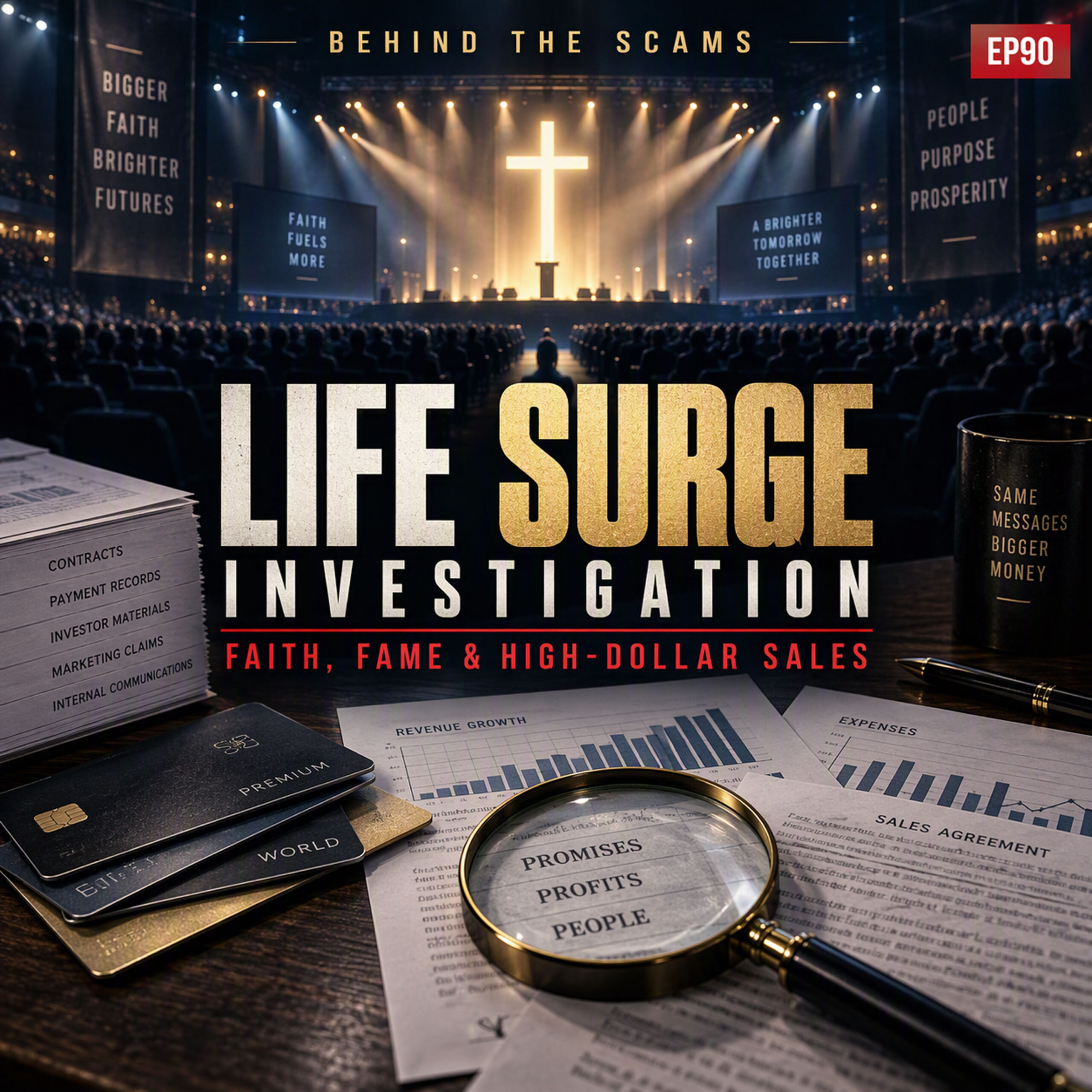
No, Sue, I'm talking about Tim Tebow and his connection to Lifeser. Tebow has appeared as a featured speaker at the company's Faith Centered arena events, and he recently paused that relationship after investigative reporting raised serious questions about the way LifeSearch sells its high priced financial training programs. That is the news and a consumer protection story we are going to unpack.
A $20 ticket gets you through the arena doors inside. Worship music, celebrity testimony, and a message about building wealth for God's purposes.
For some attendees, though, that inexpensive seat is the first step towards spending 10, 20, even $40,000.
Because apparently the nosebleed section is not where the real financial altitude begins.
[00:01:08] Speaker B: $40,000. For that price, I'd expect the course to come with a diploma, a parking space, and possibly a small building.
[00:01:17] Speaker A: At minimum, complimentary parking. But the serious question is this.
Did lifesurge sell financial education on its merits, or did it use faith, fame, and the pressure of the room to move people into purchases they might not otherwise make?
[00:01:34] Speaker B: And how does a $20 afternoon become a five figure financial decision before anyone has time to go home, open a spreadsheet, and ruin the mood?
[00:01:44] Speaker A: This is behind the scams. I'm Nick Henley.
[00:01:47] Speaker B: And I'm Sue Henley.
Today we follow the money through LifeSurge's business model, from the inexpensive arena ticket and celebrity stage to the $97 class, the high dollar training packages and financing arrangements that some customers say left them carrying serious debt.
[00:02:06] Speaker A: Our purpose is not to render a verdict from a podcast studio. It is to establish what is documented, identify what remains disputed, and examine whether the full sales process matched the impression created in the arena.
Disappointing class is not automatically fraud, and aggressive selling is not automatically illegal. LifeSurg says its programs provide real value, enrollment is optional, investing carries risk, and fewer than 3% of ticket purchasers enroll in advanced training. The company has strongly disputed reporting that characterized its practices as predatory or improper. We will include that position as we
[00:02:42] Speaker B: examine the evidence that is the company's account.
To test it, we turn to reporting that went behind the arena production and into the recordings, complaints, contracts, financing, and accounts from people who worked inside the operation, including a joint investigation by Mother Jones and Pablo Torre Finds out okay, back up a second. Who exactly is Pablo Torre?
[00:03:06] Speaker A: He is a sports journalist and the host and executive editor of Pablo Torre Finds out, an investigative podcast and video series known for following sports stories well beyond the scoreboard. Before launching the show, he wrote for Sports Illustrated and NESPN and became known for reporting on money, power and the business behind sports.
For this investigation, Torre's team collaborated with Mother Jones reporter Kira Butler. The sports connection was more than a hook. Wife Surge's stage featured figures such as Tim Tebow and Magic Johnson, who reputations could lend authority to everything that followed their joint report the Gospel of High Yields Asked what happened after the applause, one inspiration gave way to enrollment. Enrollment led to higher priced programs and the price raised. The final question how would customers pay?
[00:03:58] Speaker B: Famous names can become the story very
[00:04:01] Speaker A: quickly, which is why the names are not our starting point.
The paper trail is we identified the companies, reviewed public records and litigation, examined marketing and complaints, and compared accounts from customers and former employees. I kept three columns what LifeSurge promised prominently, what it disclosed less prominently, and what witnesses say happened once a prospect entered the sales process.
[00:04:28] Speaker B: Those columns can describe very different realities.
[00:04:32] Speaker A: The reporting drew on event audio, interviews, complaints and accounts from current and former employees and customers. The Royes Report and other watchdogs separately examined LifeSurge's sales methods and the background of its founder. Together, those sources let us compare the company's public promises with reported experiences and test whether similar complaints reflected isolated disputes or a recurring pattern.
[00:04:57] Speaker B: One complaint can be a disputed transaction. Similar complaints from unrelated people can suggest
[00:05:03] Speaker A: a pattern worth testing exactly A pattern. It's not proof, but it tells investigators where to look at what speakers said on stage, how their credibility was used, what customers were told after buying the first class and who were raised to finance.
Also raises two accountability questions that run through this episode. What did management know about the sales tactics and what would reasonable due diligence have uncovered?
[00:05:29] Speaker B: So we begin not with a $40,000 package, but with a ticket that may cost 20 or $30.
[00:05:36] Speaker A: Picture the arrival.
Families and church friends walk into a major arena. The program may run close to 10 hours and include contemporary Christian music, pastors, comedians, entrepreneurs and a celebrity keynote speaker. LifeSurge says its mission is to inspire, train and equip people to increase their resources and influence for Kingdom Impact.
On its face, that is a lot of entertainment and inspiration for the ticket price.
[00:06:07] Speaker B: The first place to test that question is the ticket itself. If 20 or $30 cannot support a 10 hour arena production, what is the
[00:06:16] Speaker A: event actually built to sell the evidence points downstream. The low price fills the room. The crowd supplies energy and social proof. The long program creates repeated opportunities to move attendees from inspiration to to action.
Worship, prayer, testimony, and applause are not inherently manipulative.
The investigative issue is how those elements function when a financial offer follows them.
[00:06:44] Speaker B: The pitch is not necessarily give money and God will make you rich. It can be more sophisticated. Build wealth so you can serve, give, fund ministry, help your family and create kids.
[00:06:57] Speaker A: Kingdom Impact that framing can fuse an economic decision with moral identity. Wanting more money may feel safeish. Wanting more resources to serve God may feel obedient. Declining the offer can begin to feel like declining growth, stewardship, or a calling.
[00:07:16] Speaker B: The arena becomes more than a building.
[00:07:20] Speaker A: It becomes a psychological frame. A financial claim made in a bank conference room may trigger skepticism. The same claim made between worship songs can borrow credibility from the setting.
[00:07:33] Speaker B: Then add a trusted public figure.
[00:07:35] Speaker A: Tim Tebow has been a marquee speaker at many lifesurge events. His public image combines elite athletics, Christian faith, philanthropy, and motivational speaking.
Other Jones cited commercial estimates placing his speaking fee between 15 $50,000 and $100,000 per appearance. That does not establish what LifeSearch paid him. The contract is not public. LifeSurg has said his composition was not tied to core sales.
[00:08:01] Speaker B: The legal distinction matters, but the audience may still interpret his presence as an endorsement of the organization.
[00:08:09] Speaker A: That is what we call the celebrity shield.
A celebrity does not need to make the technical investment claim. His presence can lower the audience's guard by implying that someone prominent has already examined the organization. The unanswered question is whether that implied assurance was ever supported by meaningful due diligence.
[00:08:28] Speaker B: Reported event audio captured Thiebaud encouraging people who had signed up to finish and follow through on their commitment.
[00:08:36] Speaker A: That sentence alone does not prove he understood every price tier, financing method, or later representation, but it is not passive scenery.
Follow through on that commitment carries weight, especially in a setting where commitment has moral and spiritual meaning.
[00:08:53] Speaker B: Magic Johnson reportedly told an audience that he listened and acted. Again, that does not establish knowledge of later sales practices, but the verbs fit the funnel. Hear the message, then act.
[00:09:07] Speaker A: Responsibility is not binary.
One person may design the funnel, another may close a sale, another may arrange financing, and another may attract the audience.
The questions are what role each person played, what each person knew, and what reasonable diligence would have revealed.
[00:09:26] Speaker B: A 10 hour day also matters. By the later sessions, people may be tired, emotionally elevated, and surrounded by others who are standing, applying, auding or buying.
[00:09:36] Speaker A: Fatigue, authority, scarcity, social proof and commitment are familiar tools of persuasion. Used transparently, they sell ordinary products used in a sacred setting around risky financial strategies. They deserve closer scrutiny.
[00:09:52] Speaker B: Christian Minister John Simmons attended, expecting guidance about financial stewardship. In published accounts, he said the event felt less like a ministry conference and more like a high pressure timeshare presentation.
[00:10:04] Speaker A: That comparison describes a recognizable rhythm. You are welcomed given something valuable, invited to imagine a better future, and then confronted with an urgent offer.
At LifeSurge, events reported stage presentations included demonstrations involving stocks and options. A simulated trade could show a mock profit of thousands of dollars on the arena's giant screens.
[00:10:29] Speaker B: The key word is simulated. A demonstration does not reproduce the experience of trading your own money. It does not show the ren do the panic of a losing position, the tax bill, the transaction costs, or the night you cannot sleep because leverage moved against you.
[00:10:43] Speaker A: The presenter also controls the example, the timing and the assumptions. A complex discipline can be compressed into a clean result. Click here. Choose this strategy. Watch the number turn green. LifeSurge acknowledges that investing carries risk and says it does not promise instant mastery.
The question is whether the total presentation delivered that warning with the same force as the success imagery. A quiet disclosure does not erase a dramatic demonstration.
Consumer protection analysis often considers the overall impression, not merely whether a technically accurate sentence appeared somewhere. What would a reasonable person take away from the entire presentation?
Risk and discipline or easy access to dramatic upside?
[00:11:32] Speaker B: Then comes the first offer, a three day impact class, often presented as a $200 value reduced to about 97 or $99.
[00:11:42] Speaker A: That price is small compared with the apparent opportunity and tiny compared with what may come later. The immediate goal is to convert an attendee into a buyer.
[00:11:53] Speaker B: The first yes.
[00:11:55] Speaker A: Once someone pays, signs and publicly identifies as a person taking action, consistency takes over.
Witnesses describe staff moving through the aisles with handheld card readers. The purchase does not happen. Later, at home with a spouse, a calculator and a search engine, the point of sale comes to the seat Add
[00:12:16] Speaker B: claims that seats are limited or language about taking a step of faith and ordinary caution can be reframed as fear.
[00:12:24] Speaker A: Former attendees and employees describe moments when hesitation was portrayed as the devil putting doubts in someone's mind if that occurred as reported, it is among the most troubling allegations in this story. It does not answer an objection. It attacks the customer's internal warning system.
Prudence becomes spiritual weakness.
A request for time becomes a failure
[00:12:49] Speaker B: of fate for a sincere believer, that can make it very difficult to say
[00:12:53] Speaker A: no doubt is healthy in a financial transaction. It tells you to ask about refunds, total cost credentials, typical outcomes and what happens if the strategy fails?
No salesperson should be allowed to recast those questions as disobedience.
[00:13:11] Speaker B: For most people, the $97 purchase is not where the real financial risk begins.
Many attendees may take the class, learn something and move on. Lifesurge says the class is optional and offers a refund guarantee to people who attend but do not find it valuable. The concern is the higher priced sales process, that the first purchase may open
[00:13:32] Speaker A: a new room, a new relationship, and a much higher ceiling. The arena acquires the customer. The impact class qualifies the prospect.
[00:13:42] Speaker B: Put that in human terms, that's easy.
[00:13:45] Speaker A: So just imagine a hypothetical attendee named David.
He's a composite, not a specific victim. David and his wife see an ad featuring people they recognize.
The ticket costs less than dinner. They enjoy the music and hear credible speakers discuss perseverance, responsibility and service.
Those messages may be sincere.
[00:14:06] Speaker B: Later, a financial presenter takes the stage. David does not perceive a hard boundary between the trusted keynote and the sales presentation. It is one program, one logo, one arena.
[00:14:18] Speaker A: A simulated trade appears to work. The crowd reacts. A limited offer is announced.
Staff enter the aisles. David notices the couple beside him buying. He is tired, inspired, and afraid of missing an opportunity. He pays $97.
Too little, he thinks, to require a family summit.
[00:14:40] Speaker B: I mean, he's vulnerable in that room, surrounded by all that, that engineered energy and that price point that. That's no accident. It's specifically chosen to feel low enough to avoid, you know, like a real serious pause for spousal approval or anything of that sort.
Yeah, it's the small but slippery slope into to really what is going to be his, his own undoing. At the Glass, instructors provide enough information to show both possibility and complexity. Then someone called a mentor asks about David's goals, retirement, family, and obstacles.
[00:15:19] Speaker A: Those questions can be appropriate in genuine counseling, but the role must be clear. Is this person a fiduciary licensed advisor, an educator, or a salesperson? Does that person benefit if David enrolls? What information is being collected and for whose benefit?
[00:15:38] Speaker B: How much do you have in savings? Sounds different when asked by a mentor than when asked by a closer.
[00:15:44] Speaker A: Exactly. A mentor implies alignment and protection. An enrollment specialist signals a commercial transaction. According to the joint investigation and accounts from former customers and employees, advance packages could rise from roughly 10,000 to $13,000, to $20,000 or $25,000, and then to 40 or $50,000 for higher level or one on one mentorship offerings and prices may vary, but the jump is unmistakable.
[00:16:14] Speaker B: From $97 to the price of a car.
[00:16:18] Speaker A: Once the price exceeds available cash, the conversation turns to liquidity. Savings credit scores CART limits home equity retirement funds. A legitimate educator asks what a student needs to learn.
The closer asks what the student can access.
[00:16:34] Speaker B: Former customers describe smaller conversations where hesitation triggered questions about dreams, family, and the cost of doing nothing. Those questions can sound compassionate while locating emotional pressure points.
[00:16:47] Speaker A: Ethical Sales requires room for an unpressured no. If a couple says it wants to go home, pray, review the contract or compare alternatives, the pitch should stop.
Any offer that cannot survive 24 hours of scrutiny should not receive $40,000 in one afternoon.
[00:17:05] Speaker B: Some sessions reportedly displayed risk disclosures stating that the average person earns little or no money and may lose money.
[00:17:14] Speaker A: Those disclosures matter, but they must be compared with the spoken message. How large was the warning? How long was it shown? Was it read aloud? Were testimonials identified as atypical? Did staff later contradict it?
A disclaimer is not a Magic Eraser.
[00:17:30] Speaker B: LifeSurge says. Investing is a skill built over time. Advanced training is chosen by only a small fraction of ticket buyers, and faith is not used as a coercive sales tool. That response gives us a specific claim to test whether the sales practices described by customers and former employees were isolated, conduct or part of a pattern management, measured, rewarded, polarited, corrected or ignored.
[00:17:58] Speaker A: We test a debt defense against the available record. The compliance question is not confined to written policy.
Investigators also ask what conduct managers measured, rewarded, tolerated, corrected or ignored and whether the same complaints appeared often enough. That leadership should have recognized a pattern.
[00:18:17] Speaker B: What happened when the customer said, I cannot afford?
[00:18:20] Speaker A: This reporting describes a third party financing broker called Copper Rock Financial.
Customers and former employees alleged that some buyers were guided toward multiple credit cards, sometimes called credit card stacking or toward home equity lines of credit. Others described retirement funds entering the conversation.
[00:18:41] Speaker B: Credit card stacking means using or opening several cards to assemble enough credit for one large purchase. A home equity line borrows against the house. A retirement loan or withdrawal reaches into money intended for later life. Each method transforms tuition into a broader financial risk.
[00:19:00] Speaker A: Interest compounds, promotional rates expire Ms. Payments can increase costs. A home equity line puts the house in the equation. Retirement withdrawals may create taxes, penalties and lost growth. None of that disappears because a motivational speaker predicts success.
[00:19:18] Speaker B: The product may be presented as the means to repay the debt used by it.
[00:19:24] Speaker A: That circular logic is a red flag. Affordability should be tested on the assumption that the course produces no income. If the customer can pay only if a speculative strategy works, the customer cannot safely afford the purchase.
[00:19:38] Speaker B: Using credit is not by itself evidence of fraud. People finance education and businesses every day.
[00:19:45] Speaker A: Correct Financing alone does not establish misconduct. What matters is the process. Were representative outcomes provided before the debt was incurred? Were risks given the same prominence as success stories? Was the financing broker independent or embedded in the sales operation? Investigators would also want to know who was compensated, what each party knew, and whether any applicant was encouraged to present misleading financial information.
Those are not questions of tone or interpretation. They are questions records can answer.
[00:20:17] Speaker B: What outcomes should a buyer demand?
[00:20:19] Speaker A: Not the best testimonial or the mock trade. Ask for completion rates, average and median results, and the number of students who lost money. Subtract tuition, interest, software, travel, taxes, trading losses and and time without the denominator. Testimonials are marketing, not proof.
[00:20:38] Speaker B: There is a moment in many extractive systems when the customer stops thinking, I bought a product and starts thinking I have to make this work because I cannot afford for it not to.
[00:20:50] Speaker A: That is the sunk cost trap. Debt becomes a reason to commit more deeply. If results do not appear, the customer may blame personal effort rather than the original promise.
Another tool, another mentorship or another upgrade may seem like the missing piece.
Failure becomes personal while revenue remains institutional.
[00:21:11] Speaker B: JAME can keep people silent A churchgoing couple may not want to admit that a faith branded event led to debt. They may fear being judged for greed, gullibility or insufficient faith.
[00:21:24] Speaker A: That silence protects the funnel.
So let us say this Asking for evidence is not cynicism. Refusing an urgent financial decision is not spiritual failure.
Walking away is not disobedience.
[00:21:40] Speaker B: You also examined the corporate history behind LifeSurge.
[00:21:44] Speaker A: Yes, we reviewed the corporate history because prior ventures can reveal people, methods and risk signals that deserve scrutiny. Public reporting has connected founder Joe Johnson to Wealth Rock, Get Motivated and Wealth ont. In a 2013 civil complaint, an investor alleged that he had loaned $12 million to help acquire and operate GetMotivated. Donson and related entities were named as defendants. Then, in August 2026, a federal court entered a permanent injunction by stipulation in a civil case involving bargain sale real estate transactions tied to wealth on Johnson admitted no wrongdoing and lifesurge was not a defendant. Those qualifications matter. So does the history.
[00:22:26] Speaker B: The investigation also identified executives with ties to Online trading academy.
[00:22:32] Speaker A: In 2020, the Federal Trade Commission announced a settlement involving Online Trading Academy that required debt forgiveness for thousands of consumers and payments and asset transfers from its founder and other individuals.
In 2021, the FTC said it was returning more than $5.4 million to more than 31,000 consumers.
Prior employment does not prove present misconduct. It does, however, make experience and sales architecture legitimate subjects for scrutiny.
[00:23:01] Speaker B: What should investigators look for?
[00:23:03] Speaker A: Investigators look for repetition, the same scripts, job titles, financing channels, objection handling language, refund disputes and sales metric. When methods recur across organizations, the resemblance becomes a lead, one that should be tested against documents and testimony.
[00:23:21] Speaker B: And what about the celebrities?
[00:23:23] Speaker A: Thibaut's decision to step back is not a finding of guilt, but it sharpens the larger accountability question. What due diligence should a paid speaker conduct before lending credibility to a company's event?
LifeSurge's chief executive says the company strongly disagrees with the the reporting's characterization and will not apologize for its beliefs or its work. Both points matter as we separate reputational consequences from evidence of misconduct.
[00:23:49] Speaker B: What would a safer process look like?
[00:23:52] Speaker A: Separate inspiration from solicitation Tell ticket buyers in advance that the program includes sales presentations. Identify compensated endorsers, provide representative outcomes, not only success stories.
Disclose the complete price and refund terms before the event.
Require a meaningful cooling off period for high dollar packages.
Do not use spiritual claims to overcome objections, do not collect credit capacity through people presented as pastoral mentors and never recommend debt on the assumption that speculative profits will repay.
[00:24:26] Speaker B: Those safeguards would not prevent adults from purchasing expensive education.
[00:24:31] Speaker A: They would also create an evidentiary test. If the education has measurable value, it should withstand disclosure, comparison, a cooling off period and an unpressured no.
If the transaction depends on atmosphere urgency or borrowed trust that tells us something important about what is really being sold.
[00:24:50] Speaker B: If someone listening has attended a lifesearch event or class, worked for the company, or was offered financing, what should that person do?
[00:24:59] Speaker A: Preserve records, contracts, emails, text messages, screenshots, advertisements, credit applications, refund communications and recordings made lawful.
Do not post account numbers or other private information public if you believe you were misled, consider speaking with an independent attorney, a state consumer protection office or the appropriate regulator.
You can also contact the behind the Scams team through the secure tip
[email protected]
[00:25:29] Speaker B: and before making any major financial decision, slow it down.
[00:25:34] Speaker A: Speak with an independent licensed professional who is not paid by the seller. Get the total cost in writing. Ask for typical outcomes and ask what happens if you earn nothing?
Take the contract home. Sleep on it. If the opportunity depends on faith in the salesperson rather than evidence about the product, Step away now.
[00:25:54] Speaker B: Hopefully listeners got some good takeaways from this episode. Remember that just because a brochure or website has a bunch of glossy photos of some famous faces does not validate what you are paying for and what you will be getting on that not. I'm Sue Henley. It is time to say goodbye. We will see you on our next episode.
[00:26:15] Speaker A: Great clothes as always, Sue. You always happen to steal my thunder. That's it. I'm going to take over the script writing process. I want to be able to close it with one of those fantastic sign offs. Hope you don't mind. Anyways, I'm Nick Henley and this is behind the Scams.
Behind the Scams is produced by the SOS Media Network, a registered, not for profit organization. This episode is for news and educational purposes and does not provide legal, tax or investment advice. Allegations discussed in this episode remain allegations unless established by a court or or acknowledged by the party involved. We invite responses from the organizations and people named in this episode. We always care about fair and balanced reporting. Bye for now.