[00:00:00] Speaker A: Imagine the phone rings on a Tuesday morning.
You recognize the number.
You recognize the name on the screen.
And then you hear the voice.
Your financial advisor's voice.
Same cadence, same little pause before explaining a term.
Same calm way of moving from market noise to long term planning.
[00:00:22] Speaker B: And he's not asking you to do something wild. He's not promising magic Internet money or a secret fortune overseas. He's talking about a bond ally application. He's using the language you've heard in planning meetings. Secure, conservative, time sensitive, suitable for your retirement horizon.
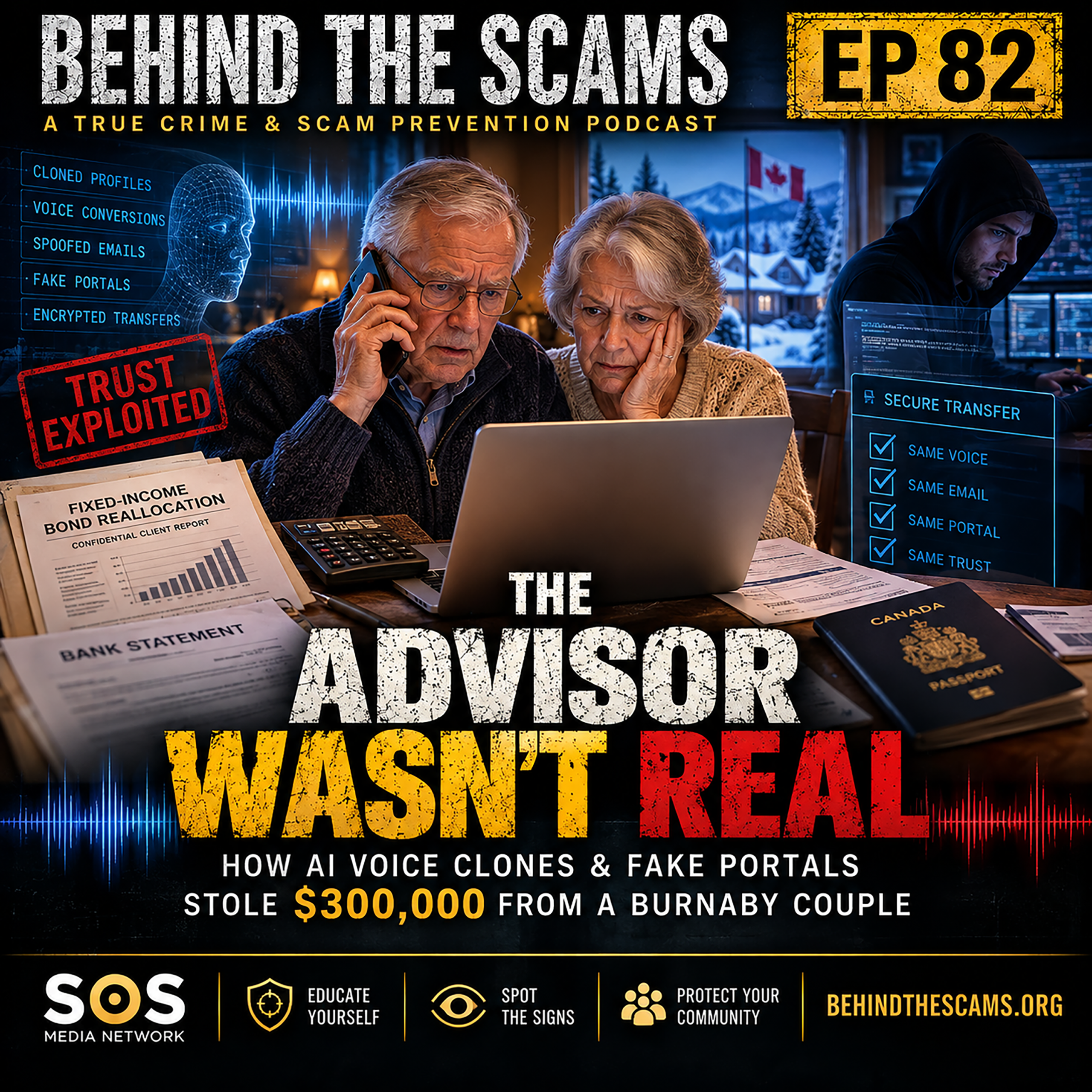
[00:00:41] Speaker A: But the man on the phone is not your advisor. The email that came before the call did not come from your advisor. The portal you logged into was not your bank. And by the time the realization hits $300,000, 30 years of retirement savings has been routed out of Burnaby, British Columbia, through accounts designed to go cold before investigators can get a grip on them.
[00:01:08] Speaker B: This episode is about the death of the old red flags. For years, people were told to look for broken English, strange punctuation, suspicious attachments and wild promises.
But what happens when the scam arrives with no spelling mistakes, no obvious pressure, and no cartoon villain on the other end?
[00:01:31] Speaker A: Then you are no longer dealing with a sloppy fraud attempt. You are dealing with impersonation as a craft.
You are dealing with reconnaissance, spoofed infrastructure, synthetic voice, and a victim selected because the criminals already knew what would sound normal.
[00:01:49] Speaker B: And we want to be very careful about something here.
The person in Burnaby was not foolish. They were not greedy. They were not careless. They were targeted by a machine built version of trust.
[00:02:03] Speaker A: In the public Burnaby case, police described the victims as a senior couple, both in their 80s.
That detail is important, but not because age equals gullibility.
It matters because by the time someone is in their 80s, $300,000 may not be recoverable through work, bonuses, a new job, or a second career.
That money is not abstract. It may be the roof, medication, home care, groceries, property taxes, and dignity.
[00:02:38] Speaker B: And it is also the emotional architecture of old age. It is the promise someone made to themselves after decades of working. I will not be a burden a I will be able to stay in my home. I will be able to help a spouse if their health changes. A scam like this does not just steal money, it steals choices.
[00:03:01] Speaker A: The first touch was an email, not a crude message dumped into a spam folder. It looked like normal correspondence from the victim's advisor.
Same structure, same greeting, same signature block, same compliance language at the bottom.
That matters because most people do not authenticate an email by examining every hidden technical marker. They authenticate it by pattern recognition.
[00:03:29] Speaker B: And pattern recognition is exactly what keeps everyday life moving. You know what your doctor's office sounds like. You know how your bank formats a notice. You know how your advisor signs off.
The fraudsters weren't trying to shock the victim. They were trying to disappear into the victim's normal routine.
[00:03:50] Speaker A: Exactly. And if anyone listening thinks they personally inspect every email header before breakfast, I admire the confidence.
I also do not believe you.
[00:04:00] Speaker B: Nick reads email headers the way other people read cereal boxes.
[00:04:04] Speaker A: That is because cereal boxes rarely hide a malicious sender domain.
Although some of those prize offers were suspicious. That takes homework.
Before the ask came, someone likely studied the Advisor's public footprint. LinkedIn posts, webinar appearances, firm bios, downloadable PDFs, maybe prior newsletters. They copied terminology from the wealth management world. Fixed income allocation window, risk adjusted yield, registered accounts settlement instructions.
The language gave the request institutional gravity.
[00:04:44] Speaker B: The email also matched the victim's life stage. It did not say get rich overnight. It said, in effect, this may fit your retirement income plan. That is colder and more manipulative because it weaponizes prudence.
It turns the victim's responsible behavior into the doorway.
[00:05:06] Speaker A: The Canadian Anti Fraud center has been warning that deception, urgency, impersonation and established trust are recurring hallmarks of modern fraud. And its 2026 Mid Year Trends showed Canadians reported about 351 million in losses in just the first six months, with investment fraud again leading the dollar loss category. Let's slow the tape down.
In a real Burnaby warning issued by the RCMP, the victims were an elderly couple in their 80s. They reported the fraud on January 28th after being contacted by someone claiming to be an RCMP officer.
The caller told them their bank account had been hacked and and instructed them to move funds somewhere safe over several weeks. The money moved out through multiple deposits and the victims were told not to contact police.
That public case was a police impersonation fraud, not the exact advisor clone scenario we're dramatizing here. But it gives us the bones of what modern fraud looks like in Burnaby. Repetition, isolation, authority and time.
[00:06:25] Speaker B: One thing we should say clearly in the public reporting I found the victims themselves are not quoted, their names are not released and we do not hear their own words.
What we do have is the police description of what they reported and the RCMP's public characterization of the crime.
[00:06:46] Speaker A: Burnaby RCMP said the couple reported that they had been contacted by someone claiming to be an RCMP officer.
Police said the fraudster told them their bank had been hacked and advised them to transfer their funds elsewhere.
That phrasing matters because it shows how the scammer framed the theft as protection.
[00:07:06] Speaker B: The RCMP also said the seniors eventually became suspicious and contacted their bank, which advised them to file a police report.
There is a whole emotional story inside that one official sentence, the moment doubt finally breaks through, the decision to reach out, and then the devastating confirmation that what had been presented as safety was fraud.
[00:07:31] Speaker A: And Cpl. Mike Collange, the Burnaby RCMP media relations officer, called it really despicable when fraudsters use manipulative tactics to prey upon people, particularly seniors. He also reminded the public that police or a bank will never contact you and tell you to transfer money.
That is the clearest official quote we have. And it belongs in the episode because it gives listeners an authority backed rule they can remember.
[00:08:01] Speaker B: Picture the couple at the kitchen table, not in a dramatic movie scene, but in the ordinary place where people pay bills and sort mail. One person may be writing down instructions, the other may be listening on speakerphone. They are trying to do the right thing. They have been told their bank account is in danger. They have been told the person helping them is law enforcement. Their instinct is not recklessness. Their instinct is compliance with authority.
[00:08:30] Speaker A: The repeated deposits matter because each transaction becomes a psychological commitment.
After the first transfer, the victim is invested in the explanation being true.
After the second, it becomes harder to stop and say, maybe I've been deceived.
Fraudsters know this. They build momentum. They make the next step feel like the only way to protect the previous step.
[00:08:56] Speaker B: And when gift cards enter the story, many listeners may think that would be the giveaway.
But by then, fear and authority may already be doing the work. The victim is not evaluating a payment method in isolation. They are trying to obey a supposedly official process under pressure while being told not to ask outsiders for help. And those bones matter.
A lot of people still picture fraud as one dramatic phone call. But the Burnaby case stretched over weeks.
That means the victims had more than one chance to wonder if something felt wrong. And the fraudsters had more than one chance to reassure them, redirect them, and keep them away from anyone who might interrupt the spell.
[00:09:43] Speaker A: Now translate that into the cloned advisor version. The first email does not demand money.
It opens the door.
It might say the advisor has been reviewing fixed income options for clients nearing or already in retirement.
It may reference preservation of capital, laddering maturity dates, or reducing exposure to equity volatility.
Those are normal concepts inside a legitimate retirement conversation.
The criminal wants the victim thinking, this sounds like what we've already discussed the detail.
[00:10:21] Speaker B: That chills me is the lack of friction. The email might include the advisor's assistant's name.
It might list the branch address.
It might use the same privacy footer. It might even mention something broad but personal, sounding like your income needs. Over the next few years, nothing has to be stolen from a bank to make that sound believable. A lot of it can be inferred from age, public records, social media and prior breached data.
So when people say I would have known, I always want to pause. Would you have known if the message contained details from your real account relationship? Would you have known if the tone matched your advisor? Would you have known if the next step was a scheduled phone call from the voice you trusted?
[00:11:14] Speaker A: The call is where the case changes. In the old playbook, if you were uncertain about an email, you picked up the phone. But now the phone can be part of the attack.
Voice cloning tools can generate convincing speech from very short samples, sometimes described in public reporting as only a few seconds and in other practical settings as 30 seconds to several minutes, depending on the quality demanded.
[00:11:44] Speaker B: And the samples are everywhere now. A conference panel, a client webinar, a podcast guest appearance, a voicemail greeting, a short video posted by a firm to build credibility with clients. The same material that makes a professional accessible can become raw material for impersonation.
[00:12:04] Speaker A: Let me put the technology in plain English. A voice clone is not a recording spliced together word by word.
The scammer does not need the real advisor to have said move $300,000 today.
They only need enough audio for the software to learn what that advisor generally sounds like.
The system studies pitch, pace, accent rhythm, vowel sounds, breath patterns, and the little habits that make a voice recognizable.
[00:12:38] Speaker B: So it is almost like the program builds a voice costume.
[00:12:41] Speaker A: Exactly. A mathematical costume.
The software turns the sample into a voice profile, then the criminal types a script and the system speaks that script in the target's voice.
That is text to speech cloning. There is also voice conversion where the scammer talks live and the software transforms the scammer's voice into the cloned voice in near real time.
That second version is especially useful for a phone conversation because it allows the fraudster to answer questions instead of just playing a pre recorded message.
[00:13:23] Speaker B: And how much audio do they really need because people hear numbers all over the place.
[00:13:28] Speaker A: The honest answer is it depends.
Some consumer facing tools and security reports warn that a few seconds of clear speech can be enough to create a basic clone. And while a longer cleaner sample usually produces a more convincing result.
Three seconds might capture the rough sound of a person.
Thirty seconds, a minute or several minutes can capture more of the rhythm, emphasis and natural variation.
So when an advisor has public webinars, podcast clips, conference introductions, or market update videos online that can provide plenty of raw material.
[00:14:08] Speaker B: That means the scary part is not just the technology.
It is the combination of technology and context. The voice sounds right and the story sounds like something that person might actually say.
[00:14:22] Speaker A: That is the expert takeaway. A cloned voice by itself may not fool you for long if the script is ridiculous. But a cloned voice paired with a spoofed email, real industry language, a familiar caller ID, and a plausible investment conversation creates what I call stacked authenticity.
Each layer makes the next layer easier to believe.
[00:14:50] Speaker B: And people should not assume they will hear a robotic glitch, right?
[00:14:54] Speaker A: Audio quality is no longer reliable as your warning system.
A scam call may sound slightly compressed because it is traveling over a phone network anyway. Small delays can be blamed on bad reception. Odd phrasing can be explained away as stress, age, travel, or a busy office.
The safer question is not does this sound real?
The safer question is is this person asking me to move money, reveal credentials, or bypass normal procedure?
[00:15:27] Speaker B: There is another piece we should explain because it sounds almost impossible at first. How could a scammer keep up if the victim switches between French and English on the phone?
[00:15:37] Speaker A: Ten years ago, that would have been a much bigger barrier. Today it can be handled with a stack of tools.
The call audio can be turned into text almost instantly.
If the victim speaks French, the words can be transcribed and translated into English on the operator's screen. The operator can understand the question, choose or type a response, and then translation software can turn the reply back into French.
[00:16:09] Speaker B: So the person running the scam may not actually be bilingual in the way the victim thinks they are correct.
[00:16:15] Speaker A: They may be reading translated text using prepared bilingual scripts or relying on an AI assistant to suggest answers. Then the answer can be spoken through a cloned voice or a voice conversion tool.
In simple terms, the scammer is not personally doing all the work.
One tool listens, one tool translates, one tool helps craft the reply. One tool makes the voice sound like the trusted person and over a phone line.
[00:16:44] Speaker B: Small delays may not feel suspicious.
People already tolerate pauses, bad reception, speakerphone echo, and someone saying, let me pull that up, those little gaps. Give the operator a few seconds to read the translated question and decide what to say next.
[00:17:04] Speaker A: That is why language fluency is no longer the protection people think it is.
A bilingual victim may ask a challenge Question in French and hear a plausible answer in French. The safer test is not whether the caller can keep up linguistically. The safer test is whether the caller is asking for money, credentials, secrecy, urgency, or a change in normal process.
[00:17:30] Speaker B: Give me a realistic example of that, because I think people need to hear how ordinary it could sound.
[00:17:36] Speaker A: Say. The victim asks in French, esque se guarantee parla banc? The scammer's system transcribes that, translates it as, is this guaranteed by the bank? And the operator sees the meaning on screen. The reply does not have to be perfect legal French. It just has to sound plausible. It is held through the institution's secure settlement process, and I'll send the documentation through the portal.
That kind of answer does two things. It avoids a direct guarantee, and it moves the victim back toward the fake portal.
[00:18:15] Speaker B: Nick, your basic grasp of French is what first attracted me to you. That pickup line you used when we first met sounded so romantic in French. Then you translated it into English, and honestly, the spell wore off a little bit.
[00:18:31] Speaker A: That is unfair. I believe the line was es que tempere et un voleurs parc la volait les etoiles du ciel pour les matre danste yeux. Which, yes, sounds better before you translate it as, is your dad a thief because he stole the stars and put them in your eyes?
[00:18:49] Speaker B: In English, that is definitely less romantic and definitely straight from one of those how to pick up women guides from the 90s.
[00:18:58] Speaker A: Fine, but it worked.
[00:18:59] Speaker B: It worked because I was young, hopeful, and apparently vulnerable to poor translation.
[00:19:03] Speaker A: Which is why, professionally speaking, romance should always include independent verification.
[00:19:10] Speaker B: Back to work. So what if the victim switches to English?
[00:19:13] Speaker A: Good question. And the answer is scary, because now the system can follow the switch.
The operator may see a rolling transcript where one line is French, the next is English, and both appear in the operator's preferred language.
So the victim says, I'm not comfortable wiring the full amount today. And the operator sees that concern almost instantly. The AI assistant may suggest a softer response. I understand completely. We can start with the initial allocation and finalize the rest after the secure verification step.
Again, it sounds reassuring while preserving the scam's momentum.
[00:19:57] Speaker B: That is chilling, because the scammer does not need to win every sentence. They only need to keep the conversation from breaking.
[00:20:04] Speaker A: Exactly. The technology gives them recovery time. If the victim asks something unexpected. Did we discuss this at my last appointment? The operator can stall, naturally.
Let me open your file. Or I'm just checking the notes. That buys five or 10 seconds. In those seconds, the operator can read the Transcript, Search the stolen or inferred profile and respond with a broad answer that feels personal without being too specific.
[00:20:36] Speaker B: So the delay itself gets disguised as professionalism, Right?
[00:20:41] Speaker A: Real professionals pause. They look things up, they reread notes, they say, I want to make sure I'm giving you the right information.
A scammer can mimic that rhythm. And if the cloned voice is imperfect, bilingual switching can actually help hide it, because accents, code switching and translated phrasing already create normal variation in speech.
[00:21:07] Speaker B: What about challenge questions? A lot of families tell loved ones ask something only the real person would know.
[00:21:13] Speaker A: That can still help, but it has to be used carefully.
If the answer is something searchable, guessable, or sitting in an email thread, it is not a strong challenge.
What is my daughter's name?
Maybe in social media.
What did we discuss last spring?
Maybe in a compromised inbox.
A stronger test is procedural.
I'm going to hang up and call your main office number from my paper statement.
A real advisor should welcome that. A scammer will try to keep you on the line.
[00:21:49] Speaker B: So in a bilingual call, the warning sign may not be the language, it may be the resistance to verification.
[00:21:55] Speaker A: Exactly. If the caller says there is no time, do not involve anyone else.
Use this link or stay on the phone while you complete it.
That is the alarm bell. The fraudster can translate vocabulary. They can fake a voice, they can spoof a number. What they cannot survive is the victim leaving their controlled channel and contacting the institution independently on the phone. The pitch was designed to feel conservative, not reckless.
A secure high yield bond allocation closing in 48 hours.
Maybe municipal, maybe corporate. The kind of language that sounds boring enough to be safe.
Scammers understand that retirees are not necessarily chasing risk. They are often trying to preserve principle while generating income.
[00:22:50] Speaker B: The urgency is carefully framed. Not do this or you'll be arrested. Not your account is frozen. It is more sophisticated. This allocation is limited. I thought of you because it fits the income conversation we've been having.
That is a different emotional lever. It flatters the victim while making hesitation feel like a missed, responsible opportunity.
[00:23:17] Speaker A: Then comes the portal. This is the evil twin. The victim clicks through to what appears to be the legitimate financial institution. The colors are right, the login flow is right. Even the two factor prompt may appear. But the site is controlled by the criminals or routed through a reverse proxy in an adversary in the middle attack. The fake site relays the login to the real site in real time, harvests the password, captures the session token after two factor authentication, and gives the attacker access without needing to break the bank's encryption, here's how the fake portal probably behaved. From the victim's chair, the page loads cleanly. There is a familiar logo. The login box is placed where it usually appears. Maybe there is a banner about enhanced security.
The victim enters a username and password. Then comes the one time code. The phone buzzes. The code arrives. The victim types it in. On the screen there may be a spinning wheel. Then a harmless looking notice.
Session verification complete. Or advisor document package loading. Behind the curtain, the credential and session are already being relayed.
[00:24:36] Speaker B: And because the screen does not explode, the because there is no warning siren, the victim may feel reassured.
The very act that should create safety two factor authentication becomes part of the theater. That is why this is so cruel. The scam teaches the victim to trust each next step by imitating all the steps security professionals have taught them to expect.
[00:25:04] Speaker A: The wire instructions would likely be dressed up too.
Not send money to a stranger.
More like subscription account, custodial settlement or temporary treasury allocation.
The beneficiary name might be a numbered company or a legitimate looking investment entity. If the fraudsters have done their homework, the first transfer may be smaller, framed as a reservation or settlement deposit.
Once that clears, the pressure shifts. The full allocation has to be funded before the window closes.
[00:25:44] Speaker B: That is the part that scares people. They did what they were trained to do. They used the portal, they entered the code, they saw screens that looked familiar. And yet the act of logging in securely was being performed inside the trap.
[00:26:02] Speaker A: If I were looking at this as an investigator, I would start with the communication trail. Was the email account actually compromised or was the display name spoofed? Did the message pass spf, dkim and DMARC checks? Or did it exploit a weak configuration? Was there a lookalike domain? One extra letter, A different top level domain, A Unicode character that looks normal at a glance?
[00:26:30] Speaker B: And while investigators are chasing headers and domains, the victim is sitting with the worst kind of silence. The account balance is gone. The phone number no longer answers. The person they thought they were speaking to never made the call.
That kind of betrayal can isolate people immediately. The discovery is its own trauma. There is the moment the bank employee says, you need to file a police report. And suddenly the story flips. The person who sounded official is not official. The safe account is not safe. The secrecy was not protection. It was a cage.
[00:27:12] Speaker A: And from that point forward, the victim is often forced to relive the crime in fragments. With the bank, with police, with family, with insurance, if any exists, with elder Support agencies, sometimes with adult children who are scared and angry.
Every retelling can feel like cross examination, even when people are trying to help.
[00:27:36] Speaker B: That is where shame gets dangerous. Shame whispers, do not tell anyone. Shame says, you should have known. Shame says, if your children find out, they'll think you can't manage your life. But isolation is is exactly what fraudsters depend on before, during, and after the scam. Emotional recovery starts with one hard truth. The victim has to be allowed to be a victim. Not a punchline, not a cautionary tale at the dinner table, not the family story everyone whispers about.
A person who loses retirement savings to fraud is already replaying every decision in their head. They do not need more shame poured onto the wound.
[00:28:22] Speaker A: That replaying is real.
Victims often go back to the first email, the first call, the first moment something might have felt slightly off.
They ask themselves why they did not stop it.
But that question can become a trap because it assumes the con was obvious from the inside. It usually was not from the inside. The scam was designed to feel consistent, official and urgent.
[00:28:51] Speaker B: Recovery then, is not just getting over it. It is rebuilding a sense of safety in ordinary systems. Answering the phone, opening email, logging into a bank account, speaking with an advisor, even checking the mailbox.
After a sophisticated scam, the world can start to feel rigged. Every contact feels suspect. Every decision feels dangerous.
[00:29:16] Speaker A: One of the most useful things families can do is separate emotional recovery from financial recovery. The bank investigation may take time.
Police may not have immediate answers.
Funds may or may not be recovered, but the person's emotional stabilization cannot wait for the case. Outcome. Sleep, meals, medication routines, companionship.
Those are part of the response, too.
[00:29:44] Speaker B: And the language matters. Instead of, how could you fall for this? Try, they targeted you. Instead of why didn't you call me? Try, let's make a plan so you never have to handle something like this alone again. Instead of taking over every account and every password, immediately ask what support would help them feel safe without making them feel erased.
[00:30:09] Speaker A: I have seen victims who were meticulous record keepers, successful professionals, former executives, teachers, nurses, engineers, people who managed households, businesses and complicated lives.
Fraud does not require stupidity. It requires a criminal who understands timing, pressure, trust, and the point at which a person is most likely to follow instructions.
[00:30:38] Speaker B: For an older couple, the practical effects can be immediate. Do they postpone needed dental work? Cancel travel to see grandchildren? Delay home repairs? Sell something they plan to keep? If one spouse needs care later, does the other spouse now worry there will not be enough?
These are not split spreadsheet questions. They are quality of life questions the
[00:31:01] Speaker A: money movement is usually built for speed and distance. Funds may go through mule accounts, shell entities, cryptocurrency ramps, or overseas beneficiaries. Each hop buys time. Each delay reduces recovery odds. That is why the first 24 hours after a fraudulent transfer matter so much in the digital trail.
I would also look for a domain registered shortly before the first contact, hosting infrastructure hidden behind privacy services, and a phishing page that was live just long enough to harvest credentials and then disappear.
I would subpoena payment rails where possible, preserve server logs if they still exist, and look for overlapping infrastructure with other cases.
Same registrar, same hosting provider, same mule account, same template language I know you
[00:31:56] Speaker B: just used the word registrar and half our listeners either nodded wisely or reached for coffee Fair.
[00:32:03] Speaker A: In plain English, I want to know who rented the Internet address, where it was parked, how long it existed, and whether it has fingerprints from other scams.
Less glamorous than television. Makes it look more spreadsheets, fewer car chases.
[00:32:21] Speaker B: So your dream detective show is mostly domain records and bad coffee.
[00:32:25] Speaker A: Bad coffee solves more cases than people realize.
[00:32:28] Speaker B: So when listeners ask who is actually doing this, is there a straight answer?
[00:32:33] Speaker A: There is not one straight answer, and we should be careful not to overstate what we know. In this Burnaby case, public reporting does not identify the offenders or prove whether they were operating from Southeast Asia, West Africa, Canada, Europe or somewhere else. What we can say is that modern fraud is usually transnational.
The person making the call may not be the person who built the portal. The person receiving the money may not be the organizer. The organizer may rent tools, buy stolen data, hire callers, and move funds through mule accounts in several countries.
[00:33:14] Speaker B: So it is less like one scammer with a laptop and more like a supply chain.
[00:33:19] Speaker A: Exactly. Investigators now see a criminal ecosystem in Southeast Asia. Law enforcement and United nations reporting have described large scam compounds in places such as Cambodia, Laos, Myanmar and the Philippines. Some are tied to organized criminal groups and human trafficking, with workers coerced into running investment scams, romance scams, voice phishing and crypto fraud.
Interpol has described these scam centers as a global crisis, and UN reporting has called Southeast Asia a major hub for the industrialized scam economy.
[00:34:01] Speaker B: That adds another layer of tragedy. There can be victims on both ends, the retiree losing life savings and trafficked workers forced to sit in a compound and run scripts under threat.
[00:34:14] Speaker A: West Africa is also part of the global fraud picture, particularly in cyber enabled financial crime business email compromise, romance scams, cryptocurrency schemes and money laundering.
Interpol Operations targeting West African organized crime groups, including groups such as Black Axe, have linked those networks to a significant share of global cyber enabled financial fraud.
More recent reporting also suggests West Africa may be emerging as a potential hub for online scam centers, not replacing Southeast Asia, but adding another node to the map.
[00:34:55] Speaker B: And then there are local pieces. Someone may open a bank account in Canada.
Someone may receive funds domestically.
Someone may advertise mule accounts online.
Someone may provide a Canadian phone number or a spoofed caller id.
That local footprint can make the scam feel close to home, even when the command structure is overseas.
[00:35:19] Speaker A: That is why I avoid saying this came from X country unless the evidence proves it. The smarter investigative frame is role based.
Who harvested the data? Who registered the domain? Who cloned the voice? Who made the call?
Who controlled the mule account?
Who laundered the funds?
In a sophisticated case, those may be five different people in five different places connected through encrypted chats, crime forums, broker relationships and money laundering channels.
[00:35:55] Speaker B: The human timeline is just as important. There is the first moment of trust, then the first transfer, then the follow up call, then the second transfer. Then the instruction not to talk to anyone because the opportunity is confidential or because the account is under security review or because previous premature disclosure could interfere with the transaction. Isolation is not incidental. It is a tool.
[00:36:21] Speaker A: The moment a fraudster says do not contact your bank, do not call police, do not talk to your family, or only communicate through me, that is not privacy, that is containment.
Investigators see it again and again.
The criminal is trying to remove the victim from every real world relationship that could challenge the lie.
[00:36:46] Speaker B: And families have to be careful in the aftermath. The first conversation should not sound like a trial. It should sound like triage. What happened? What accounts are involved? What can we still freeze? What passwords need to be changed? Who has been notified?
A victim who feels judged may stop sharing information at the exact moment. Everyone needs clarity.
[00:37:11] Speaker A: The first family conversation often starts badly because everyone is scared. An adult child hears mom and dad lost $300,000. And the first words out may be what? How? Why didn't you call me?
Those are human reactions, but they can land like accusations.
The victim may already be bracing for the moment their family sees them differently.
[00:37:37] Speaker B: A better first response sounds more like I'm so sorry this happened. We're going to handle the urgent steps first. You are not alone.
That sentence does three things. It names the harm, it lowers the temperature, and it tells the victim they are still part of the family team, not the person who created a family emergency.
[00:38:02] Speaker A: Then the family needs to move into fax without interrogation. Build a timeline together. When was the first contact? Was it email, phone, text or a portal? What number called? What link was clicked? Which accounts were accessed? Which transfers went out? Who at the bank has already been contacted? Treat it like an incident response, not a courtroom cross examination.
[00:38:27] Speaker B: And if the victim says, I feel so stupid. The family should not agree, even gently. Do not say, well, you should have known. Say they designed this to fool you. Do not say, we can't trust you anymore. Say, let's build safeguards so you do not have to carry this alone. The wording matters because it determines whether the victim keeps the talking.
[00:38:51] Speaker A: Families also need boundaries.
Support does not mean stripping someone of autonomy overnight if a parent can still make decisions. The goal is not to seize control.
The goal is to add friction where criminals exploit speed. Transaction alerts, trusted contact notifications, dual approval for large transfers. And a family rule that any urgent financial request waits until it is verified through a known channel.
[00:39:23] Speaker B: There may also be anger inside the family. Anger at the criminals, anger at the bank, anger at the advisor, and sometimes anger that leaks toward the victim.
Families have to name that carefully. I'm furious this happened to you is very different from I'm furious with you. One keeps the blame where it belongs. The other can deepen the wound.
[00:39:49] Speaker A: And one more thing. Do not let the fraud become the victim's new identity.
Yes, talk about safeguards. Yes, change procedures, but keep inviting them into ordinary life. Dinner, errands, grandkids, hobbies, church, walking, group. Whatever their life looks like. Recovery is not only paperwork. It is restoring the person to their own life.
[00:40:16] Speaker B: Traditional advice is not enough anymore. Look for typos is not wrong, but it is dangerously incomplete. Modern generative AI can produce polished emails. Spoofing can make a message appear familiar. Voice synthesis can defeat the old comfort of hearing someone you know.
The red flag may not be in the writing. It may be in the requested action.
[00:40:40] Speaker A: Rule 1 Never move money based only on inbound communication.
Not an inbound email, not an inbound text, not an inbound phone call. Even if the caller ID looks right and the voice sounds right, you create a separate channel that the scammer did not provide.
[00:41:02] Speaker B: That means hang up, do not redial the number that called you. Do not click the link in the email. Pull out the card in your wallet, the original paper statement or the official website. You type yourself, then call the number you already know to be real. And before anyone says my family will never remember a protocol, make it ridiculously simple. If the plan requires a binder or a flowchart and someone named Gary from Compliance. Nobody is using it.
[00:41:34] Speaker A: Poor Gary. But yes, the best antifraud rule is the one people can remember while scared, rushed or standing in a bank parking lot with a phone pressed to their ear. For families and advisors, build a transfer protocol before there is panic.
Any wire or Investment movement over $5,000 requires two independent confirmations.
One can be a callback to a verified number.
Another can be a prearranged verbal code that is never written in email or stored in a contact note.
[00:42:10] Speaker B: And build the human side into that protocol. Decide who gets called when something feels off. Give aging parents or vulnerable relatives permission in advance to to say I need a second set of eyes.
Make it normal, not embarrassing. The goal is not to take away independence. The goal is to protect independence from people who exploit silence. A family can even rehearse the sentence everyone agrees to use. Pause, verify. Call the known number. It should be boring and automatic, not dramatic. If dad gets a call from the bank, he knows the next step. If mom receives an investment email, she knows the next step. If an adult child gets a panicked message from a parent, they know the next step. The plan turns fear into choreography. And if you suspect you have been hit, move fast, but do not move alone. Contact the financial institution's fraud unit immediately and ask for a recall or or hold. Report to local police or the rcmp.
Report to the Canadian Anti Fraud Center. Preserve emails, screenshots, phone numbers, URLs, transaction records and any voicemail or call logs in Canada.
[00:43:32] Speaker A: If this happens, report through your local police first because they generate the occurrence file and can start the immediate law enforcement trail.
Then report through the National Fraud Reporting System. If it involves a bank transfer, ask your financial institution specifically for the fraud department, not general customer service.
Use words like wire fraud, unauthorized transfer, recall request, and time sensitive recovery.
Precision matters when every hour counts. Do not let embarrassment slow you down.
Fraud reporting is not a confession of weakness. It is an evidence trail.
The CAFC has repeatedly emphasized that only a fraction of fraud is reported, and underreporting helps criminals keep operating in the dark.
[00:44:29] Speaker B: I also think there is a grief process here.
People grieve the money, yes, but they also grieve the version of the world where a familiar voice meant safety. They grieve confidence. They grieve independence. They may grieve being seen by their family as competent in exactly the same way that deserves patience.
[00:44:50] Speaker A: And patience does not mean doing nothing. It means building structure without humiliation.
Freeze what needs to be frozen, change credentials Set alerts, create transfer rules, but also normalize support.
A weekly check in a trusted contact at the bank, a written list of verified numbers, and permission to pause any financial decision for 24 hours if something feels rushed.
[00:45:20] Speaker B: For some victims, professional counseling or a fraud victim support group can help.
Not because they are broken, but because the crime attacks. Trust, identity and control.
Talking to people who understand financial trauma can interrupt the loneliness. It can also help families stop treating the victim like a problem to manage and start treating them like a person recovering from a crime. If there is one sentence to carry from this episode, it is this Trust but verify out of band. Trust the relationship, trust the history. But when money moves, verify through a channel you choose, not a channel handed to you in the moment.
[00:46:05] Speaker A: Generative AI did not invent deception. It industrialized credibility.
It removed the clumsy parts of the con, the bad grammar, the awkward script, the voice that did not quite fit.
So our defenses have to move away from judging polish and toward controlling process.
[00:46:26] Speaker B: Talk to your family. Talk to your advisor. Decide today what verification looks like. Before anyone is under pressure. A five minute conversation can protect a lifetime of savings.
[00:46:39] Speaker A: This is behind the Scams. I'm Nick Henley.
[00:46:41] Speaker B: And I'm Sue Henley. If this episode helped you share, share it with someone who still believes they can always trust a familiar voice.
And if you or someone you love has been targeted, do not stay silent. Report it, preserve the evidence and reach out for help. Behind the Scams is part of the mission of SOS Media Network, our nonprofit dedicated to fraud prevention, victim support and giving families plain English tools. Before the next call comes in, you
[00:47:15] Speaker A: can learn more, find resources and help us get practical scam prevention information to the people who need it most through our main
[email protected] until next time, pause, verify, and never let urgency make the decision for you.