Episode Transcript
[00:00:00] Speaker A: Nick, I have a question.
If someone texts me, oops, wrong number, and then two days later they want to teach me cryptocurrency investing, am I allowed to reply with a picture of you holding a Treasury subpoena?
[00:00:14] Speaker B: Only if it is a flattering picture and only if the subpoena is properly served.
[00:00:20] Speaker A: See, this is why I married you. Romance, due process and sensible lighting.
But that little wrong number message is exactly how a lot of these schemes begin.
Not with a ski mask, not with a bank robbery, with a friendly mistake, a polite apology, a conversation, and then a slow motion emotional takeover. And the big number we are starting with today is $17 billion.
Which is one of those numbers my brain refuses to process.
I can picture a grocery bill, I can picture a mortgage.
I cannot picture $17 billion in scam losses.
[00:01:05] Speaker B: Right. Federal complaint data now puts reported cyber enabled losses in that staggering range. And crypto investment fraud and so called pig butchering scams are a huge part of it. But here is the investigator's reality check. The reported number is not the real number. It is the visible smoke from a much larger fire.
[00:01:26] Speaker A: So you are telling me 17 billion is the polite buttoned up government version?
[00:01:32] Speaker B: Exactly.
Many victims never report.
Some are ashamed. Some do not realize they were scammed until months later.
Some are told by local police that it is a civil matter. Some families discover it only after the retirement account has already been drained.
In my experience, reported fraud can be a fraction of actual harm.
10% is a rough rule some investigators discuss.
Not a mathematical law, but it captures the scale of underreporting. Let me paint the picture the way investigators see it.
A victim in Arizona thinks she is talking to a widower who likes hiking in dividend stocks.
A retiree in Florida thinks he found a disciplined crypto mentor.
A small business owner in California thinks she is testing a legitimate trading platform with a few thousand dollars.
Their stories feel separate. But when the wallet addresses come in, the money starts bending toward the same choke point.
Same deposit cluster, same laundering pattern. Same fake exchange template with the logo changed like a Halloween costume.
[00:02:37] Speaker A: So the scam websites are basically wearing fake mustaches and hoping nobody notices. They all have the same shoes.
[00:02:46] Speaker B: Exactly. And sometimes the shoes are the tell.
Same customer service script, same tax clearance demand, same withdrawal error page, same wallet reused across victims before the criminals realize they should rotate it. That is where scattered shame becomes organized evidence.
[00:03:04] Speaker A: We are going to use first names only here. And these are composite interviews based on patterns victims and families describe again and again and again. He never asked for money at first that is what I keep telling people.
He asked about my garden. He remembered my husband had passed. He sent me pictures of dinner.
By the time he mentioned investing, I thought I knew him. I thought he knew me.
[00:03:35] Speaker B: That line, he never asked for money at first, is one of the most important things listeners can understand.
The money request is not the beginning of the scam. It is the cash out phase of trust that has already been engineered.
[00:03:48] Speaker A: And that is why telling victims you should have known is so unfair. They were not evaluating a spreadsheet.
They were inside a relationship that had been built line by line to bypass normal defenses. So behind that number are people who thought they were investing or in love or helping someone.
And then they wake up financially injured and emotionally humiliated.
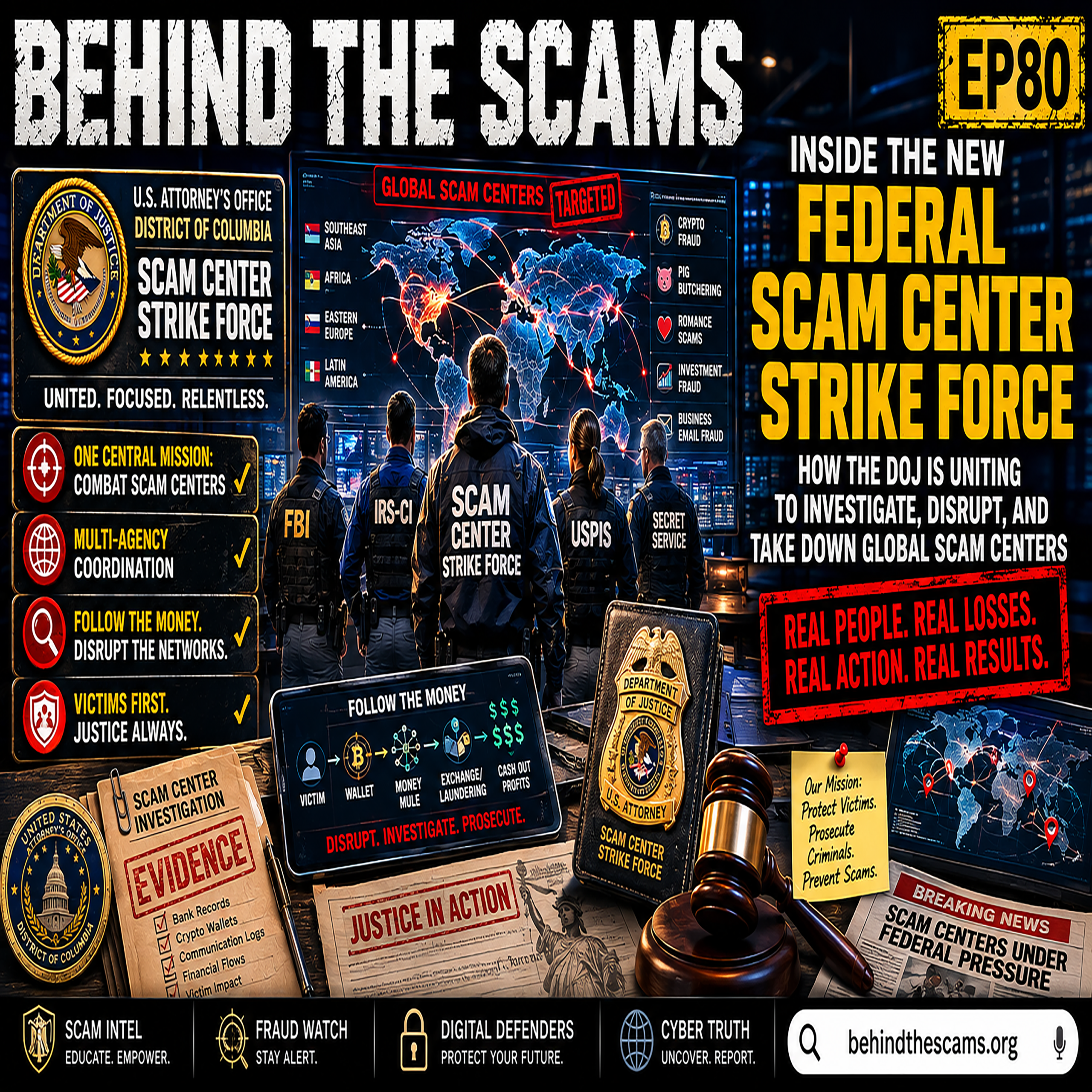
[00:04:18] Speaker B: Exactly. And that is why today matters. The federal government is escalating. A new interagency scam center strike force is aimed at the industrialized scam compounds behind these crimes. The overseas operations, the laundering networks, the domestic mules, the crypto rails, the fake websites, and the professional infrastructure that turns loneliness and trust into revenue. Hello, I'm Nick kenley. I spent 25 years inside federal law enforcement as a special agent following money through banks, shell companies, payment processors, and wherever else criminals attempted to hide their money.
I also spent three years on a DEA led narcotics task force and two years on an FBI based high technology crimes task force.
So I know how crucial interagency based approaches can be to combating scammers. It's a powerful force and should have a great impact on shutting a lot of scammers down.
It's exciting news, which is why we decided to do this podcast episode devoted mainly to this important topic. But don't worry, we won't just be talking scary stats and interagency coordination matrixes.
[00:05:31] Speaker A: And I am sue here to ask the questions normal humans ask when Nick says things like interagency coordination matrix before coffee.
So, listeners, this girl's got your back
[00:05:45] Speaker B: behind the scams starts now.
[00:05:47] Speaker A: Okay, explain this to me like I am smart but allergic to government acronyms.
Why do we need a new strike force? Haven't we had the FBI, DOJ, Secret Service, HSI, FinCEN, and all the Alphabet soup forever?
[00:06:05] Speaker B: We have.
But having agencies is not the same as having a synchronized operation.
Fraud used to arrive in neat boxes. A bank fraud case here, an identity theft case there, a wire fraud case across town.
Scam compounds do not respect those boxes.
One victim is recruited on social media, coached through a messaging app, sent to a fake crypto exchange, moved through a legitimate exchange, then into offshore wallets. Shell companies and over the counter brokers.
[00:06:37] Speaker A: So the criminals built a high speed train while bureaucracy was still looking for the fax cover sheet.
[00:06:45] Speaker B: That is painfully accurate. The strike force is designed to break the silos.
DOJ brings prosecutors and charging authority. FBI brings cyber squads, victim reporting and national case coordination.
The Secret Service brings deep financial crime expertise and crypto tracing.
Homeland security investigations brings international criminal network experience and cross border reach.
FinCEN brings financial intelligence through suspicious activity reporting and money services information.
[00:07:17] Speaker A: And treasury, your old neighborhood brings the we have been watching where the money goes. Energy.
[00:07:24] Speaker B: Treasury brings financial pressure, sanctions, regulatory intelligence, relationships with the financial sector.
The point is to turn one victim's report into a network map. Who registered the domains? Which wallets receive deposits, which exchange accounts, convert funds, which domestic bank accounts are cashing out. Which overseas entities are recurring.
That is how a consumer fraud complaint becomes an organized crime investigation. In a mature investigation, the room does not start with one dramatic confession. It starts with a wall of fragments. A phone number from one victim, a domain registration from another.
A bank account opened by a 23 year old mule in Texas.
A crypto address that shows up in six complaints.
A server provider in Virginia, A telegram handle used by the so called account manager.
Nothing looks like the whole crime by itself.
But then analysts start drawing lines.
[00:08:27] Speaker A: I am picturing one of those corkboards with red string. Except instead of a detective smoking in a dim office, it is a cyber analyst with three monitors, cold coffee and a very serious relationship with spreadsheets.
[00:08:43] Speaker B: That is not far off. And the key is that every agency brings a different piece of the legal toolkit. FBI can aggregate victim complaints and run cyber leads. Secret Service can trace digital assets and work with exchanges.
HSI can reach into cross border criminal networks and trafficking angles.
FinCEN can see patterns in suspicious financial reporting.
DOJ can turn the intelligence into subpoenas, seizure warrants, indictments and forfeiture actions.
[00:09:14] Speaker A: So the strike force is less like forming a superhero team and more like finally putting the locksmith, the accountant, the translator, the prosecutor and the computer person in the same room before the building burns down.
[00:09:32] Speaker B: That is a great way to say it. The criminals built a supply chain. So law enforcement has to build a counter supply chain. Identify the victims, document the transfers, map the wallets, subpoena the platforms, freeze what can be frozen, disrupt the infrastructure and charge the reachable people before they vanish or move the money again.
[00:09:54] Speaker A: And this matters because the old way was basically one officer in one town trying to understand a crime that had six countries and 13 apps involved.
[00:10:07] Speaker B: Exactly.
Local police May care deeply, but they usually cannot subpoena an overseas platform, coordinate with foreign law enforcement, analyze blockchain clusters at scale, and pursue federal asset forfeiture. The strike force is supposed to concentrate expertise and move fast, faster against the infrastructure.
[00:10:27] Speaker A: Because the fake profit is the bait inside the trap. It looks like proof, it feels like success.
And then it becomes leverage.
[00:10:38] Speaker B: Exactly. The platform balance is theater. It is not an account statement. It is a number on a screen controlled by criminals. But to a victim, especially one who has already sent money and wants the story to be true, that number becomes powerful evidence in the wrong direction.
[00:10:56] Speaker A: So, Les, please hold while we transfer you to another department and more. Everybody get in the war room.
[00:11:03] Speaker B: Exactly. And the war room matters because criminals exploit delay.
Every hour after a victim transfers money is an hour for the funds to hop wallets, bridge chains, enter a mixer, or cash out through an intermediary who does not ask questions. Because not asking questions is the business model.
[00:11:23] Speaker A: I have known restaurants with stricter standards for splitting appetizers.
[00:11:28] Speaker B: And yet the laundering economy moves billions. The strike force cannot arrest its way out of every compound tomorrow. But it can make the infrastructure riskier. Domains down, accounts frozen, sanctions issued, mules charged, exchanges alert, alerted, overseas, partners pressed. And victims linked into larger cases instead of left as isolated files.
[00:11:51] Speaker A: This is the part victims really want to know. They file with IC3, they upload everything, then silence.
What makes one complaint become an actual federal action?
[00:12:05] Speaker B: First, filing matters. Even if nobody calls back immediately, the report becomes data.
But a single complaint usually becomes actionable when it connects to other evidence. Same wallet address, same fake platform, same domain, same phone number, same mule account, same exchange account, same social media handle. Or the same laundering cluster.
[00:12:30] Speaker A: So one complaint is a puzzle piece. A hundred complaints with matching edges becomes the picture on the box.
[00:12:38] Speaker B: Perfect.
Investigators look for convergence. They want transaction hashes, Wallet addresses, dates, amounts, exchange names, bank wires, screenshots, chat handles, emails, and platform URLs.
The more precise the data, the easier it is to connect the victim to a target.
I sent crypto to Linda is emotionally True.
I transferred $38,400 in USDT to this address on this date. And here is the transaction hash is operationally useful. Here is a realistic sequence.
A victim files a report with a wallet address and a transaction hash.
An analyst runs that address and sees the funds moved within minutes to a consolidation wallet.
That consolidation wallet received deposits from dozens of unrelated people across multiple states.
Some transfers are usdt, some are eth.
Some are small test payments followed by much larger deposits.
Then the funds Split. One portion heads to a major exchange. One portion crosses a bridge.
One portion moves toward an over the counter broker already seen in another investigation.
[00:13:52] Speaker A: So the first little transfer is not harmless. It is like the scammer saying, let's make sure the plumbing works before we flood the basement.
[00:14:01] Speaker B: Exactly. The test transaction matters because it proves the path. A victim may think it was only $500, but that $500 may identify the receiving wallet before the larger transfer lands. If investigators or the platform move fast enough, that small transaction can help flag the destination before the real damage is complete.
[00:14:24] Speaker A: That is heartbreaking because victims are often in shock. And now we are asking them to become their own evidence technicians.
[00:14:32] Speaker B: I know, and I do not say it to blame them. I say it because good evidence can save time.
Blockchain tracing is powerful, but it is not magic. Analysts can see funds moving from address to address.
They can identify clusters, exchange touch points, Stablecoin flows, bridges, and sometimes patterns tied to known scam networks. But they still need context from the victim. I had the transaction hash. I had screenshots. I walked into the police department with a folder. The officer was kind, but he kept saying, I don't know what to do with this. I remember thinking, if I had been robbed at an atm, everyone would understand.
But because it was crypto, I felt like I had to prove the crime existed. That is why the federal intake and coordination piece matters. Local officers are often not equipped for crypto tracing or foreign platform preservation.
It is not always indifference.
Sometimes it is a tooling problem, a training problem and a jurisdiction problem colliding at the worst possible moment for the victim.
[00:15:38] Speaker A: So the blockchain is like seeing footprints in wet cement.
You can tell where someone walked, but you still need to know whose yard they started in, whether they stole the lawn gnome, and why there is a fake investment app named Trustee Coin Deluxe.
[00:15:55] Speaker B: Trustee Coin Deluxe is absolutely going to be a scam by Tuesday.
But yes, the first on ramp matters. Did the victim use a U.S. exchange?
Was there know your customer information?
Did funds pass through a hosted wallet where records can be subpoenaed? Did stolen stablecoins land somewhere an issuer
[00:16:16] Speaker A: can freeze stablecoin Freeze. That sounds like a dessert and a law enforcement technique.
[00:16:23] Speaker B: Some stablecoin issuers like Tether or Circle may have the technical ability to freeze tokens under certain circumstances.
Usually when law enforcement proceeds presents appropriate legal process or compelling illicit finance information.
But that does not mean every crypto transfer can be reversed.
Bitcoin cannot be frozen by an issuer. Unhosted wallets Are not like bank accounts. And criminals know this, so they move fast.
[00:16:52] Speaker A: Translation? If the money is in a locked office, maybe law enforcement can get a key.
If it is in a backpack on a motorcycle crossing six borders, good luck.
[00:17:04] Speaker B: Exactly.
Suspicious activity reports also help financial institutions file sars. When activity looks suspicious, victims do not see those reports and banks will not discuss them. But investigators can use them to connect mule accounts, wire patterns, exchange behavior and laundering typologies.
[00:17:26] Speaker A: So what actually triggers an indictment or asset freeze?
[00:17:30] Speaker B: Probable cause.
Prosecutors need a factual basis showing that property is connected to fraud or money laundering. Or that a person knowingly participated in the scheme.
For an asset freeze or seizure, they need to identify specific property and persuade a court. The legal standard is met for charges. They need evidence they can present and defend.
Records, witness statements, blockchain analysis, platform data, bank records, admissions, travel records, devices or cooperating witnesses. And behind closed doors, the legal question becomes very practical.
Can we show this wallet is not just suspicious, but tied to fraud proceeds? Can we show multiple victims? Can we identify the exchange account that received the funds?
Can we get records that tie that account to a person, device, IP address, bank account or phone number?
Can we move quickly enough that a seizure warrant still has something to seize?
[00:18:31] Speaker A: That sounds like a race where the criminals start with a head start, a fake passport and a motorcycle.
[00:18:38] Speaker B: They often do.
That is why timing matters. A report filed within hours is more useful than a report filed months later.
Not because the later victim matters less, but because money movement hardens over time.
Leads grow stale, platforms close accounts, logs expire, people change phones. The trail remains on chain. But the off chain evidence can decay.
[00:19:04] Speaker A: Which means Nick has a bad feeling about this. Wallet is not enough.
[00:19:09] Speaker B: My bad feelings are excellent. But the Constitution still requires evidence.
[00:19:14] Speaker A: Lets split this in two.
What changes for the bad guys and what changes for victims?
[00:19:20] Speaker B: For the bad guys, the risk goes up.
Overseas, syndicate leaders may still be hard to arrest.
Especially in jurisdictions where corruption or weak governance protects scam compounds. Extradition is slow and uneven. But the government can target assets, domains, familiar facilitators, sanctions exposure, cash out networks, travel and domestic accomplices.
[00:19:46] Speaker A: And domestic mules need to hear this.
I was just. Receiving money for someone online is not a magic invisibility cloak.
[00:19:55] Speaker B: Correct. Mules are often the reachable part of the network. They open accounts, receive wires, convert funds, buy crypto mail cashiers checks or move money through businesses.
Some know exactly what they are doing.
Some claim they were fooled.
Either way, if they are moving fraud proceeds, they can be subpoenaed, interviewed, charged or Used to climb the ladder. I want listeners to understand the mule problem because it is not always cinematic.
Sometimes it is a person recruited through a fake job ad to process payments.
Sometimes. Sometimes it is a romance scam victim who has been turned into a mule without fully grasping it.
Sometimes it is a small business owner letting funds pass through because someone promised a commission.
And sometimes it is a professional launderer who knows exactly where the money came from and does not care.
[00:20:50] Speaker A: That is the spooky part.
The money mule may not look like a movie villain.
It may look like a neighbor with a side hustle, a cousin who got hired online, or someone convinced they are helping a love interest with banking trouble.
[00:21:07] Speaker B: Right? Prosecutors have to separate intent from impact.
Did the mule know? Should they have known? Did they ignore obvious red flags? Did they keep a cut? Did they lie to the bank? Did they create new accounts after prior closures?
Those facts determine whether someone is a witness, a defendant, or a stepping stone to the larger organization.
[00:21:31] Speaker A: For victims, though, we have to be honest.
A strike force does not mean the money comes back next Friday. The hardest part was not just the money. It was telling my daughter I had always been careful. I taught my kids to be careful. And then I had to tell her I had borrowed against the house because I believed this man was helping me recover what I had already put in. That is the part numbers cannot carry.
17 billion does not tell you what it feels like to sit across from your child and explain that a stranger got into the most private parts of your hope.
[00:22:09] Speaker B: And it is why every serious anti fraud conversation has to protect dignity.
If victims think disclosure means humiliation, they delay.
Delay helps criminals. Compassion is not soft. In these cases, compassion is operationally useful.
[00:22:26] Speaker A: Before we go further, we need to say this next story involves suicide. We are not going to describe the method. We are telling it because scam trauma can become a life and death crisis. And listeners need to know that help exists.
[00:22:43] Speaker B: CNN reported the story of Dennis Jones, an 82 year old father and grandfather in Northern Virginia. His family described him as positive, active and deeply loved. In retirement, he worked with refugees, debated politics online, ran, took photographs and stayed connected to the world.
Then he met someone online using the name Jesse. The relationship developed over months.
Eventually she persuaded him to invest in cryptocurrency through a fraud fraudulent platform.
According to his family, he lost his savings when the money was gone. The demands did not stop.
[00:23:22] Speaker A: That is the cruelty of these scams. They do not just take the money. They keep the victim emotionally tethered to the person taking it.
The Scammer becomes the problem and the supposed solution at the same time, Dennis's
[00:23:39] Speaker B: children plan to help him get back on his feet. CNN reported the family intended for him to move in with one of his daughters so he would know he was going to be taken care of.
But before that meeting happened, his family learned he had taken his own life.
His son told CNN that when he learned it was suicide, he was certain the scam had crushed him.
[00:24:00] Speaker A: I want families to hear this clearly.
If someone you love has been scammed, do do not assume they are only dealing with a financial problem.
They may be dealing with shame, panic, grief, isolation and fear that their life is over.
[00:24:19] Speaker B: And if you are listening right now and you feel trapped, ruined or afraid to tell your family, please pause this episode and reach out in the United States and Canada. Call or text 98 for the suicide and crisis Lifeline.
If you are outside the United States, contact your local emergency number or a local crisis hotline.
The money matters, the evidence matters. But your life matters more than any scammer's lie.
[00:24:48] Speaker A: And for families, the first sentence should not be how could you?
It should be, you are safe with me. We are on the same side.
We will handle the money after we get you through this moment.
[00:25:03] Speaker B: Dennis Jones's story is not included here to shock people.
It is included because it shows the true danger of these crimes.
Pig butchering scams are psychological captivity with a financial exit wound. The isolation is part of the weapon. The shame is part of the weapon. The belief that no one will understand is part of the weapon.
Breaking that isolation can save lives.
[00:25:27] Speaker A: Nick, I want to sit with that for a second because I think people hear financial crime and they picture spreadsheets, bank statements, maybe a police report.
But this is heartbreak.
This is someone waking up and realizing the person they trusted was never real. The money is gone and now they have to tell the people they love that is right.
[00:25:53] Speaker B: And in 25 years of working financial crime, I saw something over and over.
The dollar amount is only part of the injury.
The deeper wound is betrayal. It is the victim asking, how did I not see?
Is the family asking why didn't you tell us?
It is the silence in between those two questions where the scammer still has power.
[00:26:17] Speaker A: And I think think spouses and adult children especially need to understand that if someone hides the loss, it may not be because they do not trust you. It may be because they are trying to protect the version of themselves they think you still believe in.
[00:26:32] Speaker B: That is beautifully said.
A lot of victims are not just afraid of Losing money they are afraid of, losing identity. The careful parent, the responsible spouse, the successful professional, the person everyone comes to for advice.
A scam can make them feel like all of that has been erased. It has not. But in that moment, it can feel erased.
[00:26:56] Speaker A: So if you are the person on the other side of that confession, your first reaction can either open a door or close it. If you say, how could you be so foolish? That door slams shut.
If you say, I am sorry this happened and I am glad you told me. The victim can breathe.
[00:27:18] Speaker B: And breathing matters. I mean that literally. When someone is in panic, they cannot organize evidence, file clean reports, or make good decisions.
The family's job in the first hour is not to solve international cybercrime. The family's job is to stop, stabilize the person, stop additional payments, and remove the scammer's emotional grip.
[00:27:41] Speaker A: And if the person says, my life is over, take that seriously.
Do not debate them out of it.
Stay with them.
Call for help.
Call or text 988 in the United States and Canada.
If you are elsewhere, contact local emergency services or a crisis line.
Do not leave that person alone with shame and a phone full of scam messages.
[00:28:13] Speaker B: Another thing.
Families should resist the urge to interrogate. You will get the facts you will need, the dates, the amounts, the wallets, the screenshots.
But the first conversation is not a deposition. It is triage.
Are you safe? Is any more money scheduled to move?
Who has access to your accounts? Can we sit together and preserve what happened?
Start there.
[00:28:38] Speaker A: Yes, maybe. Do not open with your inner courtroom prosecutor.
I know, Nick. Yours is always available and apparently wears reading glasses.
[00:28:50] Speaker B: It does. But even my inner prosecutor knows when to stand down.
The offender is the scammer. The emergency is safety. The mission is connection.
[00:29:01] Speaker A: That is the emotional game plan.
Connection before correction, safety before shame.
Evidence after. The person knows they are not alone.
[00:29:13] Speaker B: No asset recovery is possible, but it is never guaranteed. The funds have to be located frozen, seized, frozen, forfeited, and legally connected to victims.
Sometimes victims receive partial distributions.
Sometimes the government freezes assets quickly. Sometimes the money is already gone. And sometimes a restitution order is entered against a defendant who has no meaningful assets. Recovery also has an emotional timeline that is different from the legal timeline.
The victim wants a human being to say, we found it, you can breathe. The system says we need seizure warrants, forfeiture notices, claims processes, victim identification, remission review and court orders.
That mismatch is where anger, grief and confusion live.
[00:30:03] Speaker A: And that is where predators step in with fake certainty.
They sell the sentence. Victims most Want to hear we can get it back.
[00:30:14] Speaker B: Exactly. A legitimate process Sounds boring. It has case numbers, official portals, law firms you can verify independently and no demand that you pay a stranger in crypto to unlock your own money.
A fake process sounds urgent, Secret and guaranteed.
Urgent, secret and guaranteed are three words that should make every alarm in the house go off.
Now. Sue When I was a special agent, I did numerous asset seizures in many of the investigations I was involved with. In fact, I was an asset seizure coordinator for my office for a few years, so I am intimately familiar with the asset seizure process.
It is quite involved and time consuming, but it is a great tool for law enforcement and it also helps victims potentially recover some of what they have lost financially.
But it is by no means a sure thing.
[00:31:04] Speaker A: Which brings us to the Vultures Recovery scammers.
[00:31:08] Speaker B: If someone guarantees recovery, walk away.
If they say they have a special government contact, walk away.
If they want upfront fees to unlock funds, walk away.
If they send fake legal documents, fake blockchain reports, or fake exchange letters, walk away.
Recovery scammers study victims. They know the exact words that reopen
[00:31:31] Speaker A: hope and if you are a family member listener, do not lead with how could you fall for this?
Lead with we are going to stop the bleeding.
Shame is gasoline for the scammer.
[00:31:46] Speaker B: That may be the most important sentence in this episode. Victims often keep paying because they are isolated. They believe one more fee will unlock everything.
The job of family is containment first judgment, never evidence preservation.
[00:32:02] Speaker A: Immediately give us the game plan. Someone listening right now realizes they or their parent or their spouse transferred money.
What are the first three steps?
[00:32:13] Speaker B: Step one Stop all transfers. No more taxes, fees, verification payments, gas fees, unlock payments or temporary deposits.
Do not argue with the scammer. Do not announce that you know.
Quietly stop the financial flow and contact the bank exchange or platform fraud team immediately.
[00:32:37] Speaker A: Step 2 Save everything.
And I mean everything.
Screenshots, chats, emails, phone numbers, fake websites, app names, deposit instructions, wallet addresses, transaction hashes, receipts, wire confirmations and names used by the scammer. Make a folder, name it something boring like insurance documents. If you need privacy from the scammer.
[00:33:05] Speaker B: Step 3 File a useful report.
Go to ic3.gov lead with the money trail, date, amount, asset type, transaction hash, sending wallet or exchange receiving wallet, platform URL scammer handles and any bank accounts or wire information.
Then tell the relationship story.
Investigators need both, but the money trail lets them connect your case to others. A strong report might sound like this.
On June 2, I purchased USDT through a US exchange at 3:18pm I transferred $25,000 worth to this receiving address.
The transaction hash is listed here.
The person instructing me used this WhatsApp number and sent me to this website.
The platform showed a fake balance of $91,200 and then demanded a 12% tax before withdrawal.
That is the kind of narrative that gives investigators nouns, numbers, dates and digital field fingerprints.
Now, I know I sometimes have a habit of throwing out terms or acronyms that is spillover from many years with the federal government.
I have mentioned USDT several times during this episode and just realized not all listeners may know what this is.
[00:34:27] Speaker A: That's right, Nick. I'm not even sure what it is. So please tell us.
[00:34:32] Speaker B: I saw that look on your face and it looked like confusion.
Think of USDT as digital cash or a digital US dollar that lives on the blockchain.
Instead of traditional money sitting in a bank account, it's a cryptocurrency token designed so that one USDT is always worth about $1 USD.
[00:34:52] Speaker A: Thank you, Nick. Now I get it. And for families, try this.
I am not here to judge you. I am here to make sure no more more money leaves today that lowers the temperature. Then ask can we sit together and save the messages?
Not give me your phone.
Not I told you so.
Sit together, preserve evidence together. What finally helped was telling my we are on the same side.
I said it three times.
She kept apologizing and I kept saying same side.
That was when she handed me the phone. Same side might be the best anti scam phrase we have ever had on this show.
[00:35:41] Speaker B: Put that one on the refrigerator.
Same side. Stop the money, save the evidence. Report the facts, then deal with the grief together. That approach can change everything.
The victim may be terrified that admitting the scam means losing independence, reputation or control.
If the family response feels like punishment, the scammer remains the only person offering comfort. If the family response feels like partnership, the isolation breaks.
[00:36:12] Speaker A: And if you are wondering whether your report is too small to matter, remember even one report weird puzzle piece can be the missing eyebrow on the criminal's face.
[00:36:24] Speaker B: That is an oddly specific image. But yes, report anyway. The strike force runs on patterns. Your wallet address, your fake website, your transaction hash may be exactly what connects a target.
[00:36:38] Speaker A: And talk to your people. The scammer wants secrecy. Families need daylight.
If this episode helps you have one uncomfortable conversation before the next payment goes out, that is a win.
[00:36:53] Speaker B: The federal response is getting sharper. That matters. But vigilance still starts. At the kitchen table, in the family group chat. And in the moment, someone says something about this investment does not feel right.
Listen to that voice.
Ask questions, slow the transaction, verify independently. The strike force is not a magic wand. It is a signal that federal enforcement is adapting to an enemy that industrialized deception.
The policy fight is important.
The asset seizures are important. The indictments are important.
But the human fight is just as important.
Making sure victims are believed early, helped quickly and never pushed back into silence.
[00:37:38] Speaker A: And if a stranger online says they can make you rich with crypto, ask yourself, would I take financial advice from someone who opened with wrong number?
[00:37:49] Speaker B: Depends. Did they pass a background check, provide audited financials and survive dinner with Sue?
[00:37:57] Speaker A: Nobody survives dinner with sue if they are selling fake yield farms.
[00:38:02] Speaker B: I am Nick.
[00:38:03] Speaker A: And I am Sue.
[00:38:05] Speaker B: This has been behind the scams. Stay skeptical, stay kind and never let a criminal isolate someone you love.
[00:38:13] Speaker A: And if you are listening with someone you love, maybe pause after this episode and ask one simple question.
Has anyone online been pressuring you about money?
Ask it with kindness.
Ask it before there is a crisis.