Episode Transcript
[00:00:00] Speaker A: What if a romance scam did not come from a faceless compound or a bot farm, but from someone with a real name, a university record, a medical background, and a life hiding in plain sight?
Welcome back to behind the Scams. Today, sue and I are looking at how a modern romance scam can unfold slowly, personally, and with devastating precision, and why this case appears to sit outside the industrialized scam farm model most people imagine. Quick Legal Note before we get into the details, this episode discusses allegations, investigation materials, online records, payment traces, and victim accounts related to suspected romance fraud.
We are presenting this as documented and reported, not as a court finding, and anyone named is invited to provide verifiable documentation or or a response.
[00:00:55] Speaker B: The records that we have reviewed point not to a large compound, but to a highly targeted, deeply personal pattern of psychological pressure allegedly involving an independent operator out of North Sumatra, Indonesia, over the course of four years, a man who we will call Frank reports being systematically targeted, emotionally groomed and financially drained.
In addition to that, he suffered medical setbacks as a result of this experience.
[00:01:29] Speaker A: This episode follows the evidence trail as documented in the materials and documentation provided to us.
We will distinguish these records, claims and conclusions as we detail this experience.
Now for a little backstory. This incident came to our attention through an email sent directly to our nonprofit by the victim in this story.
[00:01:51] Speaker B: Quick Source Trail for listeners. The information is easy to track online through public Reddit discussions, an online dating profile, Telegram and WhatsApp activity, scribd, academic references, university records, and payment records.
We are not going to read out usernames or long identifiers here. The point is that these sources can be checked independently, especially on Reddit.
[00:02:20] Speaker A: And here is the crucial difference.
Thanks to an incredible effort by online communities like Reddit, the person behind the scam Persona didn't get to remain an anonymous digital ghost.
Investigative tracking connected the scam Persona to a real world identity. Yesi Gloria Stephanie Hudigalung.
[00:02:40] Speaker B: The documentation cited in the investigation materials is extensive.
She wasn't presented as someone trapped in a compound. The records point to a nursing student living outside that industrialized scam model.
The materials reference enrollment at the State University of Medan or unimed Under a student ID ending in 1054 and prior attendance at Universitas Imelda Medan.
They also cite an academic paper on gastritis in adolescents co authored under a slight name variation, Yesi Gloria Stephanie Huttegal
[00:03:22] Speaker A: and that distinction matters.
Scamfarm cases often involve trafficked or coerced workers using high volume scripts inside Guarded compounds. What the records describe here looks different. A specific identity, local university records, personal payment channels, ordinary daily life details, and a long running one on one relationship with Frank.
None of that proves every detail by itself, but taken together, it points away from the classic scam farm model and toward an alleged independent operator. Think about the irony of that. Sue a nursing student, someone whose chosen profession is rooted in empathy and care and healing the sick. While the messages described health crises, the investigation materials characterize as fabricated. And those claims were used to request money from someone who genuinely believed he was helping.
[00:04:17] Speaker B: It's chilling.
According to the investigation materials, the payments were not routed through some anonymous offshore maze. They allegedly went to personal financial channels including a bank Rakyat indonesia account and PayPal handle. The records linked to her name.
At the same time, the materials describe an ordinary daily life in Delhi Surdang Regency, transportation, pets and clinical hospital rotations.
[00:04:50] Speaker A: So how does a pattern like this take root? It started back in 2021 on an online dating platform where the account allegedly operated under the username Call Me Fat.
Once initial contact was made with Frank, the conversation quickly moved to private messaging apps like WhatsApp and Telegram, where the Persona used the alias Sheila and the handle hielaazr17.
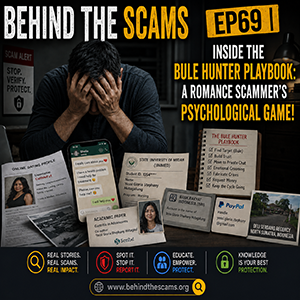
This is where the pattern began and the classic Bule Hunter playbook came into view. Now that we've established the hook, let's look at how the operation seems to have worked once Frank was inside private messaging. This does not read like a random one off encounter. The message pattern suggests a deliberate structure. Move the target away from public platform oversight, build emotional intimacy, control the pace of Contact, and use WhatsApp as the main channel for real time pressure.
[00:05:48] Speaker B: That is where the alleged conduct fits what some Indonesian online communities call the classic Bule Hunter playbook.
For listeners who may not know, bule is a local Indonesian slang term for foreigners, usually Westerners. In this context, a bule hunter is someone accused of targeting foreigners for romantic or financial exploitation, treating a relationship not as a mutual connection but but as a transaction.
[00:06:20] Speaker A: And the pattern described in the materials points to layered psychological pressure. It does not appear to begin with a massive demand for thousands of dollars that would scare many people away immediately.
Instead, according to the messages described, it began with a testing phase, often called dry begging or soft begging. In my years investigating financial crimes cases, I saw this kind of testing behavior over and over.
The first request is rarely the real objective. It is a probe the person asking is trying to learn. Will this target respond?
How fast do they ask for proof? Do they feel Guilty when I pull away.
Once those answers are known, the next request can be shaped with much more precision.
[00:07:08] Speaker B: That's right, Nick. Now, the messages reportedly introduced minor everyday problems and personal hardships in a way that invited pity and tested the waters broken. Personal items, academic difficulties and small lifestyle emergencies showed up as recurring pressure points from the records. The pattern suggests she was gauging his empathy and watching how quickly he would offer financial help.
[00:07:36] Speaker A: And when Frank hesitated or asked reasonable questions before sending money, the tone reportedly shifted toward guilt and emotional punishment.
The messages describe comparisons to other men apparently meant to trigger insecurity.
She allegedly claimed that other men sent millions of rupiah without asking these senseless questions, even though they did not even know her.
[00:08:00] Speaker B: Nothing like a little female jealousy creating game tactics. But she also appeared to lean on the economic gap between their two environments, using what we often see in these cases as a geopolitical guilt trip. According to the messages reviewed, she argued that because he lived in a wealthy Western nation, he had better conditions and should provide financial support.
If he refused. She reportedly suggested he was making Americans look bad.
[00:08:31] Speaker A: It created a toxic double standard if he claimed he could not afford a transfer. She reportedly demanded screenshots of his bank accounts as proof. But when he asked for a receipt, a physical address, or any documentation from her side, the messages suggest the response turned angry.
She allegedly accused him of violating her boundaries or refusing to trust her, using that anger to push him back toward compliance. Now we come to one of the most serious phases described in this four year case.
The fabricated medical emergency.
According to the investigation materials, once Frank was emotionally invested and had already sent money for smaller needs, the story escalated sharply. What followed appears to have been a layered emergency narrative designed to pull on his instinct to help.
[00:09:22] Speaker B: It reportedly started with a claim that she had been hospitalized for malaria.
But almost immediately, the diagnosis shifted to something far more alarming.
She told Frank that during her hospital stay, doctors had supposedly uncovered something more serious.
Leukemia.
[00:09:43] Speaker A: But according to the messages described, she did not stop at telling him she was sick.
She introduced another voice into the story, or at least another account presented that way.
Yesi gave Frank a WhatsApp number she claimed belonged to her mother.
Then came the twist.
Yesi told Frank that she did not want to break her mother's heart. So she instructed Frank to message the mother account and deliver the leukemia diagnosis himself.
[00:10:11] Speaker B: Yikes. It reads like a layered deception. When Frank messaged this mother's account, the Persona reportedly appeared shocked on cue, which reinforced the drama.
The mother Persona then claimed that the doctor had initially lied to Yesi to protect her feelings and said Yesi urgently needed a $200 blood transfusion because her white blood cell count was dangerously low.
[00:10:38] Speaker A: According to the records, whenever Frank tried to call this number directly to offer support or get clarity, nobody picked up.
The explanation was always the same. The mother supposedly did not speak English, so everything had to happen by text.
But the setup raised obvious questions. Why was Frank acting as the sole communication bridge between a mother and daughter who were supposedly in the same hospital room?
The pattern strongly suggested either a second phone controlled by Yese or someone close to her, helping maintain the deception. From an investigative standpoint, that second voice matters.
In financial fraud cases, a third party Persona often appears when the original story needs reinforcement.
A parent, a doctor, a clerk, a shipping agent, a customs officer, whoever gives the demand more authority.
The key question is always the can that person be independently verified outside the channel controlled by the person asking for money?
What challenged the COVID story was when Frank eventually shared his account with the online community, specifically Reddit.
Local Indonesian netizens began testing the story against real world medical, financial and insurance details. First, commenters pointed to bpjs, Indonesia's national health insurance system, which generally covers medically indicated cancer care through approved facilities and referral pathways that made the claimed need for 15 million rupiah in immediate out of pocket care look questionable.
Second, users with medical backgrounds noted that leukemia often involves abnormal white blood cell counts frequently elevated, which made the simplified claim about dangerously low white cells medically suspect. That is exactly how investigators look at a crisis claim, not by reacting to the emotion first, but by testing the story against the systems that should exist around it.
If someone says a hospital needs money immediately, can the hospital be contacted through an official number?
If someone says insurance will not cover care, does that match how the insurance system normally works?
And if every path to verification is blocked, delayed or redirected back to the person asking for money, that is a major warning sign.
[00:13:05] Speaker B: Local commenters also pointed out what they viewed as inflated demands.
She was asking for millions of rupiah to buy blood. But netizens cited local hospital cost estimates, suggesting a single bag of blood was closer to around 360,000 rupiah. Taken together, the emergency narrative appears to have functioned as a psychological pressure tool.
And when Frank finally began asking these exact questions, the messages suggest Yesi's response was not to provide proof, it was to lash out.
[00:13:42] Speaker A: After the leukemia story started showing cracks, the messages suggest Yesi did not back down.
Instead, the pattern shifted into something often described as darvo for listeners who are not familiar with the term. Darvo stands for deny, attack and reverse victim and offender.
[00:14:01] Speaker B: In plain English, Darvo is when someone denies the concern, attacks the person raising it, and then, recap, casts themselves as the real victim.
When Frank began asking reasonable questions about why the medical story did not line up, the messages suggest Yesie did not try to clarify things.
Instead, she appeared to flip the script, claiming she was the one being abused, attacked and mistreated simply because he was asking for basic verification.
[00:14:39] Speaker A: According to the messages reviewed, she repeatedly tied Frank's skepticism to her physical suffering, telling him that his lack of trust was breaking her heart and making her health worse.
It is a cruel trap because it pressures Frank to stop asking questions out
[00:14:56] Speaker B: of guilt, and once that emotional pressure appeared to quiet his questions, the next major financial Demand arrived in November 2025 the university tuition claim.
She said that because of ongoing medical issues and financial hardship, she was on the verge of being expelled from her nursing program because she could not afford the fees.
[00:15:22] Speaker A: To make the threat feel immediate, the materials describe another WhatsApp account. Entering the story, Yesi directed Frank to a new contact account account, claiming it belonged to an official administrative clerk at her university.
This clerk echoed the tuition story, warning Frank by text that if payment was not made quickly, YES's academic future could be ruined.
[00:15:45] Speaker B: Just like the mother Persona. Whenever Frank tried to call this university clerk to pay the institution directly or verify the credentials, the call did not go through.
According to the records, Yesi rejected third party verification and insisted the $350 tuition payment had to be sent directly to her personal PayPal or bank account.
Frank, trying to protect her education, sent the money.
He later concluded, based on the failed verification and payment routing, that the administrative clothes clerk interaction had been fabricated.
[00:16:25] Speaker A: As we enter the final phase described in the materials, the emotional hook appears to shift from fear and illness to celebration.
In early 2026, as Yesi's nursing program was reportedly wrapping up, the messages introduced a specific request tied to her impending graduation from the State University of Medan.
[00:16:45] Speaker B: According to the messages reviewed, she contacted Frank with sudden warmth after periods of distance, a shift that often appears in romance fraud cases. Before a financial request, she reportedly told him she was preparing for her official graduation photo shoot, but there was a local tradition she wanted to take part in receiving A Money Bouquet for anyone
[00:17:12] Speaker A: not familiar with the traditional trend, a money bouquet or money flowers is a decorative arrangement where paper currency notes are folded and rolled to look like flower petals.
Yesi said she did not want to look out of place or Embarrass next to her peers during the photo shoot.
[00:17:29] Speaker B: What appears to have lowered Frank's guard was the reimbursement promise.
According to the messages, she said the bouquet was only a temporary prop for the photos.
After the ceremony and photo shoot, she claimed she would dismantle it, deposit the cash back into her account, and reimburse
[00:17:49] Speaker A: him through PayPal to make the transaction feel legitimate. The materials describe another WhatsApp account. Entering the story, Frank was directed to contact what was presented as a local Indonesian flower shop.
That florist's account describes, discussed the design details, and provided an alternative PayPal account to receive the funds.
The florist Persona matters because it gives the request a costume of normal commerce.
Instead of Frank feeling like he is sending money directly into another personal emergency, he is made to feel like he is dealing with a vendor, an order, and a real world service.
In fraud cases, that kind of extra layer can lower suspension suspicion because it makes the transaction feel ordinary. Even when the verification path still runs through channels, the target cannot independently confirm. In financial crimes work, payment routing tells you a lot.
If the story is about tuition, why can't the money go directly to the university?
If the story is about a florist, why does the payment route lead to an account the victim cannot independently verify? Verify.
The more urgent the request, the more important it is to slow down and verify the destination before sending anything.
[00:19:07] Speaker B: Frank, wanting to support what he believed was her achievement and relying on the reimbursement promise, sent the funds to secure the bouquet.
But after the graduation photos were reportedly taken, the promised reimbursement did not arrive.
When Frank asked for the money to be returned. The records describe yese cutting off contact rather than providing a refund.
[00:19:34] Speaker A: The flower shop account also went silent, according to the records.
Frank later concluded that the florist interaction had been part of the same pattern. An added layer of credibility, an alternate payment route, and a graduation themed request that functioned as a high value cash demand disguised as a gift. This brings us to the final heavy chapter of this investigation.
The cost Frank says he carried. After four years of pressure, uncertainty and loss.
When we analyze suspected scams, it is easy to focus on the numbers. In this case, Frank reported losing over $2,350, roughly 32 million Indonesian rupiah.
If the broader pattern described by multiple accounts is accurate, that kind of repeated targeting can become financially significant.
But Frank's account makes clear that the financial toll was only part of the harm. He also describes a serious physical and emotional decline.
[00:20:35] Speaker B: Frank's account describes a health decline that closely followed periods of intense stress in the relationship.
In June 2025, when he first tried to pull away and break contact, he says he developed severe anxiety, painful gastritis, disrupted sleep and difficulty eating normally.
He described sharp stomach pain, chronic insomnia and a restricted diet. While he tried to recover, he says
[00:21:06] Speaker A: he spent June, July and most of August 2025 slowly recovering.
Then, after the university tuition demand in November and the realization that he may have been manipulated again, he reported a relapse of the same stomach pain and gastritis symptoms.
That does not prove medical causation by itself, but it does show how severe psychological stress can coincide with serious physical symptoms.
[00:21:33] Speaker B: And that is why the contradictions mattered.
They were not abstract fact checking points.
Each inconsistency gave Frank a way to understand that the pressure he felt may have been built on claims that did not hold up online. Commenters pointed again to bpjs, Indonesia's national health insurance system, which generally covers medically indicated cancer care through approved facilities and referral pathways.
They also cited local hospital cost estimates, suggesting a single bag of blood was far lower than the amounts being requested.
[00:22:15] Speaker A: This case shows how modern romance fraud can appear to move beyond faceless scam compounds or automated bots.
According to the investigation materials, the scam Persona was linked to a person with a nursing education background, and the messages used medical terminology in ways the materials characterize as manipulative.
The pattern also included personal intimacy, alleged fake official identities, and Darvo style pressure that Frank says wore down his psychological defenses over time. The lesson I want listeners to take from this is simple.
Fraud does not always look like a stranger demanding money.
Sometimes it looks like intimacy, sometimes it looks like crisis.
Sometimes it looks like love illness, school fees or a graduation photo.
But when every emergency requires secrecy, speed and payment through channels only one person controls, you are no longer just responding to a relationship. You may be inside a financial exploitation loop.
[00:23:19] Speaker B: And perhaps the most frustrating part of this case is the uncertainty around traditional accountability.
The investigation materials link the scam Persona to enrollment references, academic records, payment channels and public biographical details in North Sumatra.
But we have not seen documentation showing that local authorities have taken enforcement action.
International boundaries can make cyber enabled fraud difficult to pursue.
That is why documenting the playbook matters.
The purpose is not just to look backward at what Frank says he lost.
It is to give future targets information they can evaluate before sending money.
[00:24:08] Speaker A: That's absolutely right, Sue.
Now, before we close out this episode, I wanted to mention that in our communications with this victim Frank, he supplied us with a wealth of good documentation to help verify his victimization by this scammer.
This is always important anytime someone becomes of a victim of fraud.
[00:24:28] Speaker B: Oh yeah, that's right, Nick. You are always waving that document, document, document, flag, aren't you?
[00:24:35] Speaker A: Yes, I am, sue. And excuse me if you're tired of hearing it.
[00:24:40] Speaker B: No, I'm not tired of hearing it because it is such a crucial teaching moment, not only from a victim standpoint, but. But from a law enforcement standpoint, right?
[00:24:51] Speaker A: Well, you just stole my thunder, sue. But yes, you're right. Or is it I'm right? Either way, it's very true. For example, if this victim had just sent me a claim about being victimized without showing some sort of supporting documentation, it would carry a lot less weight or authority.
Same goes for law enforcement. If you're trying to get them to go chase after some alleged scammer, they you better have some documentation.
So listeners, please let this be one of your takeaways from this episode.
[00:25:20] Speaker B: Not only that, Nick, the documentation we received included images of this scammer which we are going to post in the description for this podcast episode on our website, BehindTheScams.org that's not all, Sue.
[00:25:37] Speaker A: We are also going to prepare a full blog post relative to the this scammer, which will have her images and supporting documents.
We want to warn others out there that this scammer exists and is probably still out there victimizing.
So keep an eye out for this upcoming post.
Thanks for listening to behind the Scams and please support our podcast by subscribing, commenting, giving us a bunch of thumbs ups, and of course supporting our nonprofit with any donations you can make. They are always appreciated.
[00:26:08] Speaker B: That's right, Nick. And with that, this has been another episode of behind the Scams. Thanks for listening. Bye for now.